How the Supreme Court May Untangle the Tariff Knot
Written by Dan McLaughlin
Don’t expect a broad constitutional ruling or a complete answer in the tariff case.
Share this story
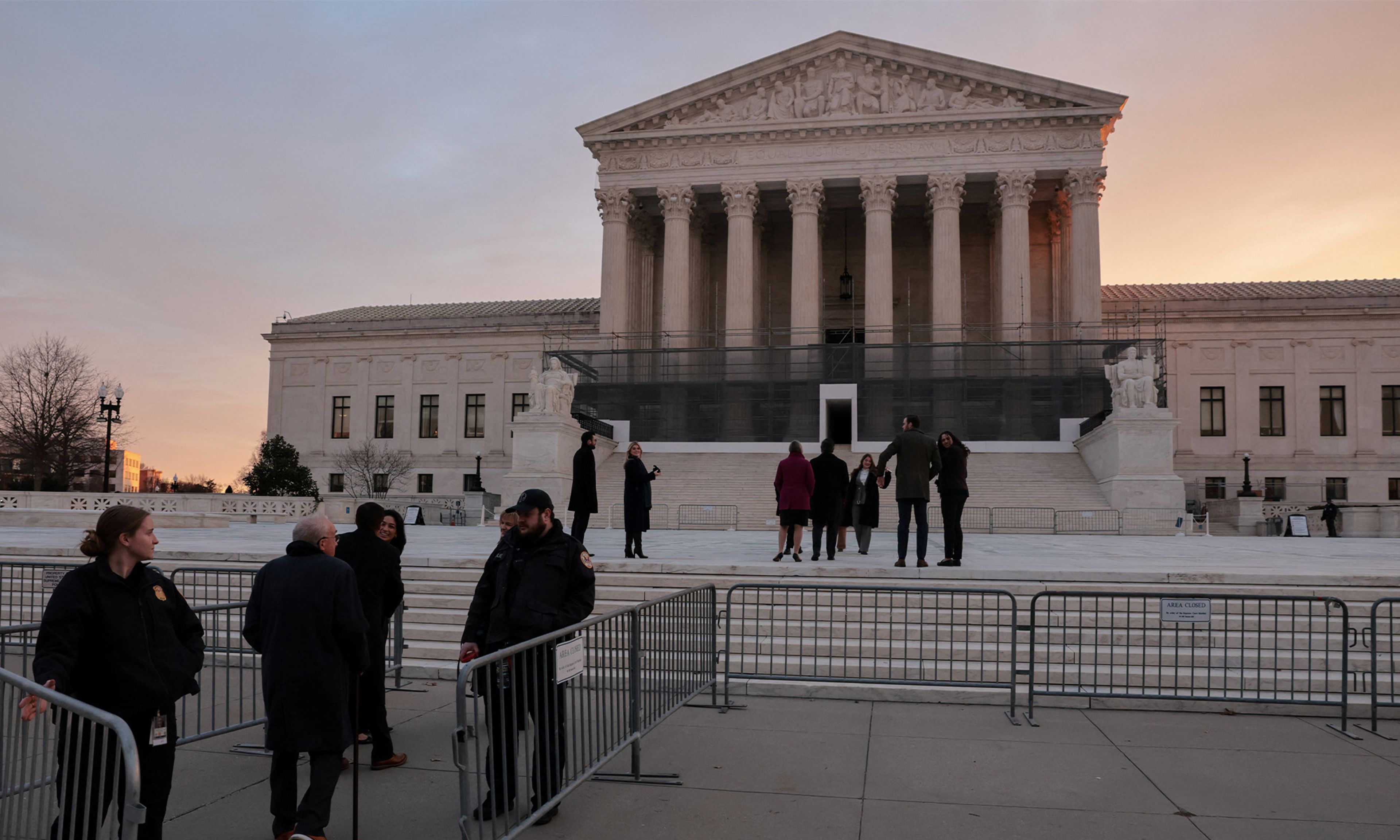
Police control access to the plaza in front of the Supreme Court building at the start of the day in Washington, D.C., January 12, 2026.
Confounding predictions, the Supreme Court on Friday did not decide the big Trump tariff case, Learning Resources, Inc. v. Trump, but instead handed down a decision on a habeas corpus issue. That gives us a little more time (we don’t know how much) to consider how this case may yet come out -- and what the Court’s timeline says about the odds.
The first two post-argument installments of my look at Learning Resources delved first into what presumptions and rules of decision the Court was likely to use, and then into the weeds of the statutory language of the International Emergency Economic Powers Act of 1977 (IEEPA). But the case also involves the constitutional question of whether Congress has delegated too much of its own authority to the president. In addition, the Court faces challenges in how it resolves this case. Let’s conclude with those two questions.
Nondelegation
At first glance, the nondelegation doctrine argument may seem promising. These are arbitrary and unbounded tariffs, far removed from any principle instructed by Congress. The nondelegation doctrine has deep roots in the history and philosophy of separation of powers. As Justice John Marshall Harlan wrote in Marshall Field & Co. v. Clark (1892), “That Congress cannot delegate legislative power to the President is a principle universally recognized as vital to the integrity and maintenance of the system of government ordained by the Constitution.” As John Locke put it long before the American Founding, “The Legislative cannot transfer the Power of Making Laws to any other hands. For it being but a delegated Power from the People, they, who have it, cannot pass it over to others.”
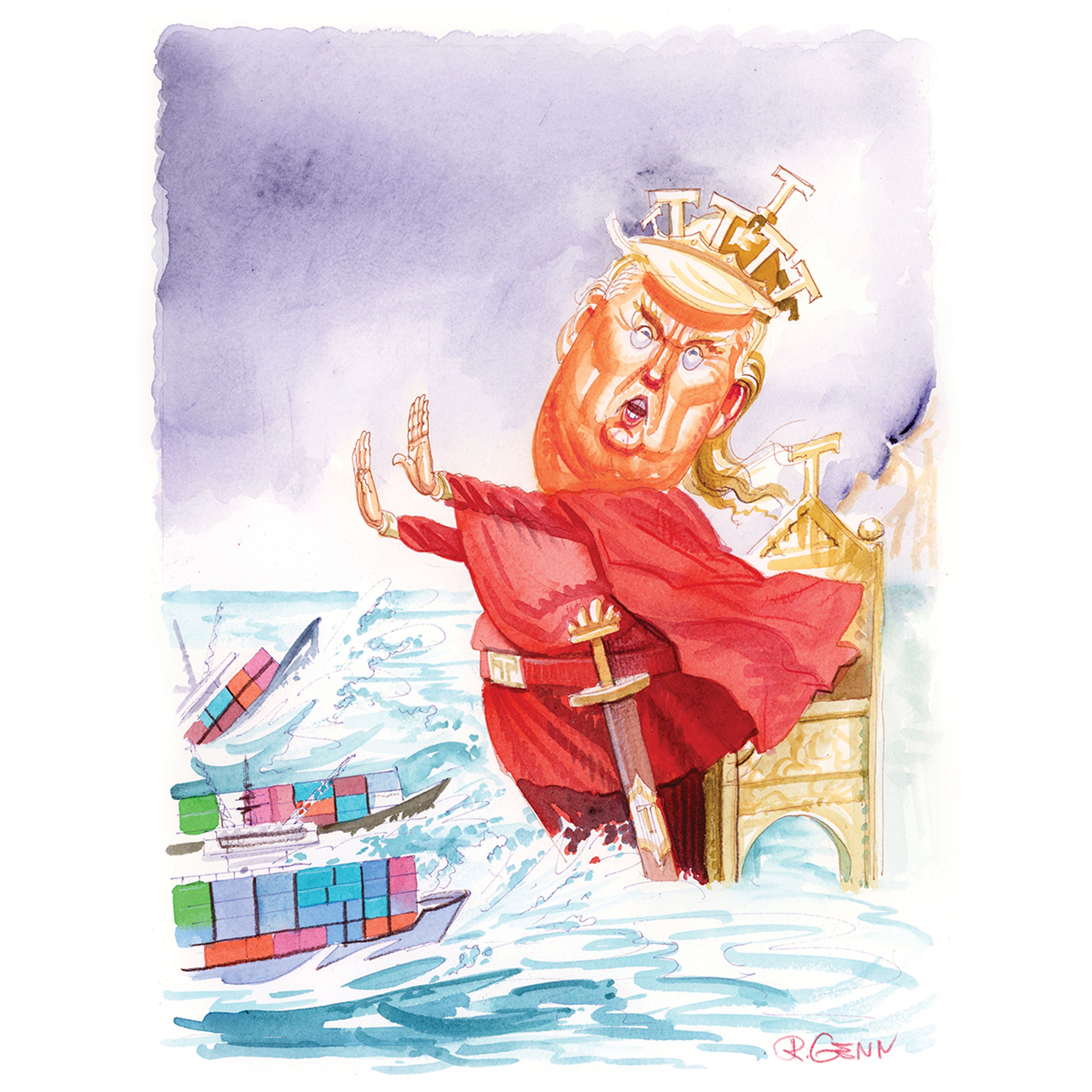
Under precedents dating back to the original tariff-power case in 1928, Congress must at least provide an “intelligible principle” to guide the president and executive agencies before delegating its lawmaking powers. If you accept the Trump administration’s view of IEEPA’s scope, it certainly sounds like a grant of power with no intelligible constraints or restraints, under which the president can (as he did Monday) just unilaterally announce on social media a 25 percent tax on trade with any country that trades with Iran -- and tomorrow, declare something completely different.
The view that delegation works only if the president stays close to the congressional shore might be strengthened if you read the 1975 Yoshida decision. Yoshida rejected a nondelegation challenge under the broad mid-1970s view of congressional discretion to empower the administrative state, but nonetheless did so on the basis of how closely constrained Richard Nixon’s global “surcharge” was by existing statutory tariff rates. Bear in mind that what Nixon’s “Proclamation 4074” did was simply to temporarily suspend international agreements so as to restore the statutory rates that would pertain without the agreements. The Court of Customs and Patent Appeals (the predecessor to the modern Federal Circuit) found it decisive that the temporary rates were those set by Congress:
In [the lower court’s] expressed fear that, if Proclamation 4074 were upheld, the President, by merely declaring a national emergency, could determine and fix rates of duty at will, without regard to statutory rates prescribed by Congress, [it erred]. . . . To uphold the specific surcharge imposed by Proclamation 4074 is not to approve in advance any future surcharge of a different nature. . . .
The surcharge was limited to articles which had been the subject of prior tariff concessions and, thus, to less than all United States imports. . . . With respect to some articles the surcharge could result in the precise statutory duty set by the Congress. . . . With respect to those articles on which no concession had been granted, the congressionally established rates remained untouched. . . . Far from attempting, therefore, to tear down or supplant the entire tariff scheme of Congress, the President imposed a limited surcharge, as a temporary measure . . . which is quite different from imposing whatever tariff rates he deems desirable. [Quotations omitted.]
Trump, of course, specifically seeks the power of “imposing whatever tariff rates he deems desirable.”
Of course, the Yoshida court asserted the judicial power of review under the principle that “the President’s choice of means of execution must also bear a reasonable relation to the particular emergency confronted.” That’s what the Yoshida court did then, and what the Court of International Trade did in this case. Today, courts are more deferential to what the president did, but more searching in the first place to ensure that he had the power to make the choice he did.
Consumers Research
The problem for the nondelegation argument is that the Court has been hesitant to actually apply the doctrine to limit what powers Congress can give the agencies. Instead, the Court tends to use the constitutional doctrine as a bogeyman while deploying the major questions canon of construction to rule, in interpreting statutes, that Congress must not have offhandedly delegated major powers by implication without any guidance in the first instance. Last year, in FCC v. Consumers Research, a case with no serious question of what power the statute had delegated, the justices who pushed for strengthening the doctrine -- Justice Neil Gorsuch, joined by Justices Clarence Thomas and Samuel Alito -- were outvoted.
Consumers Research involved a statute that not only delegated to the FCC, but had allowed the FCC to delegate to a private body, the assessment of a tax on telecom companies without any upper limit on how much they could charge. Justice Elena Kagan’s opinion for the 6–3 majority held that Congress had nonetheless imposed meaningful constraints by detailing what services the tax was supposed to fund, which thereby limited what could be collected to support those services. To anyone familiar with how federal service mandates can grow like topsy -- or with the alarming growth of this particular assessment -- this is a perilous fiction. Justice Brett Kavanaugh, for his part, added in his Consumers Research concurrence the view that delegation should be viewed more skeptically when the delegate is an “independent” agency -- but that is no solace to challengers of IEEPA, which delegates power to the president directly.
Significantly, the Consumers Research dissenters -- in an argument the majority rejected -- contended that the Court should limit far more sharply delegations of the core congressional taxing power. Congress “alone has access to the pockets of the people,” Gorsuch began, quoting Madison in Federalist 48. “To survive the intelligible principle test, a delegation involving such a significant power must supply more significant limits on an agency’s discretion than when Congress confers some lesser authority,” the dissent added. As Gorsuch concluded:
Nowhere did the framers see that principle as applying with greater force than in the field of taxation. . . . In so many other arenas, this Court vigorously polices the Constitution’s allocation of power. . . . Yet there is one exception. When Congress has willingly surrendered its power to the Executive Branch, this Court’s responses can only be described as feeble.
What happens when Congress, weary of the hard business of legislating and facing strong incentives to pass the buck, cedes its lawmaking power, clearly and unmistakably, to an executive that craves it? . . . Then, our anemic approach to legislative delegations . . . can permit the delegation to stand and move us all one step further from being citizens in a self-governing republic and one step closer to being subjects of quadrennial kings and long-tenured bureaucrats. . . .
There is another way. The Constitution promises that our elected representatives in Congress, and they alone, will make the laws that bind us. . . . Someday, soon, we should find our way back.
There were indications at the Learning Resources argument that Gorsuch might be persuaded that IEEPA delegated the authority Trump wants, but that he believes this to be unconstitutional. No other justice was so focused on the delegation issue. Some commentators counted this as favorable news for Trump, but how? If Gorsuch votes against the administration’s position on constitutional rather than statutory grounds, that is still a no. That said, it is less clear whether Thomas and particularly Alito would persist in their dissent on this question, having lost in Consumers Research. It is Thomas’s habit to persist in dissents, but he is unusual on the Court in that regard.
Untying the Knot
I return to where I’ve been for a while: I can’t see how the tariffs survive. There are just too many holes in the administration’s argument, and too many justices with too many different concerns. If the case came up on the basis of the Court of International Trade’s theory that Trump exceeded tariff authority he had in IEEPA, there would be split-the-baby outcomes available, such as upholding the fentanyl-specific tariffs. But the Court would need to go back in its jurisprudential time machine to the 1970s to get there. Justice Alito, who seemed irked at the argument that stronger statutory bases for tariffs were available and had not been tried, might write a roadmap to how to do that. Justice Kavanaugh may be the member of the Court most inclined to give broad leeway to the executive. But I don’t see the path to five votes.
On the other hand, it’s very possible that the Court fractures along multiple lines in saying no. That alone could produce delay in a decision. It would also not shock me if Chief Justice John Roberts is writing a ruling against the administration but throwing it a bone by slow-walking the outcome, giving Trump more time to hammer out new international agreements and otherwise prepare for the day after losing this case. In any event, the Court is likely to give the administration some time to unwind the current tariff regime, either directly or by remanding the case for a lower court to deal with questions of when the ruling becomes effective.
It seems unlikely, on the other hand, that the Court will foreclose all future avenues for other Trump assertion of tariff powers, or that it will do much to address how unjustly paid tariffs can be recouped (an issue that only Justice Amy Coney Barrett really focused upon at argument). There will be answers coming -- but probably more questions, too.

About the Author
Dan McLaughlin is a senior writer at National Review Online and a fellow at National Review Institute.
Featured Tags
Advertisement
Advertisement

Comments