How to Counter Beijing's Influence Campaign
Written by Jimmy Quinn
Taiwan could teach the U.S. a thing or two
Share this story
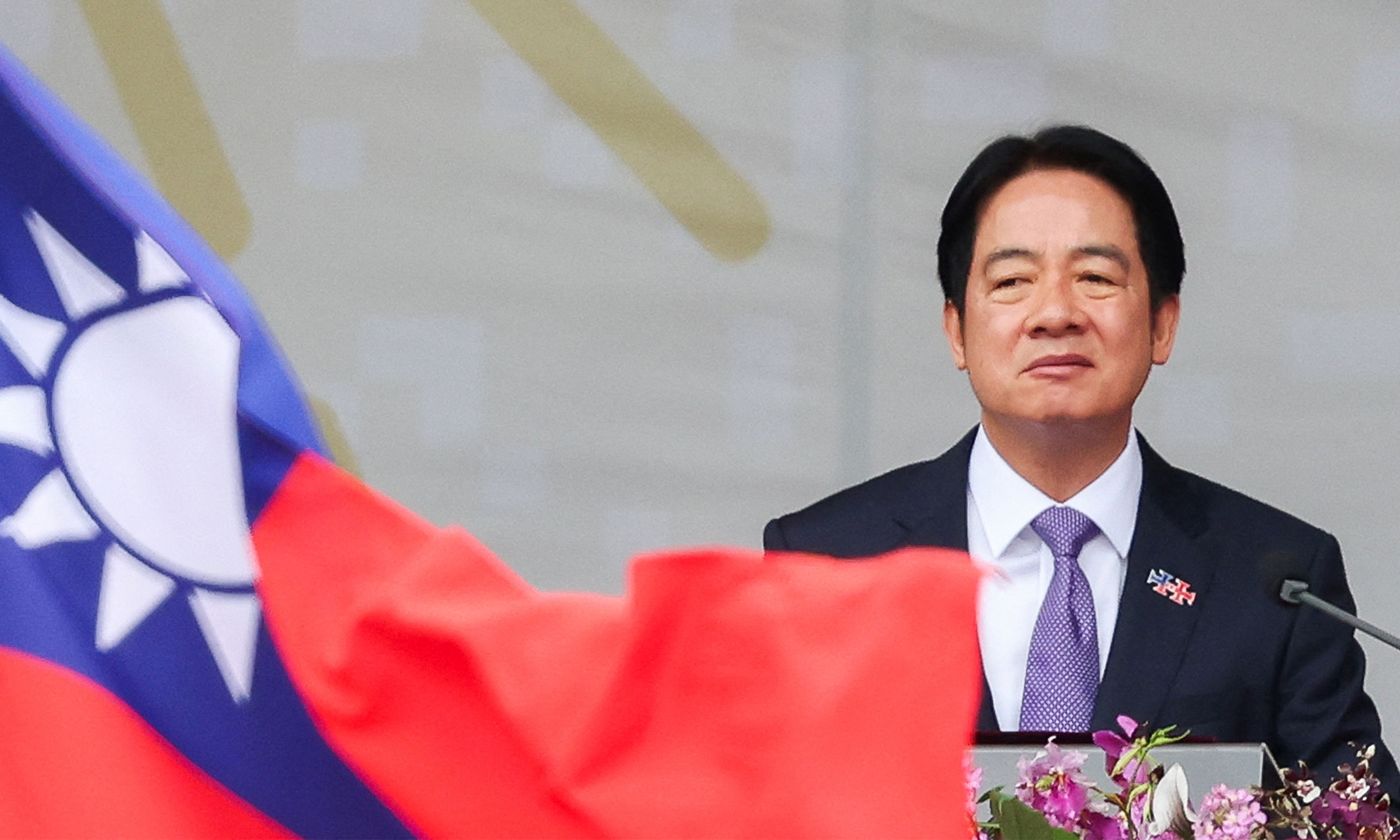
Taiwanese President William Lai gives a keynote address on national day in Taipei, Taiwan, October 10, 2024.
At the end of March, the Trump administration’s effort to deport foreign students involved in anti-Israel disruptions on campus received an unexpected endorsement. A senior Taiwanese official weighed in on the issue, a move out of step with his country’s penchant for cautious diplomacy.
“Way to go, @SecRubio,” Joseph Wu, the secretary-general of Taiwan’s national security council, wrote in a post on X. He was responding to a clip in which the secretary of state explained the decision to begin proceedings against Rümeysa Öztürk, a Tufts University doctoral student from Turkey, whose arrest outside Boston triggered a controversy in America. Taiwan’s government is normally very hesitant to address contentious U.S. political matters, but Wu, a former foreign minister, gave a clear endorsement of the administration’s deportation campaign against foreign students whom Rubio described as participating in movements that are “vandalizing universities, harassing students,” and “creating a ruckus”: “Similarly, there’re also those who come to #Taiwan but want to invite the communists to take over. Well, their permits will be revoked, & they’ll be expelled. We don’t welcome the visitors who want to come & destroy our democracy.”
The Taiwanese deportations to which Wu alluded began five days after the arrest of Mahmoud Khalil, a green card holder and recent graduate of a master’s program at Columbia University who had a role in disruptive protests there. By the time that Wu made that post on March 29, Taiwan had already compelled the departure of Liu Zhenya, a social media personality who had endorsed a Chinese takeover in a video posted to the Chinese app Douyin (a cousin of TikTok and popular in Taiwan), where she has 500,000 followers. Two days later, two additional influencers -- all Chinese nationals married to Taiwanese -- were deported.
As Beijing prepares for a potential invasion of Taiwan, Wang Huning, Xi Jinping’s top political theorist and a member of the Politburo standing committee, has advanced a strategy that works in tandem with military pressure. The goal is to press Taiwanese to choose Chinese domination of their country. The strategy includes publicly floated proposals for joint economic zones with Fujian Province, just across the strait from the island. Covertly, Beijing has escalated its use of espionage, cyberattacks, online propaganda, proxies who work to co-opt specific segments of Taiwanese society, and paid junkets that bring students and public servants to China. Taiwan’s government has documented a sharp uptick in espionage-related investigations in recent years.
Taiwanese President William Lai considers these developments a real threat -- a national crisis -- that could facilitate the country’s absorption by its communist neighbor. In a speech at the presidential office on March 13, he referred to growing alarm among Taiwanese that the country and its hard-won freedoms “are being washed away bit by bit due to these united-front tactics” -- a reference to Beijing’s method of co-opting citizens and social groups who are not members of the Communist Party by means of its United Front Work Department and countless other offices that collectively carry out united front work. China, Lai said in his speech, is a “hostile foreign force” against whom Taiwan must more proactively defend. As if to make his point, three members of the unit that guards his office were sentenced on espionage charges at the end of the month.
Aggressive immigration-enforcement policies targeting pro-unification Chinese nationals were not an explicit part of the ambitious 17-point strategy that Lai outlined, but they clearly overlap with this broader campaign, and hence Wu’s strong endorsement of Rubio’s remarks. Also on the agenda: reviving military tribunals to try the spies that China has recruited from the ranks of Taiwan’s armed forces in recent years, creating a disclosure system for public officials at all levels who travel to China, and subjecting Chinese nationals residing in Taiwan to more stringent legal requirements and barring them from dual citizenship with Taiwan.
The Trump administration, apparently by coincidence, is also interested in moving against Chinese agents on U.S. soil. It has already brought proceedings against at least one Chinese national. Ming Xi Zhang, a restaurant owner and U.S. resident who immigrated from China in 2000, pleaded guilty to charges of acting as an unregistered foreign agent in 2021. He was taken into custody in March, as ICE moved to deport him. Zhang had agreed to subject himself to potential removal as part of a 2021 sentencing agreement.
In countering subversive efforts by the Chinese Communist Party, Taiwan is pioneering techniques that Washington might want to adopt and adapt to broaden the scope of its own actions against united front work. While the crisis in Taipei is far worse than the situation in the United States, influence efforts clearly directed by Beijing continue to engage American politicians, business leaders, and other prominent figures. Trump’s decision to embark on a sharp escalation of America’s trade war with China means that Chinese officials and organizations doing united front work are likely to redouble their efforts to win over Americans to carry water for Beijing. They did this during the first Trump administration, and it is more likely than not that the regime will continue to employ similar methods.
A series of Justice Department cases over the past five years provides a partial look at how Chinese agents have sought to subvert government institutions, recruit spies within the American military, and export Beijing’s legal system through a secret “overseas police service station” in Manhattan. But those prosecutions implicate only those activities so egregious that officials saw fit to bring a case. They evidently want to make an example of such figures as Linda Sun, a former aide to New York Governor Kathy Hochul and her predecessor, Andrew Cuomo. Sun allegedly took direction from the Chinese consulate general and a New York–based community group that coordinated with party united front organs back in China to sway state government in a pro-Beijing direction. For every Linda Sun, there are dozens of instances of legal, or at least sufficiently ambiguous, activity whose significance is not high enough for it to become the focus of a prosecution or that falls short of the threshold for registration under the current legal framework.
Law enforcement responses have gone only so far for a couple of reasons. The party’s united front network is nebulous. It recruits ordinary people in all walks of life who interact with CCP-controlled bureaus and organizations, often through other seemingly innocuous community groups in cities that host large Chinese diaspora communities established by immigrants who arrived at the end of the 20th century. United-front work is effective because it corrupts and hijacks existing civil-society arrangements to promote the party’s ends. Legal mandates to register lobbying for foreign powers are virtually never heeded by individuals who report to united-front organizations that take direction from Beijing.
Another obstacle is that some Americans are willful or unwitting pawns of Beijing’s influence schemes. In some quarters, taking trips offered by groups linked to the Chinese government is still considered acceptable, and so state and local officials have continued to travel to China on Beijing’s dime. Students at universities have also received invitations. While some are unnerved by the propagandistic nature of the junkets, others come away with a far more positive view of the regime. Beijing’s goal is to bring 50,000 American students to China within the next five years.
The U.S. response to these activities can take inspiration from Taiwan, while modifying the latter’s program for its own political and legal framework. The Taiwanese justification for its deportations and other enforcement actions loosely resembles the Trump administration’s argument that participation by foreign nationals in activities that support Hamas undermines U.S. foreign policy interests and that such individuals can therefore be deported. But the Taiwanese government’s stance applies in the American context only up to a point: Taiwanese government officials, including Liu Shyh-fang, minister of the interior, have argued that free speech does not extend to endorsing a Chinese invasion of Taiwan and that such speech is a violation of the terms attached to residency in Taiwan.
U.S. officials could consider deporting noncitizens who have clearly associated with organizations subordinate to united front offices and other Chinese-regime entities, including those who have not been convicted of a crime. If the administration were to do so, it would instead make its strongest case by pointing to provisions of the law barring immigrants to the U.S. from associating themselves with communist parties, rather than by asserting that pro-Beijing rhetoric itself is not protected.
Proving the existence of evident allegiances to a foreign authoritarian regime would undermine the validity of opposition to deportation proceedings brought against noncitizens with united front affiliations. Foreign nationals who are, for example, active participants in a local U.S. chapter of the China Council for the Promotion of Peaceful National Reunification could face deportation because of their membership in a Chinese Communist Party–led entity (the council sits under its United Front Work Department), not for the content of their speech favoring Beijing’s perspective on various issues. Same for those who have traveled to Beijing in their capacity as delegates to meetings of united front bodies and who have held secret titles within these organizations.
Another idea from the Taiwanese crackdown worth considering is Lai’s plan to create a registry for trips to China by government officials at any level. Bringing transparency to U.S.-China exchanges would help the public understand how government officials might be influenced by the highly favorable look at China that the party offered them. Lai’s order that “people-to-people” exchanges across religions, cultures, and academic institutions be “depoliticized and de-risked” is similarly worthy, as it recognizes that almost every Chinese public-diplomacy program answers to the regime.
Up to now, Washington has only haltingly confronted Beijing’s obvious propaganda efforts. As China escalates its political warfare against Taiwan -- it might have taken Lai’s speech as a pretext for its latest military drills around the island in early April -- America can observe the Taiwanese counteroffensive and take from it ideas worth trying here.

About the Author
Jimmy Quinn is the former national security correspondent for National Review.
Featured Tags
Advertisement
Advertisement
Comments