Hulk Hogan Should Be Remembered for Piledriving Gawker Media into the Ground
Written by Jeffrey Blehar
His biggest victory came outside the ring.
Share this story
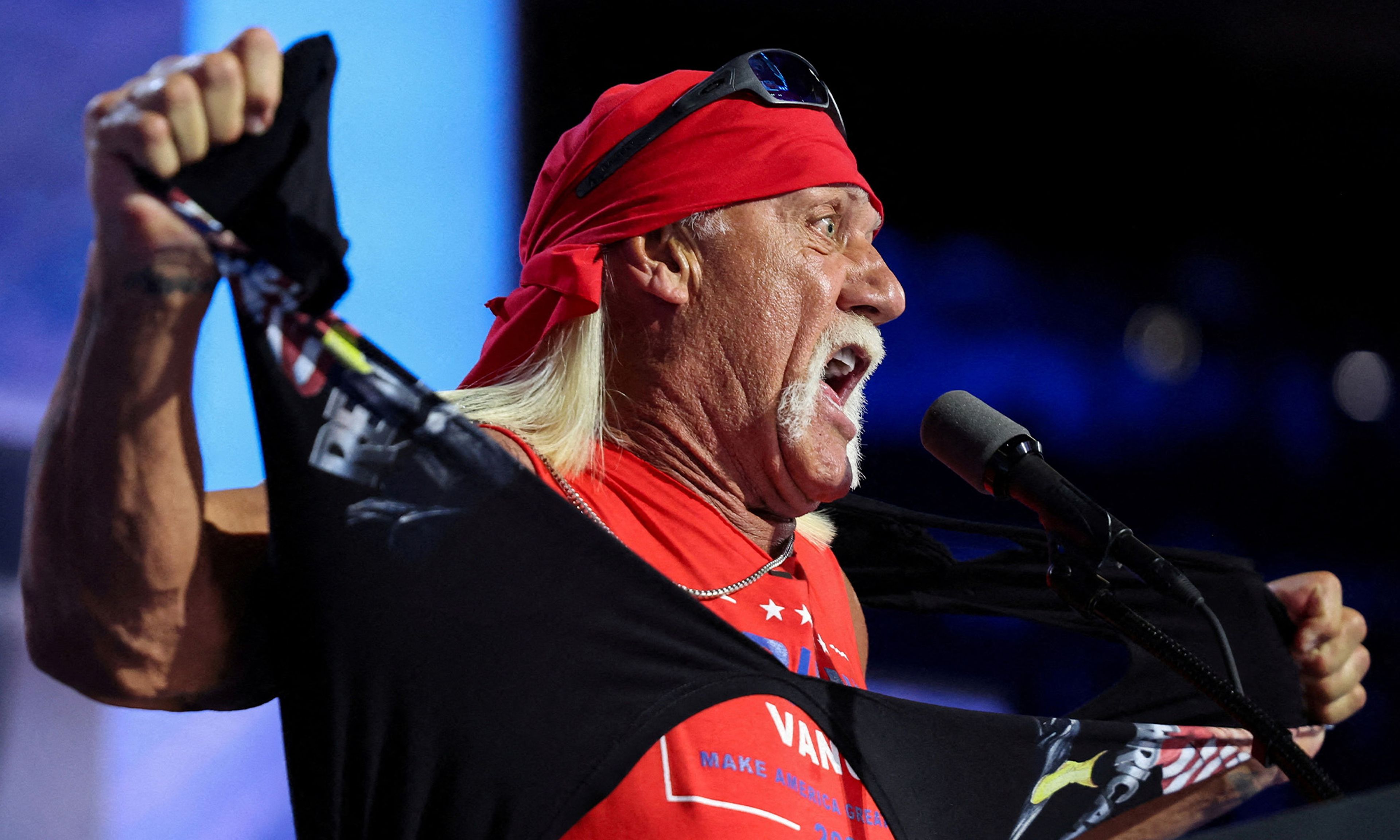
Hulk Hogan, professional entertainer and wrestler, rips his shirt while speaking at the Republican National Convention in Milwaukee, Wis., July 18, 2024.
Terry Bollea, better known to the world as Hulk Hogan, passed away the other day from a heart attack at his home in Clearwater, Fla., at the age of 71. He'd have been pleased that our culture's last memory of him will be at the rostrum of the Republican National Convention in July 2024 as he ripped off his shirt to announce the return of “Trumpamania.”
And this won’t be a proper obituary for the man, because I’m the wrong person for such an assignment. Although Hulkamania and pro wrestling was everywhere during my ’80s and ’90s youth, I was never much of a fan. What I know about the world of wrestling is similar to what I know about the world of Harry Potter: knowledge acquired via cultural osmosis rather than direct experience. (My one crystal-clear wrestling memory from the ’90s was gathering in a friend’s basement to watch NBA players Karl Malone and Dennis Rodman face off against one another in a pay-per-view match, and being disappointed at the lack of brutality — one night where the Mailman failed to deliver.)
No, instead the primary reason I will forever fondly remember the Hulkster is that he is one of the men who helped destroy Gawker Media, arguably the foulest, most ethically corrupt, and generally most corrosive media corporation of the 21st century. Younger readers (or our older ones less inclined to spend their spare time stewing in online culture) may not be familiar with the toxic cloud of reckless hatred it ginned up, and even those who were there during that era may not recall that Gawker Media ran not just the infamous Gawker website itself but several spiritually and tonally related sites like the women’s-oriented Jezebel and the sports/media criticism site Deadspin.
Now is not the time to delve into the immensely damaging legacy of Gawker and the media culture it spawned. Suffice it to say that it was founded on an explicit ethos of wanton cruelty: a bunch of frustrated New York hipsters experiencing cocaine for the first time and spending their hungover waking hours writing left-coded invective against any and every “insider” target available. This soon metastasized into an all-out war against decency — as long as it garnered laughs or clicks from its leftist (and media-heavy) audience.
The tales of Gawker Media’s ethical wretchedness during the 2010s are legendary to my generation of media observers: Deadspin once happily relied on a gay hustler to out a random media executive as homosexual (the hustler had unsuccessfully tried to blackmail the executive; Gawker was presumably his avenue of last resort). Why did they do it? Merely because the man was a Condé Nast executive, and Gawker Media forever cast itself as the implacable enemy of establishment New York publishing.
But everyone was grist for the mill, really: If clicks could be wrung out of spotlighting, shaming, and destroying even complete civilians, then to hell with them. Gawker infamously posted a video of a drunken girl having sex in the bathroom of a college bar. When the girl in the video pleaded with Gawker to remove it, editor A. J. Daulerio emailed her a three-word reply: “blah blah blah.” He later conceded that he didn’t know if it was a rape or not, and didn’t care.
This all climaxed with the Hulk Hogan incident. In 2012, Daulerio posted a video to Gawker of Hogan having sex with the estranged wife of a friend. (The video was filmed secretly and was delivered to Gawker, again, only after a failed blackmail attempt on Hogan.) Hogan sent a cease-and-desist letter to Gawker, but owner Nick Denton refused to have it taken down, arguing that the comments Daulerio made underneath it mocking Hogan gave it “news value,” despite its otherwise being a fairly clear-cut case of invasion of privacy. Hogan, then near bankruptcy, lacked the ability to pursue what would have inevitably been a monumentally expensive case against the Gawker Media empire.
That is, until billionaire Peter Thiel quietly stepped into the picture. The PayPal co-founder and Silicon Valley CEO had been outed as gay by Gawker several years prior to this — the only reason proffered by Gawker and its defenders at the time was that he had demonstrated right-wing proclivities — and he had never forgiven them for the invasion of his privacy. While Thiel had little hope of legal recourse in his own situation — he was, in fact, gay, so he had no grounds for a defamation suit — he recognized immediately that the humiliating invasion of privacy Hogan had suffered (and was continuing to suffer) was a very different, and much stronger, case.
So Thiel went to Hogan with a proposition: If Hogan wanted to sue, he would cover all of his legal expenses — to the tune of what turned out to be over $10 million — so long as Hogan promised never to settle the case. They were going to take this one all the way to court and to a jury verdict, win or lose, come hell or high water.
You probably know what happened next: They won. The trial was a pig circus for the ages, with Daulerio destroying Gawker forever by announcing, during a videotaped deposition, that he would publish the sex tape of anyone unless they were a child under the age of four. When the jury finally handed down its verdict in June 2016, it awarded Hogan a whopping $140 million in cumulative damages. The jury award ended Gawker Media almost instantly. (They filed for bankruptcy in June and were sold for scrap in August.)
People, it was a beautiful thing to see. With one fell swoop, this titanic engine of evil — for that is truly what I believe Gawker Media to have been — was destroyed wholesale, its powers winking out in nearly an instant, its ashes scattered to the four winds. Imagine what it must have been like to be at the battle outside the Black Gate of Mordor at the end of The Return of the King, as the Men of the West are beset on all sides by the seemingly victorious forces of darkness . . . and then Orodruin erupts, Barad-Dur collapses, and the baleful Eye of Sauron is extinguished forever. (The instant the verdict came down, I emailed a friend: “The Ringbearer has completed his quest!”)
I would be lying if I said that America’s political and cultural discourse has improved in any way since 2016; the evil legacy of Gawker Media (the so-called “Gawkerization” of commentary, a well-noticed phenomenon) lives on in a thousand uselessly snarky pieces on unread websites. But that’s like saying that the Rebels in Star Wars shouldn’t have felt proud about the outcome of the Battle of Yavin: You might not have won the larger war, but you still blew up the Death Star, and that counts for something.
So while others will happily remember all of the great moments Terry Bollea gave the world in the wrestling ring while playing a larger-than-life all-American, I want to warmly salute him for tag-teaming with Peter Thiel to suplex the greatest heel in recent media history — from the top rope. R.I.P. Hulk.
[slideshow slideshow="1860032" /]

About the Author
Jeffrey Blehar is a National Review staff writer living in Chicago. He is also the co-host of National Review’s Political Beats podcast, which explores the great music of the modern era with guests from the political world happy to find something non-political to talk about.
Featured Tags
Advertisement
Advertisement

Comments