In Defense of Strip Malls
Written by Noah Rothman
If these commercial establishments offend your taste, don’t shop in them.
Share this story
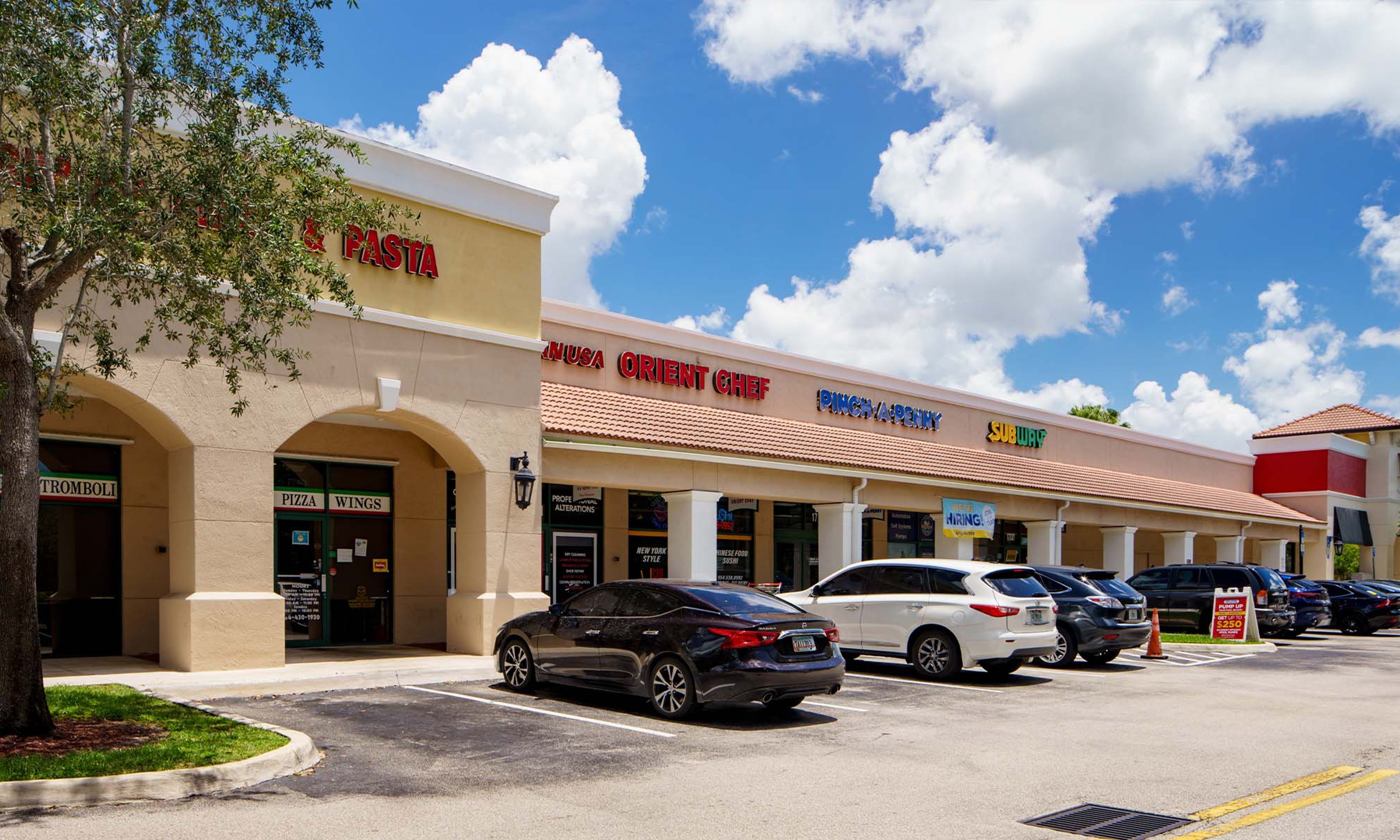
Businesses in Miramar FL RK Center, Miramar, Fla., July 30, 2022.
We are fast approaching the singularity of cultural discontent. The event horizon has been crossed, beyond which logic bends around an argument so impenetrable that its density is rivaled only by its arguer.
Take, for example, the following expression of general irritation that achieved that most odious of modern distinctions: “virality.”
View this post on X
Is this a right-coded complaint or a left-of-center gripe? Who is to say? It could be either. Indeed, not even those who engaged with it seem to know.
Perhaps this is a new iteration of the progressive technocrats’ irritation with America’s lamentable deficit of walkable, mixed-use, exurban spaces that are both residential and commercially zoned. Some in that predictable cohort seemed to assume as much.
Or maybe this is a version of the exasperation Tucker Carlson recently expressed with the very existence of strip malls. “Is there anyone who makes your life worse than a developer?” he recently asked, citing his displeasure with the Dollar Store aesthetic. They “make everything ugly, desecrate God’s creation,” he added. Carlson’s remedy to his own agitation isn’t “high-density housing,” but it’s not low-density housing either -- or any free-standing structure, really. “In a normal society, we’d like to burn your strip mall down,” he mourned. “You can’t do that here.” Such a bummer.
These outlooks are united in their contempt for the form that the commercial venues they hate take. What they resent is, however, changing with the evolution of the commercial landscape and consumer tastes.
As online shopping slaughters big-box retailers, strip malls are attracting new tenants who provide experiences and services as well as goods. As NorthJersey.com’s Daniel Munoz reported this summer, “You can now visit local strip malls for fitness and wellness, sports and recreation, specialty grocers, international food stores and dog grooming.”
What he described as retailers’ efforts to “Amazon-proof” their livelihoods have led to a revitalization of these spaces, many of which would please the eye of even the most discriminating fan of Moscow’s grocers and subways. Indeed, the troubled conventional mall -- the one you remember from the 1990s -- increasingly features strip-mall-like outdoor shopping settings.
But perhaps the problem isn’t what the strip mall looks like but what’s in it. Maybe it's not the multi-unit structures that line the nation’s arterial roads and divided highways that they hate. Rather, they resent, à la Carlson, the “karate studios and vape shops.”
Ostensibly, the left shares Carlson’s lament only insofar as these conventions are car-centric -- encouraging not just the pollution produced by the combustion engine but the disaggregating influence of the automobile on the community and the accompanying prospects for communitarianism. But they also hate the stuff you buy at these places, too. Out with the karate studios, they also say; in with the “yoga studios, fad fitness classes.” Down with the vape stores, they agree; in their place, erect niche cafés, jewelry makers, and outlets that cater to the “furbaby movement.”
Uniting these disparate discontents is their idealized nostalgia. As the father of the modern shopping mall, Victor Gruen, mused, the shopper’s experience was meant to “provide the needed place and opportunity for participation in modern community life that the ancient Greek Agora, the Medieval Market Place and our own Town Squares provided in the past.” His creation took on an organic life of its own -- one that disappointed its creator -- but it’s unlikely that the small-business owners who forge a life for themselves and their families in these brick-and-mortar establishments agree.
“What we’ve found is when national brands pull out of prime spots, it’s less about simply filling those spaces, it is about reimagining it as an experience and destination that reflects the local community,” said Andy LaPointe, a gourmet-food-business proprietor with two strip mall locations in Michigan. Declining rates of occupancy by large businesses are creating spaces for small firms to move in and create “something unique, a place to linger and a sense of belonging.” The strip mall and similar retail spaces allow “access [that] wasn’t on the table for startups and small businesses three years ago in most metro areas,” San Diego wellness counselor Kimberly Blair agreed.
Real estate watchers can’t help but notice that foot traffic at strip malls is up over their pre-pandemic baseline, and rental rates continue to rise. Indeed, “strip malls currently boast the highest occupancy rates among all shopping center types, with almost 46% of available space being leased,” property manager Sandra Sigman observed. “The demand for strip mall properties is currently outpacing supply, with buyers willing to pay a premium for these assets.” In fact, “Open-air neighborhood shopping centers are now one of the hardest types of commercial real estate to find space in,” the Wall Street Journal reported in January:
Flexible work schedules are driving more traffic to neighborhood retail centers. White-collar workers who used to spend five days a week at a downtown office are now likely to work a day or two from home and can visit the grocery store at lunchtime.
“This is where America shops now,” said one asset manager. It’s also where customer-facing small businesses are experiencing what he called the “retail renaissance.” And it’s not just the “flashy” outlets that are designed to dazzle. It’s also the lowly roadside conveniences that so offend the aesthetic sensibilities of Americans who don’t have to worry about their weekly shopping bill.
For some, there is no modern iteration of the capitalist enterprise that will satisfy their cultural ennui. You just can’t improve upon the feudal ideal -- scratching out a subsistence living, kicking just enough up to your lord to justify your parcel, and never traveling much beyond the confines of the village. Those of us who do not languish in the life of the mind patronize these local businesses and are presumably grateful for the services they provide -- the evidence of which is apparent in aggregate shopping patterns.
If strip malls offend your taste, don’t shop there. Assuming enough of your neighbors share your preferences, those ugly edifices will disappear soon enough. But if you cannot convince anyone else of your view, you’d probably have the urge to take matters into your own hands -- regulating these features of the commercial landscape out of existence or, in the extreme, resolving to “burn your strip mall down.” But that tendency is revealing. As is so often the case, those who insist that everyone secretly agrees with them appear to be speaking only for themselves.

About the Author
Noah Rothman is a senior writer at National Review. His third book, Blood and Progress: A Century of Left-Wing Violence, will be published by Hachette in May 2026.
Featured Tags
Advertisement
Advertisement




Comments