In Stanley Cup Playoffs, Excitement Builds for Big Game Sunday
Written by Neal B. Freeman
Columnist offers rare personal guarantee on spectator satisfaction.
Share this story
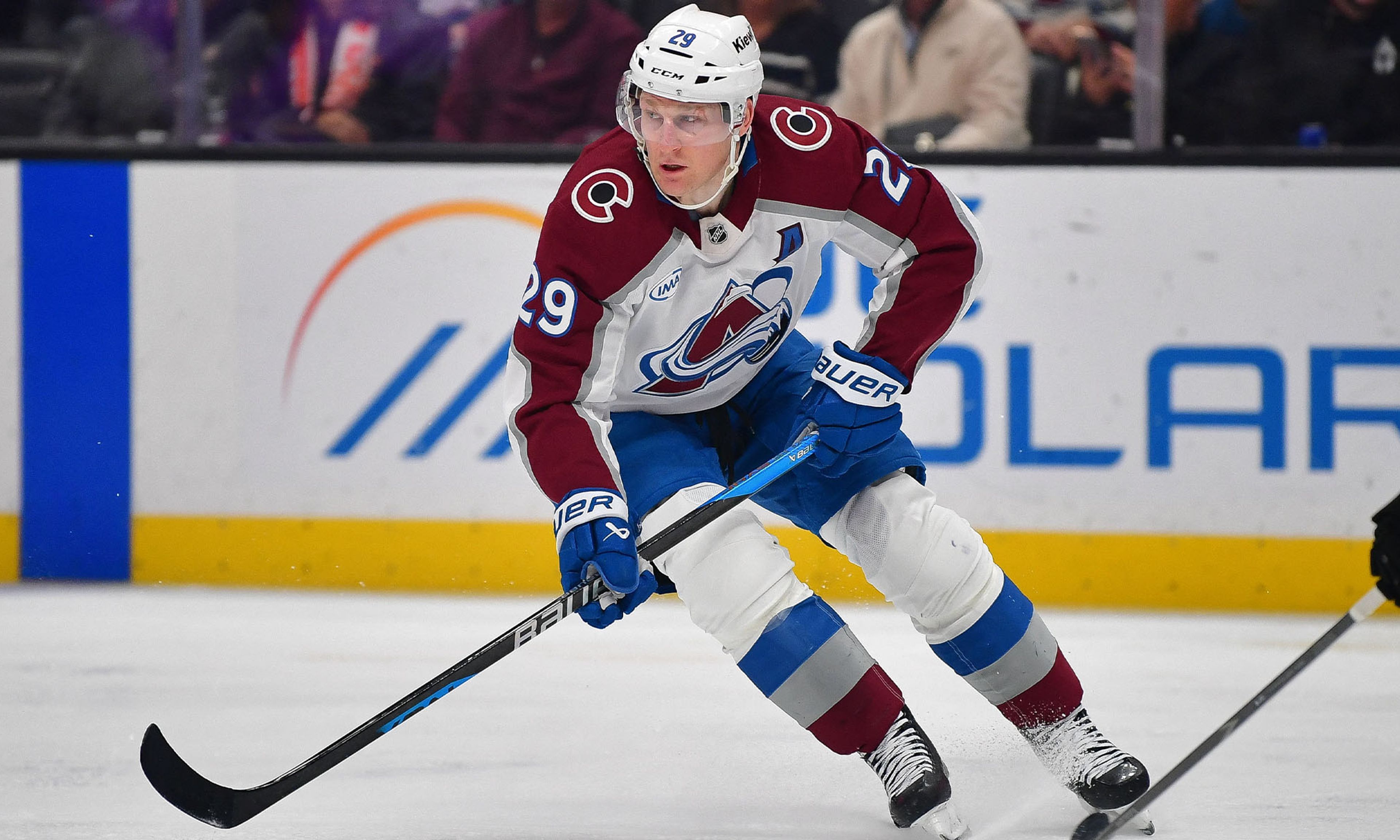
Colorado Avalanche center Nathan MacKinnon controls the puck against the Anaheim Ducks during the third period at Honda Center in Anaheim, Calif., March 3, 2026.
You have a treat in store. Tomorrow afternoon, at 1 p.m. Mountain Time, the puck will drop for the first game of the Stanley Cup playoffs between the Los Angeles Kings and the Colorado Avalanche. You’ll enjoy the game. For many years -- decades, even -- hockey was the most compelling of the big four sports to watch in person and the least compelling to watch on television. No more. The TV producers have caught on and caught up.
If you watched the Winter Olympics in Milan-Cortina, you’ll recognize some of the Avalanche players. Colorado’s captain, stone-jawed Gabe Landeskog, was the captain of the Swedish team. Marty Necas, the high-scoring Avs winger, was the best player on the Czech team. Artturi Lehkonen, who plays a Swiss Army knife role for the Avalanche, played the same role for the Finnish team. Brock Nelson, the two-way centerman, was a forceful presence for the gold-medal-winning USA team. Colorado’s two best players, Nathan MacKinnon and Cale Makar, were the second- and third-best players on Canada’s star-stuffed roster. (Sorry, but the great Connor McDavid is still in his own tier.) Big Val Nichushkin, the Avs' octopussian forechecker, would have played for Russia but for the fact that their team was ruled ineligible for drug violations. (Finally!) As with all the top teams in the National Hockey League, the Avalanche are something of an international all-star team.
If the Avs win a series or two, and you stick with them, four other players will capture your attention. Defenseman Brent Burns is a unicorn. Twice over, actually. Most NHL players weigh in at between 180 and 210 pounds. They have to be big enough to hit (and to take a hit). And they have to be small enough to race up and down the ice at speeds that would leave a pro football star with great wheels chuffing far behind. Burns is 6-foot-5 and 228 pounds. By hockey standards, that’s bigger than big but -- watch him tomorrow -- he skates with remarkable fluidity for a man that size.
Burns is unique in another way. He’s old. He’s 41, which by hockey standards is Bidenesque. But he has played in more than 1,000 consecutive games. Think about that -- for a decade, he’s never taken a night off for an injury or a bout with the flu or a canceled flight or a kid’s ballet recital or whatever else life may have thrown at him. Why does he continue to compete against players half his age? Simple. Because he’s never won a Stanley Cup. Brent Burns is a hockey player -- a tough, skilled, hungry hockey player. (Plus he’s got a great smile. It’s where his teeth used to be.)
And don’t miss Nazem Kadri. He’s dark and bearded and gives off what he probably hopes is a malevolent vibe. If he plays for your team, you love him. He rattles the opponent. If he plays for the other team, you hate him. You boo every time he touches the puck.
Character traits aside, I can promise you this: At some point in the series, Naz Kadri will slide a no-look, rink-wide pass through a forest of sticks that will find a teammate at the edge of the crease for an easy tip-in. As hockey players say, somewhat nonsensically, Naz “sees the ice.” He sees players, that is, not just where they are, but where they will be by the time his pass arrives.
The Avs have the luxury, rare in a salary-capped sport, of having two goaltenders of starter quality -- Mackenzie Blackwood and Scott Wedgewood, known perhaps inevitably as the Lumber Yard. Which Wood would a Wood-lover love for tomorrow’s tone-setting game? Blackwood has the heavier résumé, but Wedgewood is riding a hot streak. In a streaky sport, I try not to fight the psychological tape. I’m going with the Wedge Wood.
The Avs are built to win the Stanley Cup. They have the key ingredients -- speed, power, grit, and creativity -- and they have shown that they can play with intensity (which is a hockey euphemism for “barely contained frenzy”). The trick is to sustain that intensity over the course of a two-month tournament. That’s an unnatural human act.
To win the Stanley Cup will require four consecutive victories in the best-of-seven series. That is to say, it will require a minimum of 16 victories in a maximum of 28 games. That is not to be confused with a three-hour contest waged in the afternoon sunshine of Super Bowl Sunday. That is an additional season, and the frequently used descriptive, “grueling,” doesn’t begin to do the job. By the time the winning team skates the Cup in June, every player will be injured. Some of them will go directly from the victory parade to a surgical ward. The rest will go to rehab and begin a feverish effort to get ready for next season’s training camp beginning a few weeks hence. (Stanley Cup champions rarely repeat, unless of course their top line is centered by somebody named Wayne Gretzky.)
The Avs are in relatively good physical shape as they open the playoffs. Kadri will play with a broken finger. Defensive forward Logan O’Connor is regaining his form following hip surgery. Landeskog seems to be getting around pretty well on his lab-contrived knee cartilage. And Makar says he’s now recovered from an unspecified “upper body injury.” The more immediate concern is the coach, Jared Bednar, who took a puck to the head earlier this month. In time-honored hockey tradition, few details of his injury have been released. (The only report I’ve seen is that he suffered “broken facial bones.”) The hope is that Bednar is behind the bench tomorrow, his brain unscrambled, and prepared to make a hundred tactical decisions over three periods of mad-dash hockey. The expectation is that he may look less like a hockey coach than a hockey player.
The prediction here is: The Avs win the Cup in 24 games. But don’t bet the ranch. Or even the condo. It’s hockey.
Neal B. Freeman represented the ownership group in its acquisition of the Quebec Nordiques in the spring of 1995. The team was relocated to Denver, renamed, and relaunched as an American team that October. The Colorado Avalanche won the Stanley Cup in their first season.

About the Author
Neal B. Freeman, businessman and journalist, was a director of National Review Inc. for 38 years.
Featured Tags
Advertisement
Advertisement



Comments