Is Bondi Saying Her DOJ’s Prior ‘Exhaustive’ Epstein Review Was a Sham?
Written by Andrew C. McCarthy
The Justice Department is in the business of investigating crime, not the business of conducting political opposition research.
Share this story
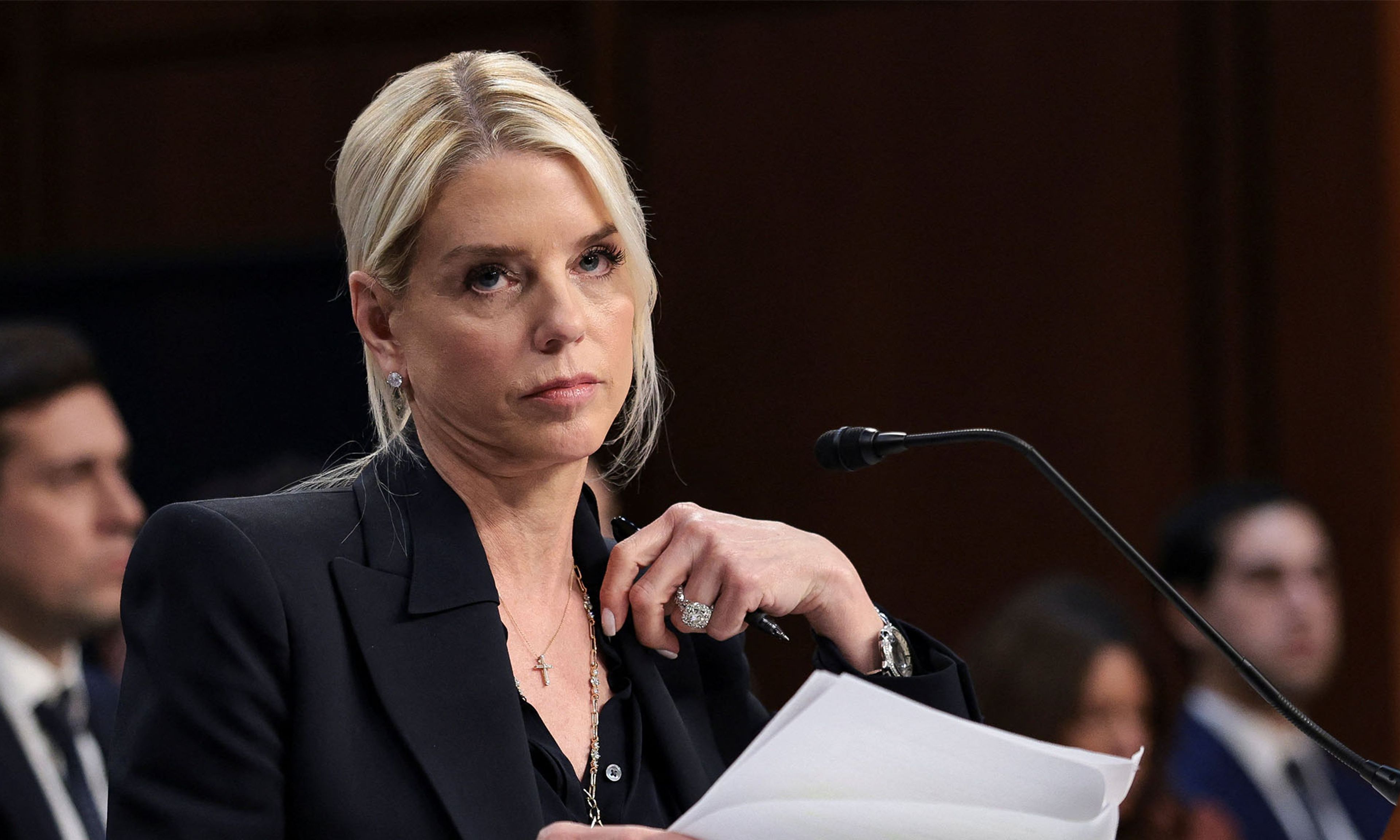
Attorney General Pam Bondi looks on as she testifies before a Senate Judiciary Committee oversight hearing on Capitol Hill in Washington, D.C., October 7, 2025.
On Friday, President Trump posted yet another order directing Attorney General Pamela Bondi to weaponize the government’s law-enforcement apparatus for political gain.
Unlike the last one, in which the president inveighed against Bondi’s failure (theretofore) to indict three of his enemies (James Comey, Letitia James, and Adam Schiff), this one was not intended as a private dressing down that Trump inadvertently published on Truth Social. This time, the president purposely and openly demanded that the Justice Department and the FBI
investigate Jeffrey Epstein’s involvement and relationship with Bill Clinton, Larry Summers, Reid Hoffman, J.P. Morgan, Chase [sic], and many other people and institutions, to determine what was going on with them, and him.
Sadly, it is no longer surprising that Bondi can’t bring herself to tell her boss that it would be a waste of the Justice Department’s time to conduct investigations at the public direction of a president who leaves unconcealed his partisan motivation for giving such an order. Even if there were anything to investigate, most attorneys general would explain to the president that the courts would throw out any resulting prosecution as an abuse of process.
Moreover, by pursuing such nakedly politicized investigations, prosecutors and FBI agents would be opening themselves up to potential civil-rights charges. At this very moment, in fact, Trump supporters are demanding that the current Justice Department bring just such charges against Obama and Biden administration officials, and Trump himself is seeking a $230 million payday from the taxpayers over having been the target (notwithstanding that the federal investigations against him were based on actual misconduct).
No, no one at this point expects Bondi to say, “Mr. President, it would be wrong to do what you’re ordering me to do.” But couldn’t she at least summon up the gumption to say, “Mr. President, we already looked at the Epstein files and announced to the public that we found nothing that could justify new criminal charges”?
Apparently not.
In a prompt, public public response, the attorney general was obeisant:
Thank you, Mr. President. SDNY [i.e., Southern District of New York] U.S. Attorney Jay Clayton is one of the most capable and trusted prosecutors in the country, and I’ve asked him to take the lead. As with all matters, the Department will pursue this with urgency and integrity to deliver answers to the American people.
But Bondi’s Justice Department and the FBI told us just four months ago that they had pursued a review of the government’s Epstein files with urgency and integrity to deliver answers to the American people. That had to be done due to the pressure Bondi herself helped create by hyping the Epstein files as if Democrats had conspired to conceal them (rather than because of laws and regulations that prohibit the Justice Department from publicizing information about investigations and uncharged persons — see, for example, Justice Department Manual §1-7.400 and 28 C.F.R. §50.2). They told us there was nothing more to investigate, to charge, or to say.
So . . . is Bondi now telling us that her No. 2, Deputy Attorney Todd Blanche, is not one of the most capable and trusted prosecutors in the country? And what about FBI Director Kash Patel, for whom she publicly professes admiration (despite reports that she is privately exasperated)?
Blanche and Patel collaborated in July on a joint Justice Department and FBI memo asserting that, as part of the Trump DOJ and FBI’s “commitment to transparency,” they had “conducted an exhaustive review of investigative holdings relating to Jeffrey Epstein.” Their conclusion? “We did not uncover evidence that could predicate an investigation against uncharged third parties” (emphasis added).
Furthermore, despite Bondi’s awkward intimation in an earlier television interview that she had Epstein’s “client list” sitting on her desk, the Justice Department and FBI reported:
This systematic review revealed no incriminating “client list.” There was also no credible evidence found that Epstein blackmailed prominent individuals as part of his actions.
This was not a fleeting review. According to the memo approved by Blanche and Patel:
To ensure that the review was thorough, the FBI conducted digital searches of its databases, hard drives, and network drives as well as physical searches of squad areas, locked cabinets, desks, closets, and other areas where responsive material may have been stored. These searches uncovered a significant amount of material, including more than 300 gigabytes of data and physical evidence.
The files relating to Epstein include a large volume of images of Epstein, images and videos of victims who are either minors or appear to be minors, and over ten thousand downloaded videos and images of illegal child sex abuse material and other pornography. Teams of agents, analysts, attorneys, and privacy and civil liberties experts combed through the digital and documentary evidence with the aim of providing as much information as possible to the public while simultaneously protecting victims.
The memo is emphatic that the Trump DOJ and FBI looked in granular detail at evidence relating to, and claims made by, Epstein’s victims. They’d left no stone unturned in the effort to identify any co-conspirators and prosecute criminal cases if that could be done:
Consistent with prior disclosures, this review confirmed that Epstein harmed over one thousand victims. Each suffered unique trauma. Sensitive information relating to these victims is intertwined throughout the materials. This includes specific details such as victim names and likenesses, physical descriptions, places of birth, associates, and employment history.
One of our highest priorities is combatting child exploitation and bringing justice to victims. Perpetuating unfounded theories about Epstein serves neither of those ends.
Given the amount of time and effort that was dedicated to this probe by legions of prosecutors and agents, what conceivable basis can there now be for Attorney General Bondi to refer the Epstein files back to the SDNY — whence the files came from in the first place?
As I’ve previously related, the SDNY spent years prosecuting Epstein and his accomplice, Ghislaine Maxwell (whom Blanche was dispatched to interview about three months ago, presumably because of his intimate familiarity with the Justice Department’s exhaustive review). It could not be more obvious that the SDNY was determined to indict child trafficking cases if any evidence warranting charges could be found. There is every reason to believe the SDNY would have spotlighted crimes of pedophilia if they could have found them — such cases, especially against prominent defendants, would have been career-makers for the prosecutors. But that aside, common sense says that if prosecutors want to bury cases, they don’t bring two indictments, thereby triggering massive discovery of the government’s files.
What is Bondi saying by suddenly instructing Jay Clayton “to take the lead”? Does she think Blanche and Patel missed something?
Yes, these are rhetorical questions. When a president demands that something lawless and unethical be done, an honorable subordinate tries to talk the president out of that course and, failing that, resigns. Clearly, that is not going to happen.
The mission of the Justice Department is to uphold the rule of law by investigating potential criminal conduct with an eye toward indicting criminal cases. The Justice Department is not supposed to do politics. If there is no criminal case to bring, the Justice Department’s work is over, and the rules prohibit it from publicly broadcasting investigative information regarding people who are neither charged nor called as witnesses.
In his post, President Trump didn’t even pretend to have a law-enforcement reason to demand a Justice Department and FBI inquiry. He unabashedly asserted that he wanted it done because “the Democrats are using the Epstein Hoax, involving Democrats, not Republicans, to try and deflect from” their political “failures.” In retaliation, he insisted that the DOJ and FBI look into the “involvement and relationship” that Epstein had with top Democrats and institutions which Trump sees as Democrat-adjacent.
As Bondi presumably knows, it is not a federal crime to have had “involvement” or a “relationship” with Jeffrey Epstein. The president claims, “Records show that these [prominent Democrats he’d just mentioned,] and many others, spent large portions of their life with Epstein, and on his ‘island.’” Even if we assume that’s true, to have spent time with Epstein, wherever that allegedly happened, is not in itself a federal crime.
The Justice Department is in the business of investigating crime — not of conducting political opposition research. It would be a federal crime to have conspired with Epstein in a sex-trafficking ring . . . but Blanche and Patel have already said, after a scorched-earth review of the government’s vast array of Epstein files, that there is no evidence of that.
Naturally, the media-Democratic complex is lavishing attention on mounds of unsavory — but non-incriminating — emails and reporting tying the president to Epstein. In retaliation, the president is prodding his attorney general to dig up unsavory information tying notable Democrats to Epstein. That is an overtly political task. The president has an array of political operatives, in and out of government, whom he could deploy for such purposes. But it would not be an appropriate assignment for the Justice Department, even if the Justice Department hadn’t already conducted an exhaustive review and announced there was no point in further investigation.
Pam Bondi’s answer to the president’s political command was to salute and tell the U.S. attorney in Manhattan to get right on it.

About the Author
Andrew C. McCarthy is a senior fellow at National Review Institute, an NR contributing editor, and author of Ball of Collusion: The Plot to Rig an Election and Destroy a Presidency.
Featured Tags
Advertisement
Advertisement


Comments