Is the Latin Mass for Freaks?
Written by Michael Brendan Dougherty
Traditional Catholics are optimistic about their movement, and for good reason: It’s growing.
Share this story
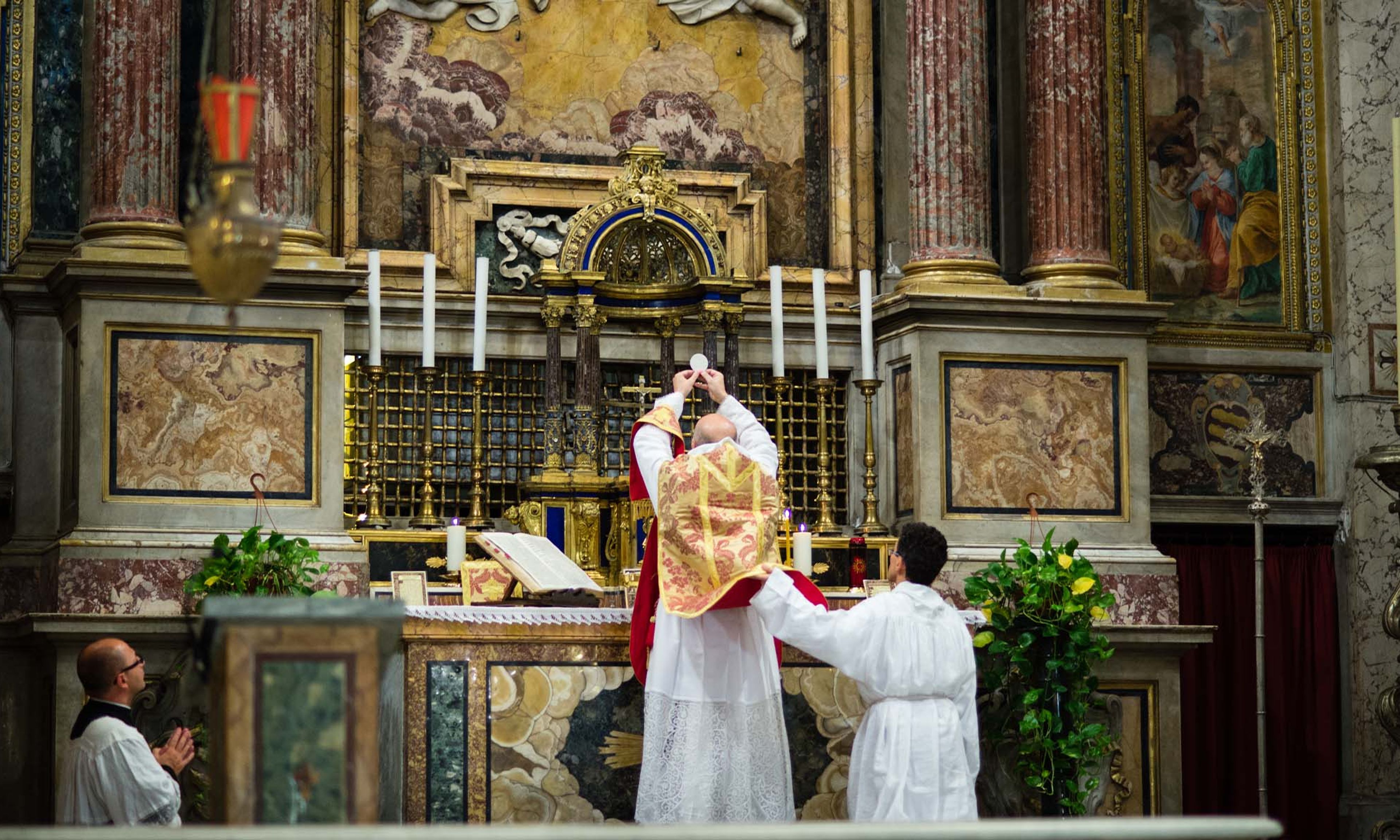
emanuelecapoferri/via Getty Images
Writing in Tablet, Maggie Phillips explores how the internet has “remade” the traditional Latin Mass. It’s a story meant to warn people off. The Latin Mass is surrounded by male internet freaks and insane politics, and it doesn’t deserve the attention it’s getting because it’s practiced by so few Catholics. Or so Phillips tries to tell us.
For those who don’t know, the traditional Latin Mass (TLM) is just the form of the liturgy celebrated in the Roman Rite of the Catholic Church up until the time the Novus Ordo Missae — the New Order of the Mass — was introduced in the wake of the Second Vatican Council. Ever since that council, some Catholics and non-Catholics have lamented the disappearance of the traditional liturgy, and a movement to make it more available or bring it back has been percolating for decades, until it burst into the mainstream under Pope Benedict XVI. The founder of this magazine was devoted to the old liturgy. The English literary hero Evelyn Waugh was also a partisan for it. So was Pat Buchanan. (Phillips is correct to see an association between the TLM and political conservatives.)
I’ve been a part of this movement for almost a quarter of a century. And the picture that Phillips paints seems distorted to me. She cites the picture that TLM advocates like to paint for themselves: They’re a group of devoted, energetic younger families who are leading a genuine revival. The reality, she says, is that the movement remains small, and it’s increasingly defined by an internet “tradosphere” that’s filling Latin Mass spaces with socially awkward, mentally rigid male freaks.
While she is correct to cite Pew’s estimate that only about 2 percent of American Catholics are devotees of the Latin Mass, she doesn’t ever back up her claim that Latin Mass spaces are dominated by men on the autism spectrum. Phillips overinterprets the fact that TLM attendees are a small percentage of Catholics to mean that they’re not the “vanguard” of a major trend in the church.
She goes on to let an autistic Christian podcaster describe how the Latin Mass movement functions and is dysfunctional in the church, without much evidence. There’s some truth in the claim that a few odd young men are attracted to the traditional Latin Mass, and that they’re loud online, and that some of their enthusiasm turns off others. But the reason young traditionalists like viewing themselves as a group of energetic young families is that this is what you actually see at Latin Mass parishes. You don’t see pews filled with bow-tied men who look like they’d just as well be playing Dungeons and Dragons.
It was Benedict’s liberalization of the Latin Mass that began disassociating the movement with social and political extremism. When the TLM was marginal in the church, it tended to attract a disproportionately marginal audience. The reason that trad Catholics are optimistic about their growth is that the movement does continue to grow, and it grew out of a time, not very long ago, when it was being actively suppressed in the church. Finally, they probably consider themselves a vanguard because they are one.
There is no greater evidence of this than Pope Francis’s own pontificate in which he offered nearly constant anti-trad commentary, focused on the youth who were coming into the seminaries. I know exactly what he’s talking about, because those seminarians are disproportionately from traditionalist parishes like mine. Traditionalist Catholics have always been a vanguard, one that has always included artists, intellectuals, and writers. When Pope Francis put restrictions on the Latin Mass, he was met with a letter opposing his action (much as Pope Paul was when he imposed the new Mass) signed by cultural luminaries and intellectuals. In 2024 this included Bianca Jagger, historian Tom Holland, composer Andrew Lloyd Webber, and world-renowned musicians such as the cellist Steven Isserlis.
There are faults in the trad community. Certain charismatic priests dominate individual congregations, particularly in religious orders dedicated exclusively to the old Mass. But where the TLM is incorporated into parish life, it attracts young families of normal social ambitions and a variety of temperaments. If I can lay one criticism of the movement it is that it does fall into the sociological trap of “middle-class traditionalism” that surfaces in all religions. The impulse and longing for tradition go along with lives that are otherwise directed toward respectability and modest success. After our time in the church’s ghettos, traditionalists are too often satisfied by merely having the liturgy, rather than taking it out to share with the poor and with prisoners. The emphasis on marriage and family can make for a forbidding subculture, especially since other aspects of traditionalism attract and nourish artistic ambitions and a kind of flamboyant religious bohemianism.
I suppose the greatest thing I want to say in response to the portrait Phillips paints is the message the angels so often give: Do Not Be Afraid.

About the Author
Michael Brendan Dougherty is a senior writer at National Review Online.
Featured Tags
Advertisement
Advertisement



Comments