Israel Must Be Self-Sufficient, for Its Own Sake
Written by Danielle Pletka & Daniel J. Samet
U.S. taxpayer-funded assistance to Israel has become a cudgel.
Share this story
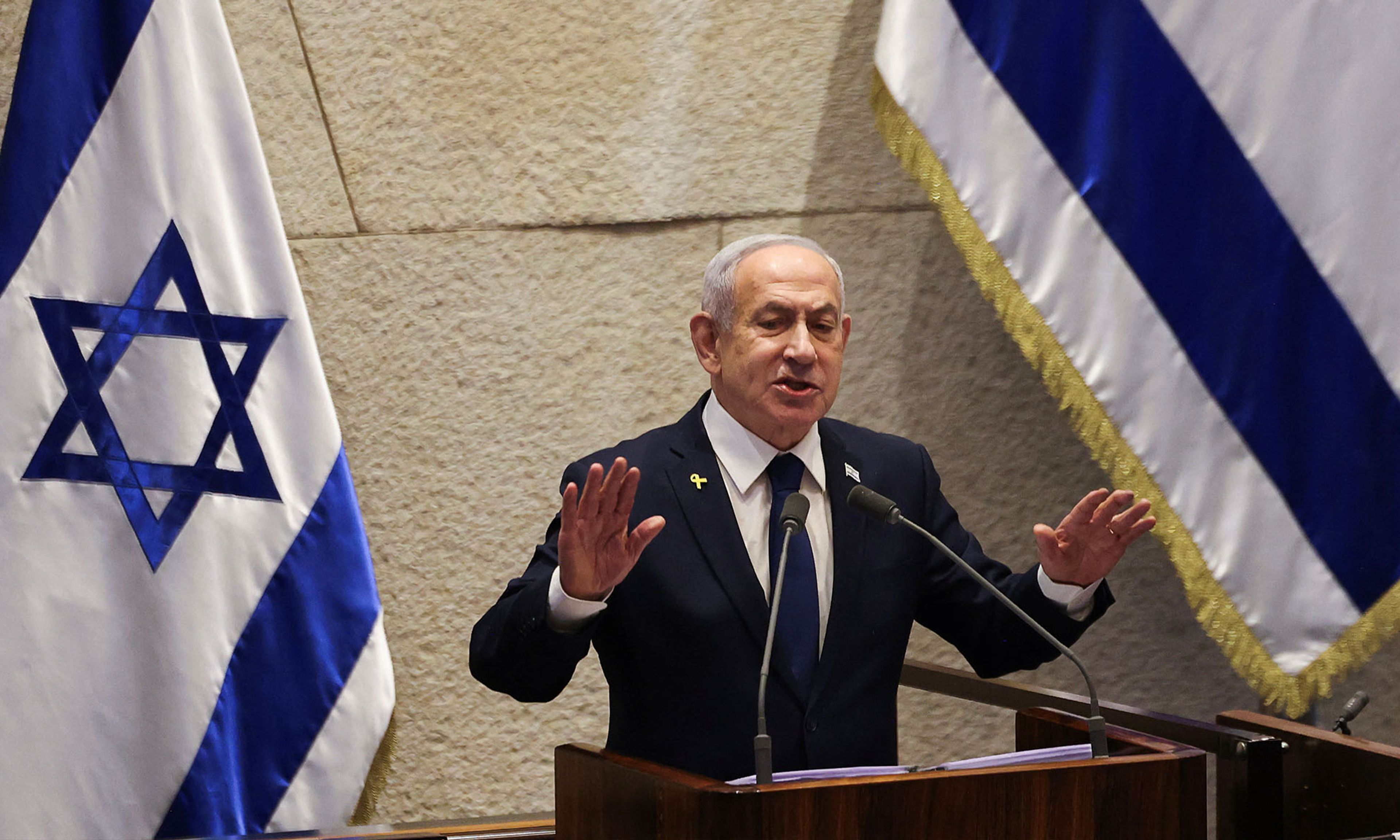
Israeli Prime Minister Benjamin Netanyahu speaks at the plenum of the Knesset, Israel's parliament, in Jerusalem, November 10, 2025.
Israeli Prime Minister Benjamin Netanyahu recently denied a report that Israel is seeking a new 20-year commitment of military aid from Washington, insisting that “I want to make our arms industry independent.” Israel, which received some $17.9 billion in defense assistance from the United States during the course of the Gaza war, is one of the most technologically innovative and capable military powers in the world. It can and should achieve self-sufficiency. It’s long past time for Jerusalem to decline additional financial support from Uncle Sam.
Israel has been under assault from the Arab world (and, more lately, Iran) since its inception. Dwarfed by the wealth and size of its enemies, it has nonetheless managed to dominate them — at enormous cost in Israeli lives and treasure. After the 1967 Six-Day War — following decades during which the United States had done little to nothing to support the Jewish state — U.S. military assistance to Israel rose. It skyrocketed after the 1978 Camp David Accords and the prospect these agreements offered for a wider peace in the Middle East. By 2000, Congress was appropriating almost $2 billion a year in Foreign Military Financing and almost $1 billion more in Economic Support Funds for Israel. And though this economic support ended in 2008, the military funds kept increasing. In 2016, recognizing the threat from Iran, the Obama administration sought to mitigate Israeli objections to its prized Iran nuclear deal, the Joint Comprehensive Plan of Action, by committing $3.8 billion per annum in Foreign Military Financing for Israel through 2028.
But the Israel of yesteryear bears almost no relationship to the Jewish state of 2025. In 1960, the Bank of Israel put per capita income at a meager $1,229. By 2021, even in the midst of Covid, Israeli income had jumped to $43,689 per capita, ranking in the global top 20 richest countries, ahead of Canada, New Zealand, and the United Kingdom. Israel is regularly ranked as the second-richest country in the Middle East. The deeper issue with U.S. taxpayer-funded assistance to Israel, however, is that it has become a cudgel. As early as the Nixon administration, the White House used military aid to compel changes in Israeli behavior. Threatening to deny assistance became a regular feature of Democratic as well as Republican administrations that sought to protest Israeli policies. The culmination of this approach came with President Joe Biden’s decision to withhold munitions from Israel at the height of its latest war with Hamas, following October 7, 2023.
Nor are Israel’s political challenges in the United States confined to the left. Although 55 percent of Republicans still view the Israeli government favorably, according to a recent Pew poll, support is plummeting among Gen Z and younger conservatives. The recent controversy sparked by Tucker Carlson’s decision to platform neo-Nazi “groyper” Nick Fuentes — and the subsequent defense of Carlson by the president of the once-Reaganite Heritage Foundation — underscores a widening generational divide over Israel on the right. And to a significant degree, this traces back to America’s continuing subsidization of Israel.
While it was once an uncontroversial object of bipartisan consensus, U.S. military assistance now provides a convenient pretext to a growing chunk of the critics of Israel on the left and far right. Their denunciations of Israel — while they remain silent about Muslim violence in countries like Syria or Nigeria — aren’t the product of antisemitism, they insist. It’s just that U.S. assistance makes America responsible for Israel’s actions in a way that it’s not for the actions of others, and therefore America has a special responsibility to restrain Israel. Or so they say.
Many supporters of Israel in the United States argue that U.S. interests as well as wartime exigencies — another war seems all but certain given the region’s track record — require the continuation of U.S. military aid. They also stress that Israel often uses U.S. aid to do necessary but dirty work that America avoids, whether in Lebanon, Iran, or Yemen. But U.S. subsidies have become a liability, and their elimination would not preclude U.S. arms sales to Jerusalem. Indeed, Congress has been the driving force behind annual appropriations for Israel, and, should it choose to, Congress can dictate the sale of certain weapons systems to support Israel against its regional enemies.
Absent U.S. taxpayer subsidies, the temptation for the White House to blackmail Israel, and the arguments that fuel much of the popular outrage against the Jewish state’s policies, will likely diminish. As the Democratic Party moves inexorably in the direction of Zohran Mamdani — a lifelong anti-Zionist — and the right is buffeted by the antisemitism of fringe influencers, the right choice for Israel would be to say, “Thanks, but no thanks; we’ll take it from here.”
Danielle Pletka is a distinguished senior fellow at the American Enterprise Institute and the host, with Marc Thiessen, of the podcast What the Hell Is Going On? Daniel J. Samet is a Jeane Kirkpatrick Fellow at the American Enterprise Institute.
About the Author
Danielle Pletka is a distinguished senior fellow at the American Enterprise Institute and the host, with Marc Thiessen, of the podcast What the Hell Is Going On? and the related Substack.

About the Author
Daniel J. Samet is a Jeane Kirkpatrick Fellow at the American Enterprise Institute and the author of U.S. Defense Policy toward Israel: A Cold War History.
Featured Tags
Advertisement
Advertisement



Comments