It's the Economy, Viktor
Written by John Fund
Hungary's prime minister could lose his election bet on 'unorthodox economics.'
Share this story
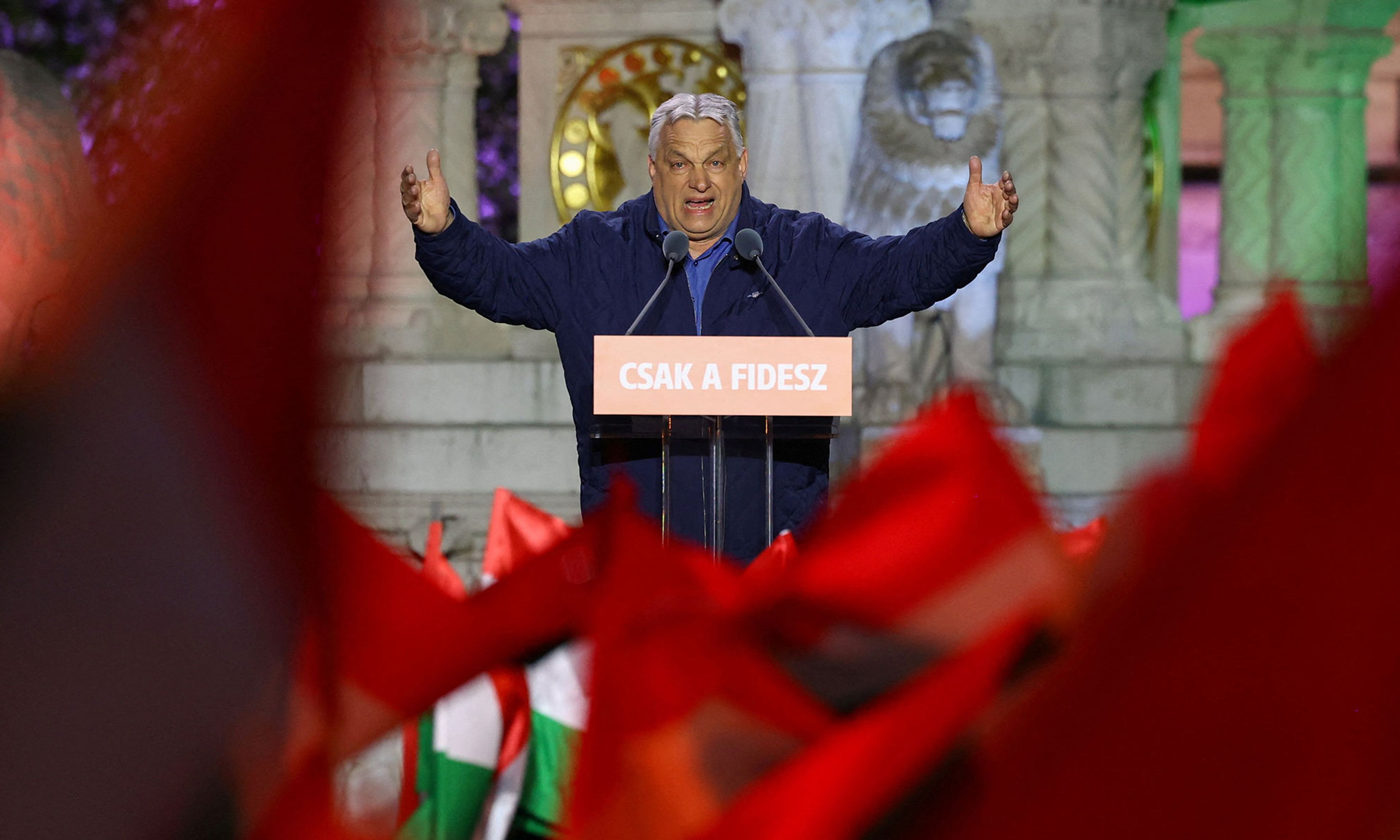
Hungarian Prime Minister Viktor Orbán speaks during the closing rally of his electoral campaign, ahead of the Parliamentary election in Budapest, Hungary, April 11, 2026.
Eger, Hungary — With voters scheduled to cast ballots in just twelve hours, Hungarian Prime Minister Viktor Orbán held his final election rally at Buda Castle on Saturday night.
The themes of his speech were familiar. He claimed the election was a choice between peace and war, with Peter Magyar’s opposition Tisza Party trying to drag Hungary into the war in Ukraine at the behest of European Union forces in Brussels. The EU was also using migration policies to undermine Hungary’s sovereignty and dilute its national character. His opponents had waged a campaign of “anger, hatred, destruction” against his ruling Fidesz party.
The problem for Orbán is that his closing messages contrast with what Hungarians tell pollsters are their top concerns.
Polls show voters are focused on Hungary’s economy, which has been stagnant since the 2022 election. The Orbán-friendly Heritage Foundation reports that the average growth rate over the last three years has been 0.1 percent.
Since late 2019, inflation has gone up more than 57 percent, more than double U.S. inflation. All three major bond rating agencies — Moody’s, S&P, and Fitch Ratings — project a negative outlook for the Hungarian economy.
Internal polls for both sides confirm the economy is uppermost in voters' minds. A public poll released this week by the European Council on Foreign Relations confirms this. When asked what they thought was the most important issue facing Hungary, the sample of 1,001 adults reported:
The cost of living and inflation: 20 percentage points
Corruption and governance: 17 percentage ponts
Quality of public services such as healthcare and education: 16 percent
Economic growth and jobs: 9 percent
Energy security: 9 percent
Relations with the EU and security and defense were tied as the most important issue at 6 percent, with migration and border control at 5 percent.
The mismatch may prove fatal to Orbán’s chances of winning a fifth consecutive term. Polls show him trailing Magyar despite districts that are gerrymandered and whose population size gives rural areas more clout.
Ironically, Orbán ally Donald Trump seems to be more aware than his friend of the importance of the economy.
View this post on X
The problem is that Orbán’s leadership on economic issues has changed. In 1993, when he was first elected president of Fidesz, he proclaimed his commitment to free markets and the Rule of Law. He largely followed that course during his first term as prime minister from 1998 to 2002.
When he returned as prime minister in 2010, he made further reforms. The income tax, which had a top rate of 36 percent, was replaced with a flat tax, which now stands at 15 percent. The corporate tax rate was set at 9 percent, the lowest in the EU. Foreign investment poured in.
But Orbán’s restless mind became frustrated by what he termed conventional approaches. He told advisers: “I don’t like economists, because they always tell me what I shouldn’t do. I was elected to do things.”
What Orbán increasingly settled on was a series of jury-rigged policies that would have probably won approval from Franklin Roosevelt, who most economists now say prolonged the Great Depression with his endless tinkering and interference in the economy.
Orbán imposed extraordinary taxes on such sectors of the economy as banks, energy, and telecommunications.
Hungary had become the first postcommunist country in Europe to allow workers to invest a share of their salaries in private accounts. But by 2014, Orbán had nationalized those private pensions, effectively depriving almost 3 million Hungarians of their personal savings without compensation. The move mirrored a similar asset grab made by Peronist leader Cristina Kirchner in Argentina six years earlier.
By the mid-2010s, Orbán was publicly boasting he had discovered the need for an “unorthodox economic policy.” He proclaimed that “for rebuilding the economy it is not theories that are needed but rather thirty robust lads who start working to implement what we all know needs to be done.”
Once Orbán embraced both “illiberal democracy” and “unorthodox” economics, there was no stopping him.
The government took control of between 300 and 400 companies in areas ranging from energy to broadcasting to garbage collection, and even restaurants.
Then in 2021, Orbán convinced himself that Hungary’s high-tech future depended on his government making huge investments in Chinese and South Korean lithium battery and electric car plants. This industrial policy has since crashed and left a trail of toxic waste problems behind.
Facing slumping poll numbers leading into this election, Orbán went into overdrive in giving handouts to sections of the electorate. There was an 11 percent increase in the minimum wage, an extra annual month of pension benefits, expanded tax exemptions for mothers, increases in teacher salaries, and price caps on a range of products. Gasoline prices were capped along with those of basic food items. But retailers rebelled and often compensated for their losses from the caps by raising the prices of other products. Economists predicted this grab bag of measures would increase inflation, but their thinking was dismissed as “orthodox.”
Orbánomics is responsible for Hungary taking a reputational hit in rankings compiled by some of its closest allies. This year, the Heritage Foundation ranked Hungary’s economy as the 79th freest in the world, 39th out of 44 countries in the Europe region. Heritage ranked the country’s government integrity score — which measures perceptions of corruption and the danger of “capture” of the state by elites and private interests — at 44 out of 100. In 2009, the last full year before Orbán returned to power as prime minister, Hungary’s score in the Heritage Index was 53 out of 100.
Many Orbán allies in America make the argument that Orbán has experienced an unprecedented campaign of vilification by elite institutions such as the EU, the European media, and left-leaning NGOs.
True enough. But as Joseph C. Sternberg, a columnist for the Wall Street Journal’s editorial page, points out: “No amount of media rigging or anti-Soros inveighing alters the reality that Hungarians have grown exasperated with economic underperformance and exhausted with such a long-tenured prime minister.”
For many years, Viktor Orbán had his finger on the pulse of the many Hungarians who feel aggrieved by their neighbors and pushed around by countries that won’t abide Hungary's social conservatism.
But in the last few years, he lost the plot and forgot that they also wonder about what kind of economic future they and their children will have. Janos Nogylaki, a 64-year-old car mechanic from the wine-growing region of Eger, told me he and his wife are thinking about moving to Austria. “For me, change is more urgent than stability,” he told me. “Change will not come unless we insist on it.”
Prime Minister Orbán disagrees: “Change is dangerous,” he warned at his last rally. We’ll see on Sunday which message resonates more with voters.

About the Author
John Fund is National Review’s national-affairs reporter.
Featured Tags
Advertisement
Advertisement

Comments