Lessons from <i>Excalibur</i>
Written by Armond White
John Boorman’s restored masterpiece salvages the era of bad movies.
Share this story
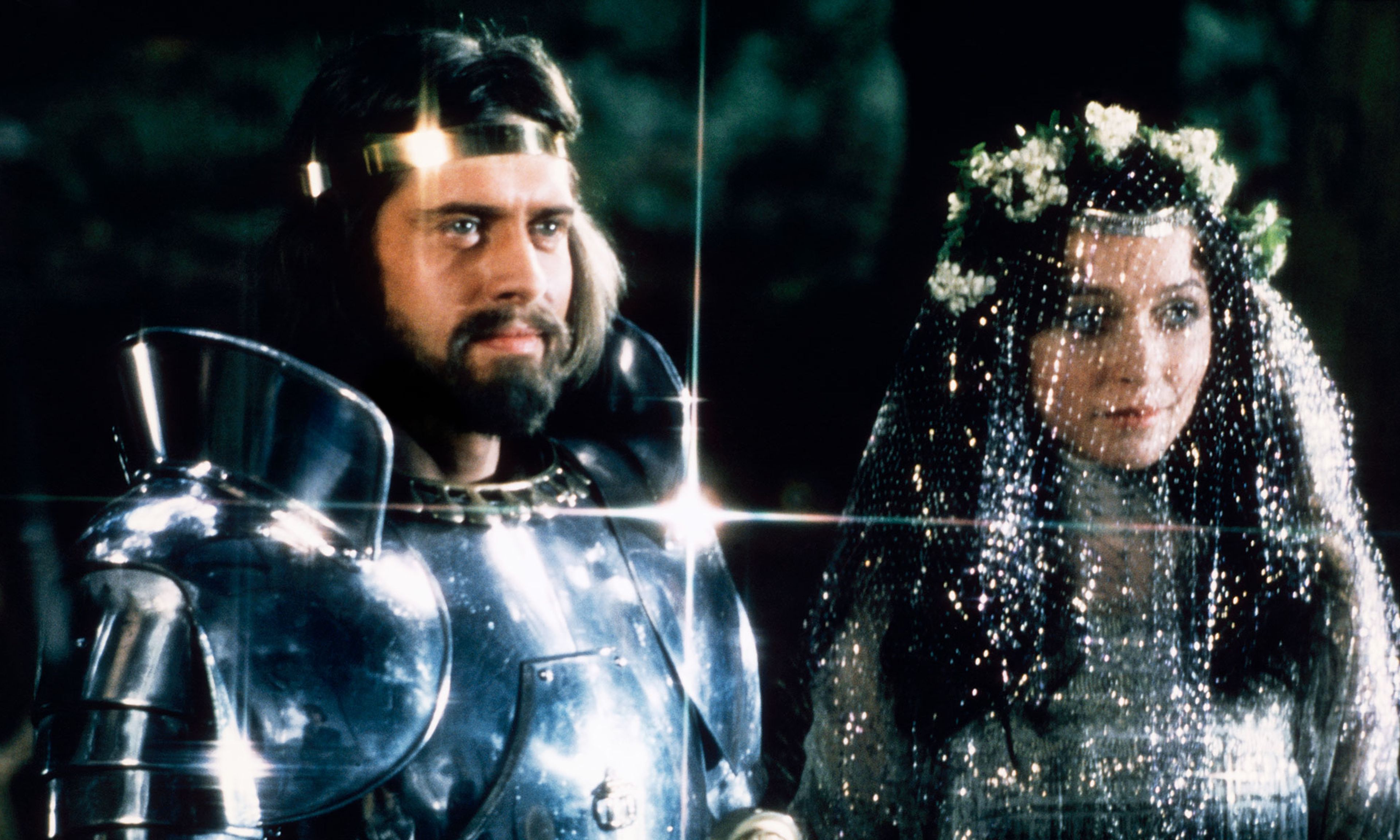
Nigel Terry and Cherie Lunghi as King Arthur and Queen Guenevere in <i>Excalibur</i>
King Arthur in Excalibur asks, “What is the greatest quality of knighthood? Courage? Passion? Loyalty? Humility?” And his mentor Merlin answers, “Truth. That’s it. It must be truth above all. When a man lies, he murders some part of the world.”
In that scene, Excalibur answers the riddle of these times when truth and the quality of character are fungible. But the exchange between leader and teacher only hints at the visual and philosophical splendor that make director John Boorman’s Excalibur so great.
The inspiration Boorman took from the Arthurian legends (which undergird the moral lessons of all his films from Point Blank, Deliverance, and Hope and Glory, to Where the Heart Is, The Tiger’s Tale, Queen and Country, and the rest) feels freshly relevant in Excalibur’s new 4K and Blu-ray restoration from Arrow Films.
Now is the perfect time to recall the Arthurian example of law, chivalry, and brotherhood. Boorman transformed the medieval historical legend into a big-screen dream, a smooth-moving epic that compresses the Dark Ages of Arthur’s prehistory as foretold by the sorcerer Merlin; Arthur’s ascension as Britain’s king ruling over Camelot with the power of the sword Excalibur; Camelot’s fall from grace via Queen Guinevere’s adultery with the knight Sir Lancelot; then Arthur’s search for the Holy Grail and the promise of Arthur’s return. It’s a cinematic quest for spiritual truth.
Seeing Excalibur again -- witnessing Boorman’s modernist, erotic, quasi-Christian vision -- revives ideals we’ve lost about cinema and film culture. It was the best film of 1981 and easily outclasses last year’s paltry propaganda movies currently being celebrated.
Like all great films, Excalibur is an oddity. While departing from regular genre and commercial formats, it was popular because of a swift narrative that was violent and sexy enough to stir fascination with its characters’ instinctual behavior — the appeal of all classic drama. Neil Jordan, Boorman’s creative consultant, explains in an interview included among the Arrow bonuses: “I think John would agree that the great thing about fairy tales is that they strike very deep, yeah. And they come from an unknowable place that you absolutely recognize.” Excalibur has an abundance of images that capture the imagination at the same time that Boorman evokes human history. Jordan elaborates: “There are these images that are recognizable, so profound in a way, with the deeper world beyond rationality, the kind of Freudian analyses of why we are what we are.”
Excalibur revived an interest in mythology that was latent in the success of Star Wars. George Lucas publicized his affinity with anthropologist Joseph Campbell while Boorman explored his own interest in psychologist Carl Jung and Irish ethnography, which turned out to be more esoteric than Hollywood commercial practice.
So it was a delightful shock when Zack Snyder paid tribute to Excalibur in Batman v Superman: Dawn of Justice. But it’s no surprise that Snyder has borne the brunt of naysayers who defend Marvel Cinematic Universe banality; they reject mythology and its significance. Snyder proves to be the Millennial filmmaker most influenced by Boorman’s mastery of form and personal expression.
Boorman’s exploration of mythology gives Excalibur richness. Each evocative scene, linked by editing dissolves that keep moving us forward and deeper, makes it unlike any other feature film. Scenes of pagan superstition flow from Druid edifices to Shroud of Turin symbolism. Lustful motivations hidden behind metal armor give way to Nicholas Clay embodying the erotic and spiritual turmoil of Lancelot. These figures contrast with Percival (Paul Geoffrey) searching for the Grail to restore the faith of the demoralized King Arthur (Nigel Terry). All of this is roused by Boorman’s choice of culturally linked music: Carl Orff’s magnificent “O Fortuna” from Carmina Burana and Wagner’s Die Götterdämmerung and Siegfried’s Funeral March. Blending Celtic and Germanic motifs is ideal.
Throughout Excalibur, Merlin (Nicol Williamson) and Morgana (Helen Mirren) engage in otherworldly competition that, though unfortunately not au courant, is literally timeless. Boorman achieves in one film the good-versus-evil power struggle that his disciple Zack Snyder, following a brief, befuddled political foray, can only attempt to duplicate in endless, confused revisions.
Boorman understood that we explain the world to ourselves through mythology. That sophistication radiates from every frame of Excalibur, including in the astonishing sight of Arthur’s being borne to Avalon. It affects sentient viewers on more than one level. At its simplest, it conveys Boorman’s belief that “in filmmaking we’re converting money into light, and everybody finally hopes you can convert it back into money again, at a certain point.” In this strained era when superficial ideologies have replaced Hollywood aesthetics and lies murder some part of the world on a daily basis, Excalibur offers a lesson that is also an epiphany.
https://www.youtube.com/watch?v=knJQxaO5Bt4
About the Author
Armond White is National Review’s culture critic and the author of New Position: The Prince Chronicles and Make Spielberg Great Again: The Steven Spielberg Chronicles.
Featured Tags
Advertisement
Advertisement




Comments