Share this story
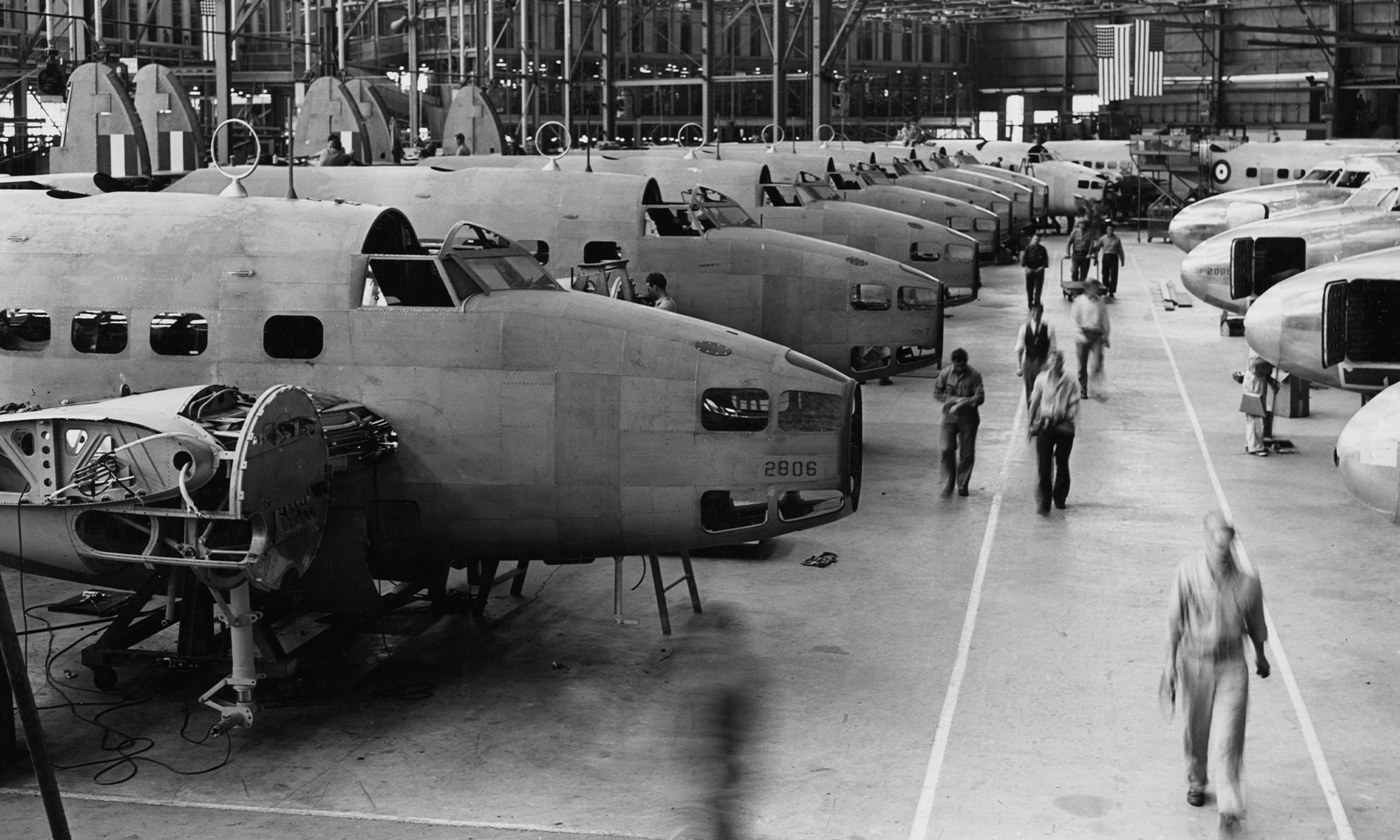
A row of Lockheed Hudson light bomber aircraft under construction at the Lockheed Vega production facility in Burbank, Calif., c. 1942.
Dave Hyatt had a classic mid-century Southern California childhood. Not in the Beach Boys sense of long days in the sand, though there were plenty of those. Rather, in that it mapped onto the region’s social and economic contours: booming, patriotic, sun-drenched suburbs spread out against a backdrop of flourishing industry.
Dave grew up in Los Angeles’s San Fernando Valley. His dad, Darwin, engineered aircraft for Lockheed in nearby Burbank and even logged time in the vaunted Skunk Works division that would develop the legendary SR-71 Blackbird. Hyatt the younger graduated in 1964 from Polytechnic High School, just off the Hollywood Freeway, and would go on to Cal Poly Pomona at L.A. County’s eastern edge. Following the family path, he went into the aerospace industry, starting at McDonnell Douglas right out of college.
In a career that would span more than four decades, Dave worked on some of the most iconic projects of the Cold War and post–Cold War eras. In the 1970s, he was based at McDonnell Douglas’s Santa Monica site working on the Spartan antiballistic missile. He then moved to TRW, a satellite maker, a bit south in Redondo Beach. He later returned to McDonnell Douglas at the company’s Huntington Beach space-systems facility, where it made the Delta II rockets that would launch the original GPS satellites. Dave’s career culminated in the 2000s, following McDonnell Douglas’s merger with Boeing, when he was a program manager handling components of the Cassini spacecraft that would fly to Saturn.
In the middle and later decades of the 20th century, a path like Dave Hyatt’s was common. Aerospace and the defense-manufacturing industry were economic pillars and employed Californians en masse. Lockheed had more than 90,000 workers in Burbank at its World War II peak. Douglas had more than 150,000 and during the Cold War still employed more than 50,000 Californians. In Huntington Beach, McDonnell Douglas’s presence was so deep that it had its own rec center and softball league, which Dave helped organize. Lockheed and McDonnell Douglas were part of what we would now call a tech cluster, an interlocking constellation that included such other firms as Northrop, North American, and, of course, the legendary Hughes Aircraft Company. The region not only supplied much of the country’s aerospace brawn, it also generated cutting-edge aerospace research at Caltech and NASA’s Jet Propulsion Lab in Pasadena and drew up war plans at the Santa Monica–based RAND Corporation. In historian Peter Westwick’s words, it was “the aerospace capital of the world” -- and it was one that met the geopolitical demands of its time.
But the SoCal of Dave Hyatt’s childhood and working prime is long gone. In the mid-1980s, more than 300,000 Californians worked in the aerospace industry, about one-third of the industry’s national workforce. In the 1990s, the state lost more than 165,000 such jobs, according to research by California economic historian Rosa M. Moller. By 1999, California employment in the aerospace industry was less than half of what it was in 1986. By the turn of the millennium, Californians held only about one-fifth of national aerospace jobs. In the subsequent decade, the state would lose more than 30,000 more.
Where once aerospace manufacturing employment lifted workers to the middle class and abundant suburban housing met the needs of their growing families, a two-tier economy has now emerged. Orange County, which includes Huntington Beach, may offer the clearest example in the country of an uneasy cohabitation between a professional class and the millions of service workers who supply it with comforts. Along the same stretch of Bolsa Chica Road where McDonnell Douglas welders and technicians once built rockets, Amazon workers now sort packages for same-day delivery. The kind of life that aerospace manufacturing supported for decades is now rare in a county where the median sale price of a single-family home is $1.2 million. Not by coincidence, L.A. County and Orange County are both hemorrhaging their native-born populations. The families that once made up SoCal’s mid-skill, middle-class, Republican backbone now think they’ll have a better shot in the the suburbs of Phoenix, Las Vegas, and Dallas.
In a great historic irony, the evaporation of aerospace employment in Southern California can in large part be attributed to the geopolitical triumph of its conservative hero, Ronald Reagan. With the disintegration of the Soviet Union came adjustments to America’s defense procurement and its wider strategic posture. Mass production of planes and projectiles went into the dustbin.
But the still-crucial production of matériel that does occur nationally happens mostly elsewhere -- and California’s own politics are to blame. To structural shifts in national defense, the state government added punitive kicks of its own.
The state’s environmental policies have delivered the harshest of them. Designed in theory to account for environmental damage, the California Air Resources Board (CARB) and the California Environmental Quality Act (CEQA) hamper all heavy industry in the state, including SoCal’s aerospace golden goose. CARB has banned or restricted key chemicals in aerospace production, such as methyl ethyl ketone, which cleans precision components, and hexavalent chromium, which protects aircraft from corrosion. CEQA forces aerospace manufacturers to undergo yearslong environmental impact assessments before expanding production facilities or building anything new. And it opens veto points for degrowth activists that add yet more time to any new work.
The result is that new aerospace production has been sited increasingly in places like Texas, Georgia, and Alabama. According to PwC’s 2024 Aerospace Manufacturing Attractiveness Rankings, California no longer ranks even in the top ten nationally. Aerospace companies, like the people who in an earlier era might have worked for them, are today seeking greener pastures.
California’s aerospace decline -- and its wider spurning of manufacturing -- is most acutely visible in Burbank. For decades, Lockheed anchored the L.A. suburb’s economy. It churned out P-38s to beat the Japanese in World War II, then produced the world’s most advanced surveillance aircraft to gather intel on the Soviets in the years that followed. Post–Cold War Pentagon cuts dealt Lockheed’s Burbank facility a bad hand before California’s own environmental regime and the litigation it invites proved the final straw. Lockheed left Burbank in the 1990s. The site that was more pivotal than perhaps any other in providing America with air superiority across the 20th century is now a shopping mall and Hollywood back lot.
It would be erroneous, however, to suggest that the aerospace industry has fled the Golden State entirely. The two most ascendant aerospace companies of the 21st century -- Elon Musk’s SpaceX and Palmer Luckey’s Anduril -- are based in Hawthorne and Costa Mesa. Together, they are outcompeting the legacy defense primes, pushing the technological envelope, and redefining what it means to operate in the aerospace and defense market. Their rockets, drones, artificial intelligence applications, and autonomous systems constitute warfare’s cutting edge. Along with smaller firms like Astrolab and the cluster of entrepreneurs based in El Segundo, SpaceX and Anduril are building on the foundation of excellence laid down a century ago by Howard Hughes, Donald Douglas, and the Loughead brothers. The difference today is that Musk and Luckey are primarily conducting design work, not making hardware, in California. SpaceX built Starbase in Texas. Anduril chose Ohio for Arsenal-1.
Though disaggregation of design and manufacturing is a hallmark of modern commerce, caused mostly by the greater specialization needs of complicated production, California’s policies have distorted the process. As Jarrett Catlin, a former RAND researcher who runs the California Future Society podcast and newsletter, describes it to me, “For 30 years, California has forsaken our manufacturing legacy as we profited from a software-fueled gold rush.”
In so doing, it has created a national liability. If the Russia-Ukraine war has taught us anything, it is that design-production feedback loops are more crucial than ever. Ukraine has remained afloat because of its defense industry’s flexibility, rapid prototyping, and fast production. California’s abrogation of its national aerospace manufacturing role weakens American power. With Russia and China -- the latter the ultimate geopolitical competitor -- thrusting America and its allies into a new era of threats, the country needs a tech cluster that can quickly iterate.
Long though the odds may seem for Southern California to reunite aerospace design with aerospace production, recent political developments within the state suggest there may be hope yet.
Just this summer, another long-shot policy dream became reality. California Governor Gavin Newsom signed legislation exempting certain forms of housing construction and other projects from the same onerous CEQA rules that have squeezed aerospace. Assembly Bill 130 allows for new housing on previously used land (in-fill) to be built without CEQA rigmarole. The less heralded Senate Bill 131 may open a lane for aerospace manufacturing.
SB 131 grants CEQA exemptions to projects that the state deems of special interest, including -- promisingly -- “advanced manufacturing.” While that designation, codified in California statute 26003, names nanotechnology, biotechnology, and advanced materials, its spirit lends itself naturally to aerospace, too. Newsom should capitalize. Though the governor cannot unilaterally exempt aerospace from CEQA under SB 131, he can order a more favorable interpretation of the code, direct the Office of Land Use and Climate Innovation to coordinate among state agencies and prioritize advanced manufacturing in aerospace, and raise the stature of the Governor’s Military Council, which has the explicit mission of boosting California’s national defense role and the companies that support it. Newsom can also use his clout to formalize aerospace’s advanced manufacturing recognition.
Newsom’s appetite for policy change suggests he may be willing to do so. Flawed though he is, the governor has forcefully argued that California’s degrowth model is harming the state. “We’ve got to get out of our own damned way,” he has said of CEQA. Another of Newsom’s appetites -- for the American presidency -- could be the key to convincing him of the importance of an aerospace-inclusive “advanced manufacturing” interpretation. His White House ambitions all but declared, Newsom has cast himself as a moderate willing to jettison left-wing pablum. He has backed up canny PR moves, like debating Florida Governor Ron DeSantis, with substantive defections from his political coalition, such as vetoing a Teamsters-backed bill to ban autonomous trucks.
Invoking his state’s proud aerospace history to bolster America’s defense capacity would further the national interest and do more to improve his national reputation than would any debate or podcast. Newsom, who is fond of distinguishing California as a “nation-state,” should instead consider emphasizing California’s enduring centrality to the American project. A revival of aerospace manufacturing, moreover, would help restore California’s social contract by creating jobs for workers caught between the state’s two economic tiers.
For more than a century, Southern California has been the aerospace industry’s cerebral cortex. For half of one, it was also the industry’s muscle. It was the building ground for much of America’s hard power and for a patriotic middle-class life for families like the Hyatts. By using the legislative momentum behind environmental reform to rejuvenate aerospace and defense manufacturing, and luring the industry back home, California can again form the kind of industrial cluster that warfare demands. The old Southern California -- Dave Hyatt’s -- was a showcase of patriotism and production, of thriving family life and upward mobility in America’s Eden. With the country facing new and profound geopolitical perils, it is time for California to reclaim its historic aerospace mantle.

About the Author
Jordan McGillis is a fellow at the Economic Innovation Group and a 2025-2026 Novak Journalism Fellow with the Fund for American Studies.
Featured Tags
Advertisement
Advertisement



Comments