Mark Carney’s Failing Grade
Written by Matthew Lau
Somehow, the Canadian PM has managed to blow past even Trudeau’s last spending estimate.
Share this story
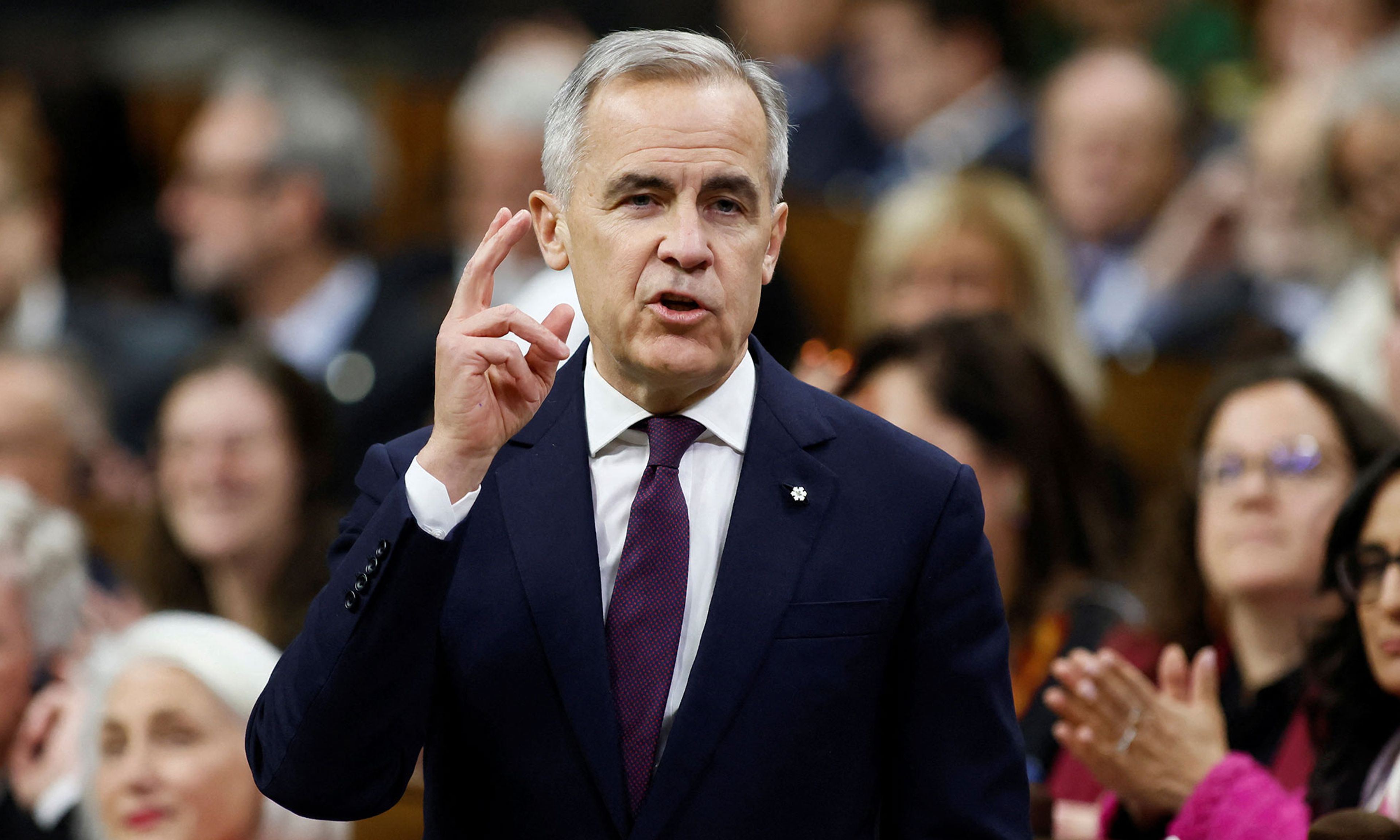
Canada's Prime Minister Mark Carney speaks during Question Period in the House of Commons on Parliament Hill in Ottawa, Ontario, Canada, November 17, 2025.
Canadian Prime Minister Mark Carney recently presented his first budget. It follows nearly a decade of ruinous economic policy under Justin Trudeau, which resulted in Canada suffering by far the worst real GDP per capita change of any country in the G7 from 2015 to 2025 and a collapse in business investment so that in the second quarter of this year, machinery and equipment investment per worker in Canada was less than one-third of what it was in the United States.
Given the failures of the Trudeau decade, Carney signaled ahead of his budget that he was prepared to do some things differently. Unfortunately, not all of his changes were positive.
Let us begin, however, with the ones that were. Carney’s budget increased defense spending as expected, to the tune of $81.8 billion over five years. It also proposed to modestly reduce employment in federal departments and agencies by 28,000 over the next few years, an 8 percent reduction, following a decade in which Trudeau grew the federal public service at approximately triple the rate of population growth. And finally, a Trudeau-era luxury tax on certain aircraft and boats, which had no purpose except to increase political support from the “eat-the-rich” crowd, will be scrapped.
Unfortunately, that is just about all the good news, which is not nearly enough.
The number that best tells the story of government finances is total spending. “Keep your eye on one thing, and one thing only,” as Milton Friedman wisely counseled, “how much government is spending, because that’s the true tax. . . . If you’re not paying for it in the form of explicit taxes, you’re paying for it indirectly in the form of inflation or in the form of borrowing.”
How does Carney’s total spending plan differ from Trudeau’s? The earliest budget that projected as far out as the 2025–26 was Trudeau’s 2021 budget. That budget called for $468.4 billion in total spending in 2025–26. Fast forward to the 2024 Fall Economic Statement, Trudeau’s final fiscal document, published less than a year ago. According to that projection, there would be $558.3 billion in total federal spending in 2025–26 — an astonishing jump of $90 billion, or more than 19 percent, versus the projection for 2025-26 just a few years earlier.
Somehow, Carney has managed to blow past even Trudeau’s last spending estimate by proposing $585.9 billion in federal spending in 2025-26. The expected deficit is $78.3 billion, nearly twice what was anticipated for 2025-26 in the 2024 Fall Economic Statement. And while the government previously said the federal debt-to-GDP ratio would go down, Carney’s budget now shows it increasing in this fiscal year as well as the next two.
“Notwithstanding pre-release talk of restraint and even austerity,” summarized Bill Robson, president and CEO of the C.D. Howe Institute, “comparing the budget’s projections for 2025–26 and beyond with its earlier budgets and fall statements reveals that the spending projections have risen yet again. Nothing has changed.” Moreover, given the government’s tendency to drastically understate its spending ambitions, some of the budget’s suggested savings — such as the modest reduction in the number of federal public servants — may never come to pass.
“If the spending projections are not serious,” Robson concluded, “the fiscal plan is not serious. . . . We have no more reason to believe the federal government’s latest plan than we had to believe the earlier ones. The government’s fiscal credibility crisis continues.”
The higher spending in Carney’s budget includes increased taxpayer handouts to the agricultural and forestry sectors, a biofuels production incentive, a $5 billion “Strategic Response Fund” to be disbursed to various industries and companies, and many billions more in other industrial policy initiatives. There is also a Soviet-style “Build Canada Homes” initiative costing more than $13 billion in the next five years, $150 million more for the Canadian Broadcasting Corporation, and even $100 million for the FIFA Men’s World Cup. Health care, arts and culture, youth employment, and the Department for Women and Gender Equality — they are all promised more money in Carney’s budget.
On energy and the environment, Carney proposes to continue picking winners and losers, and his budget, as Fraser Institute researchers Kenneth P. Green and Elmira Aliakbari write, “includes major new spending initiatives to promote a so-called ‘green economy’” while maintaining most of the Trudeau-era regulatory constraints on fossil fuels. Notably, the budget ponders an increased carbon tax on industrial emitters, and while Carney has paused Trudeau’s coming electric-vehicle mandate in the face of massive headwinds to Canada’s automobile sector, the Liberals appear to remain committed to it. Ahead of the budget release, Liberal Members of Parliament on the House of Commons Industry Committee voted against a Conservative motion calling for the government to repeal the mandate.
All told, Carney’s budget gets a failing grade and does nothing to reverse Canada’s worst-in-class economic performance over the past ten years or the country’s declining business investment. It is not exactly identical to a Trudeau budget, but with respect to spending levels, the credibility of fiscal projections, and major regulatory initiatives, there is no significant improvement.
About the Author
Matthew Lau is a writer in Toronto.
Featured Tags
Advertisement
Advertisement

Comments