Michigan Previews Joe Biden’s Corporate Welfare Jobs Bust
Written by James M. Hohman
Biden’s legacy on job creation is nothing more than smoke and mirrors. Michigan has already seen the proof.
Share this story
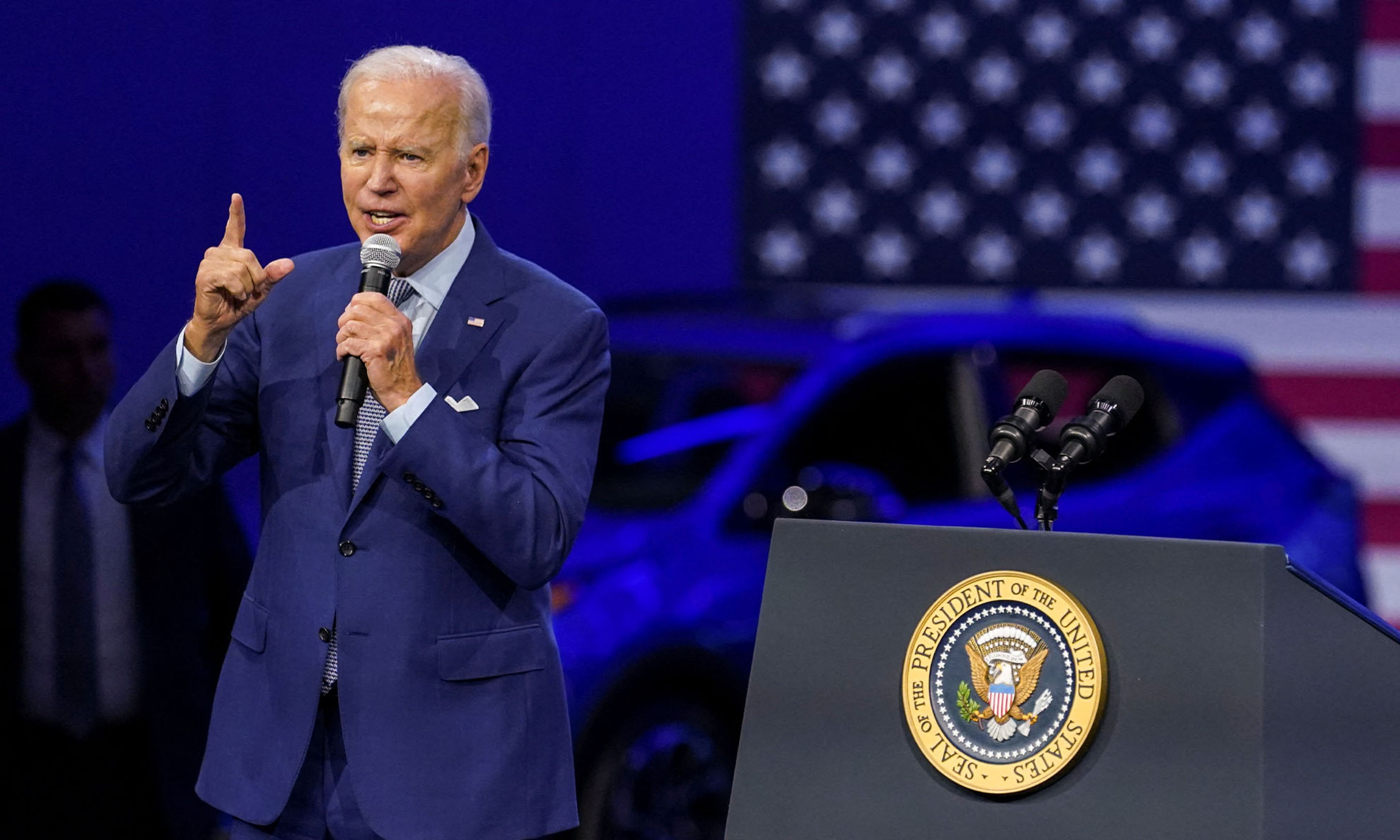
President Joe Biden delivers remarks to highlight electric vehicle manufacturing in America, during a visit to the Detroit Auto Show in Detroit, Mich., September 14, 2022.
Joe Biden has staked a big part of his legacy on jobs created by corporate welfare. Through the CHIPS Act alone, he’s doled out well over $30 billion in taxpayer funding, mostly to semiconductor companies, with billions more on the way. Each announcement has been paired with flashy headlines about the numbers of expected jobs -- i.e., more than 115,000 from 16 semiconductor factories alone. Other Biden policies, like the Inflation Reduction Act, devote hundreds of billions of dollars to various industries, usually with the promise of a new jobs boom.
Spoiler alert: Almost none of the jobs will materialize. But creating jobs likely isn’t the point of such massive handouts to private companies. Subsidies make politicians look good, thanks to glowing media coverage when they give public money away. But the public rarely follows the money’s utter failure to achieve the lofty promises announced at launch. In other words, Joe Biden’s legacy on job creation is nothing more than smoke and mirrors.
It will be years before the failure of Biden’s corporate welfare bonanza is fully documented, but to see how it will likely pan out, consider the experience in my home state of Michigan. I’ve analyzed 20 years of media coverage of jobs announcements tied to state taxpayer giveaways. Between 2000 and 2020, Michigan’s largest newspaper -- the Detroit Free Press -- ran dozens of front-page stories touting the economic impact of major taxpayer-funded projects. Countless people read them, while many more encountered the slew of stories in television, radio, and online outlets that usually followed.
All told, the most widely read and respected outlet in the state declared that this corporate welfare would create more than 123,000 new jobs. It was fake news. According to the state’s own reports, those same projects ultimately created a mere 10,889 jobs. That’s a success rate of barely 9 percent.
The list of failures is a stark contrast from the front-page promises of economic success. The first big announcement in the 21st century was Webvan, a now-defunct online grocer that promised to create 900 jobs, at a cost of $23.4 million in tax credits from taxpayers. Zero jobs were created; the promised facility never opened.
The same story played out time and again. In 2009, IBM announced 1,500 jobs in exchange for a grant, yet nothing happened. In 2008, at the height of the Great Recession, the Free Press declared that the “state reels in new jobs” -- 4,800 in total -- via 13 taxpayer-funded deals that were a major political priority for then-governor Jennifer Granholm. Only 112 jobs materialized.
Nor have recent announcements been more effective. In 2017, Penske promised a 403-job logistics center as part of a $2.5 million deal, but the center closed after losing its contract. Waymo, the self-driving car company, pledged up to 400 jobs in 2019 for a Detroit facility that received an $8 million deal. It couldn’t deliver half that number. Of all the front-page stories I analyzed, only Amazon consistently created the jobs it promised when receiving taxpayer support. But Amazon built even more distribution centers in Michigan without asking for taxpayer money.
The failure of these front-page examples is hardly unique. Studies routinely show that corporate welfare is ineffective at creating jobs, yet very effective at wasting taxpayer dollars. The reason is simple: Politicians are neither fortune tellers nor economic savants. They’re handing out money to companies that ask for it. They stack the deck in their own favor by trumpeting job promises when they are giving out public money but remaining silent when their deals fall apart. In other words, their attempts to pick winners and losers are designed so that politicians always win.
Many of the stories about Michigan subsidies feature pictures of governors and state lawmakers, often standing with the corporate recipients of taxpayer largesse. The politicians look as though they’re supporting a new era of what are invariably called “good-paying jobs.” They aren’t, but by the time that’s clear, they’ve reaped their reward, with glowing media coverage that strengthens their reputations and maybe even delivers votes.
Joe Biden is a case in point. As he prepares to leave office, he’s already being feted for the jobs he created via corporate welfare, despite the utter lack of evidence proving it worked. In some cases, it clearly didn’t -- see semiconductor maker Intel, which is slashing 15,000 jobs despite receiving nearly $8 billion under the CHIPS Act. Joe Biden should really be remembered as a president who wasted more money on corporate welfare than any of his predecessors -- and, one hopes, his successors.
About the Author
James M. Hohman is the director of fiscal policy at the Mackinac Center for Public Policy.
Featured Tags
Advertisement
Advertisement




Comments