Mr. Conservative and the Minister
Written by Shiv Parihar
One Man’s Freedom: Goldwater, King, and the Struggle over an American Ideal, by Nicholas Buccola (Princeton University Press, 464 pp., $35.00)
Share this story
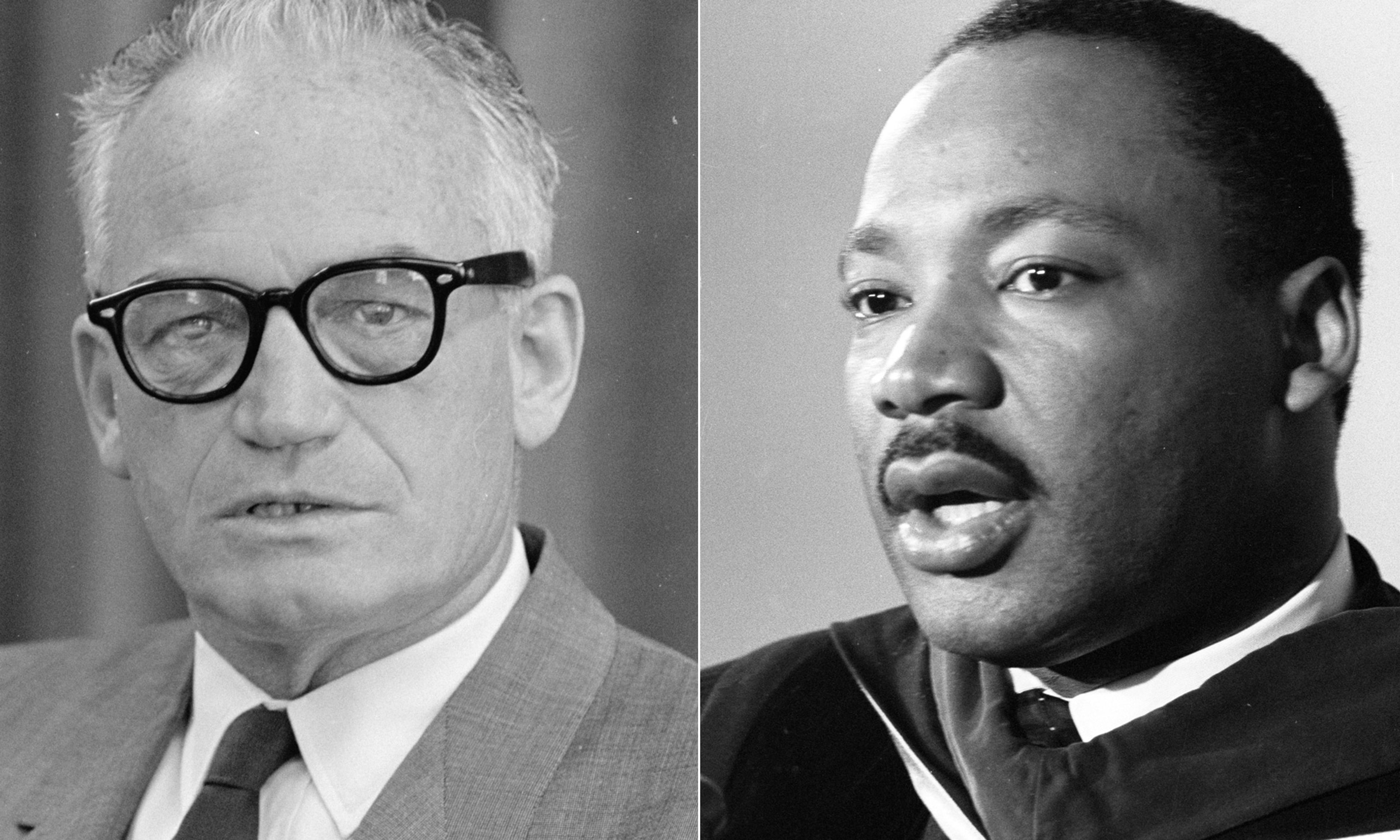
Left: Senator Barry Goldwater in an interview in 1962. Right: Martin Luther King Jr., at a press conference in 1965.
The political stage of the 1960s was set by Martin Luther King Jr.’s "Letter from Birmingham Jail" and Barry Goldwater’s acceptance of the Republican nomination for president. Both embraced the title of extremist for themselves. In Goldwater’s case, the label had been applied by Harry V. Jaffa, a professor of government at Claremont McKenna College. Sixty years later, Nicholas Buccola, also a government professor at Claremont, has delivered One Man’s Freedom: Goldwater, King, and the Struggle over an American Ideal, covering the lives of King and Goldwater in the crucial years between 1955 and 1965. The book is a sequel to Buccola’s 2019 The Fire Is Upon Us, a similar tale of parallel lives chronicling legendary National Review founder William F. Buckley Jr. and the activist and author James Baldwin.
One Man’s Freedom ostensibly poses a larger challenge. Unlike Baldwin and Buckley, King and Goldwater never met. Yet this pairing works just as well. Buccola presents speeches of King’s and Goldwater’s in tandem with analyses of the deeper political philosophy he finds in each. His vivid writing brings the era to life. Moreover, Buccola’s willingness to use the black press as a source yields interesting observations not seen in the many mainstream media tellings of these men’s lives and separates the book from the pack.
Buccola shines a light on the influence of Reinhold Niebuhr and the Christian neo-orthodox movement on King's political thought, including his rejection of communism. This casting of King has a conservative shine to it. By contrast, Goldwater’s admiration for Ayn Rand, whose work he described as “a new conservative horizon,” was not in keeping with the views of early conservatives such as Brent Bozell and Buckley, who saw Rand’s amoral objectivism as antithetical to genuine conservatism.
Goldwater is “ever the preacher,” says Buccola, but his career shows a more complicated reality. Goldwater had already arranged a clandestine abortion for his daughter in 1955, and his wife had helped lead Arizona Planned Parenthood since 1937. His reluctance to embrace federal civil rights legislation may say less about what conservatism is than about what it is not; it would not be fair to extrapolate too widely from his opposition. As an admirer of Ayn Rand, Goldwater saw the world as broadly amoral. His civil rights views might be best understood as social libertarianism rather than conservatism. Buccola expertly narrates an otherwise forgotten face-off between Goldwater and black Republican delegate George A. Parker at the 1964 Republican National Convention, where Parker castigated Goldwater not for being too conservative but for defying the conservative civil rights leadership of Republican Senate Leader Everett Dirksen. As Buccola notes, some of Goldwater's delegates at the RNC shouted slurs at black reporters. Conservatives should heed this history, but they must do so within its proper context. Displays of racism were ignorant and abhorrent, but they weren’t representative of American conservatism more broadly.
Buccola argues that “Goldwater matters as an individual, but he matters far more as a symbol.” The "critical contradictions in Goldwater’s racial politics might help us understand something deeper not only about the American Right but about American history.” To establish this, Buccola notes that King saw Goldwater as more dangerous than avowed racists such as George Wallace and Strom Thurmond; in fact, he described Goldwater as “the most dangerous man in America.” Buccola concludes, to King’s credit, that conservatives were “right to be fearful of the minister’s politics” as it “sought to overturn many forms of privilege they held dear.”
Buccola concludes the book by excoriating the conservatives of today who lay claim to King’s legacy without endorsing his vision of “social democracy or radical liberalism.” While some conservatives today claim King as one of their own, Buccola writes, “nothing could be further from the truth.”
Here, Buccola fundamentally misunderstands the nature of the claim conservatives make on the legacy of King. It is a narrow claim to his civil rights legacy and his morality, not that King would have voted Republican had he not been murdered. Nor does praise for King entail the endorsement of every facet of his economic agenda.
Buccola misses the potential for peril in his own mission. Building a wall between conservatism and King’s legacy will not drive conservatives away from conservatism, but it may drive some on the noxious wing of the right away from King. Principled conservatives must make the case for the compatibility of American conservatism and King's work, contra the far right and far left. Conservatism has preserved both Goldwater’s individualist strength and King’s “moral universe,” and the latter's legacy is compatible with the political project of the American right.
King was not a strict partisan. He maintained a strong relationship with avowed conservatives such as Dirksen. Speaking to the Chicago National Conference on Race and Religion, as Buccola explains, King conjured none other than Whittaker Chambers, National Review’s senior editor, to implore his fellow religious leaders to act for civil rights on religious grounds. Modern conservatism best exemplifies King’s unifying vision of America, even as the progressive left prefers to venerate such figures as Marcus Garvey and Malcolm X. Conservatism has room enough for both King’s civic freedom and Goldwater’s individual liberty.
Buccola's flowing writing and in-depth research make One Man’s Freedom a praiseworthy book. Although his conclusions about the nature of conservatism miss the mark, the book is a valuable addition to the canon of 1960s history.
About the Author
Shiv Parihar is a writer based in Claremont, Calif.
Featured Tags
Advertisement
Advertisement
Comments