Navies Go to War with the Fleets They Possess
Written by Seth Cropsey
Legislators must turn to the U.S. defense budget with a particular focus on industrial capacity.
Share this story
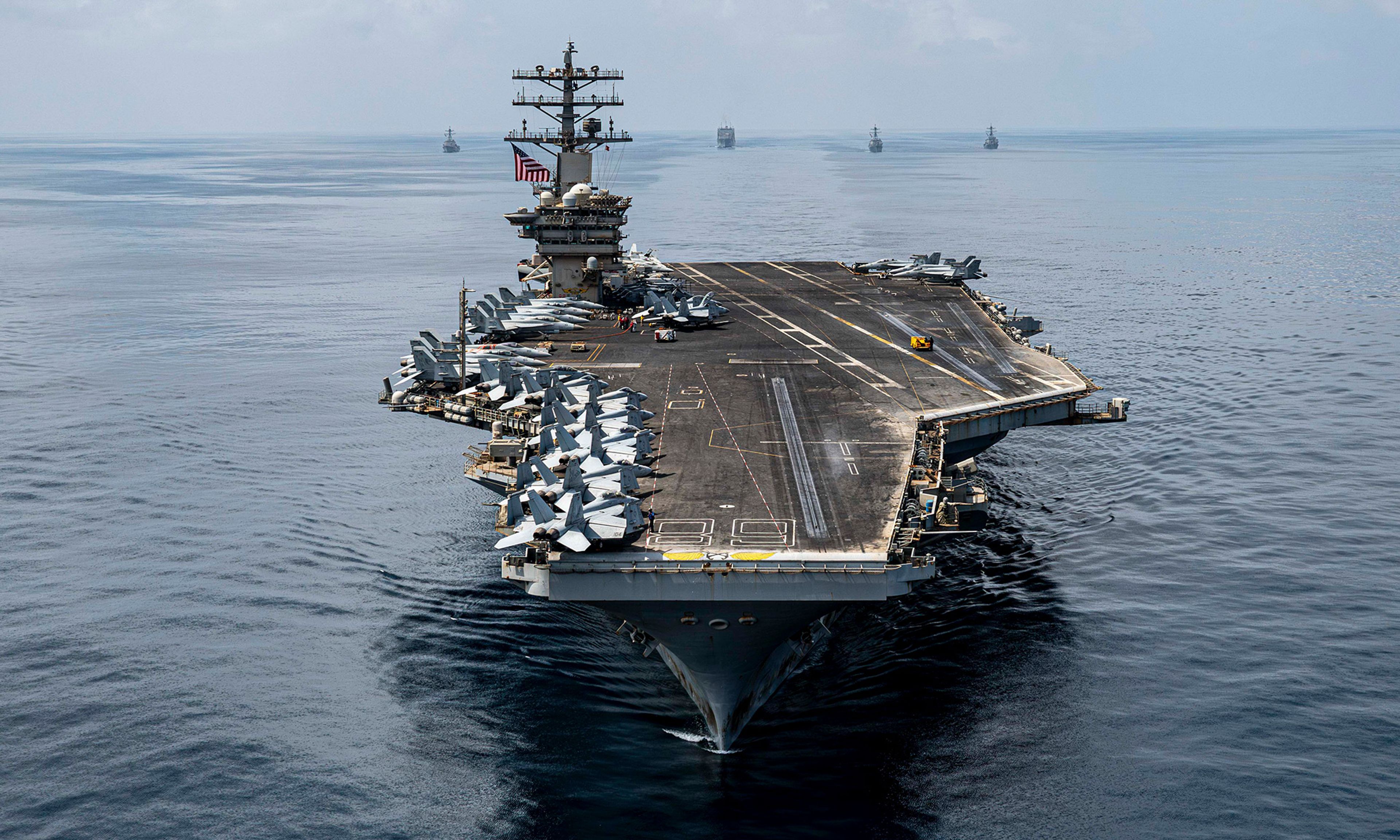
The U.S. Navy aircraft carrier USS <i>Nimitz</i> (CVN-68) steams ahead of the Nimitz Carrier Strike Group during an integration exercise in the U.S. Central Command area of responsibility, September 28, 2025.
It’s an unnerving fact that U.S. industry is woefully unprepared for a war. The Navy has blown through offensive and defensive missile stockpiles in its campaign against the Houthis in Yemen, depletions which will take at least two years to replace. Yet late in October, just as the U.S. Navy’s newest supercarrier, the Ford, sailed towards the Caribbean to intimidate the Maduro cartel, the oldest supercarrier, the Nimitz, had two “flight mishaps” within a half-hour, losing more than $100 million in military hardware.
The industrial problem ordinarily gets more attention than how the military would operate in war. Operations matter just as much as industrial capacity: If the U.S. cannot create realistic war plans and train for them, then the industrial production piece is irrelevant. Crucially, the Navy’s planning for a war with China has — at best — an uncertain grounding. As Congress considers the next military budget and engages with the Trump administration’s appointees across the armed services, it should force the Navy to scrutinize and justify how it plans to fight. Specifically, Congress should insist that the Navy explore military options other than its existing plan to complicate an enemy’s offensive operations by fanning out arsenals of manned and unmanned vessels over a wide area — a strategy known as Distributed Operations.
Future warfare is always uncertain. Combat is chaotic; very small changes to scenarios can produce radically different results. Thus, it matters a great deal how militaries think about war. The assumptions military organizations make about the character of combat determine how they develop operational concepts, how they train for these concepts, and what weapons they buy to execute them. Flexibility is key: Committing to one narrow vision of future warfare seldom primes militaries to adapt to savage combat conditions. Indeed, this is the crucial lesson of the Ukrainian and Russian military experiences in the ongoing Russian invasion of Ukraine — that the textbook needs for “mass” and industrial capacity alone won’t suffice to win a war.
The U.S.’s most profound long-term competitor, Communist China, is building a military force designed to defeat the United States. American forces win — as they did in 1991 and 2003 — when they can access a military theater, gain air superiority, and then use precision-guided weapons against high-value targets. China is countering this by building the world’s largest missile arsenal — including several thousand ballistic and cruise missiles launched from land — alongside thousands more air, sea, and submarine-launched missiles. Complex systems of over-the-horizon radars, high-endurance drones, and hundreds of reconnaissance satellites guide these weapons to their targets between 600 and 1,000 kilometers from the Chinese coast — which happens to be the range within which U.S. warships and aircraft must operate for their aircraft and missiles to reach their targets.
By threatening the specific units — for example, aircraft carriers — the U.S. uses to apply its highest-value weapons, China can either deter the U.S. from intervention in an Asian crisis or, if war comes, isolate Taiwan and the First Island Chain by inflicting heavy losses on the U.S.’s largest and most powerful platforms.
All the military services are adapting to the challenge of Chinese missiles. Except for the Army, which forms regional partnerships and uses missiles to defend U.S. bases in Asia, all the services’ responses are essentially the same: They spread out forces to make it harder for China to find and attack them. In the event of war, Marine Littoral Regiments will fan out across the First Island Chain, armed with anti-ship missiles to force Chinese warships and aircraft to hunt them down instead of attacking higher-value units. The Air Force’s fighters will shift between airfields quickly, confusing Chinese reconnaissance and tricking China into shooting missiles at empty concrete. The Navy’s idea — Distributed Maritime Operations — follows the same logic. But full implementation will require decades of uninterrupted additions to the fleet and its capabilities.
However, for today, the U.S. Navy operates in Carrier Strike Groups, each of which is centered on a big-deck 100,000-ton supercarrier with its air wing of 60 to 100 fighters, electronic warfare aircraft, helicopters, and other supporting assets. Operating together with the carrier are several missile-armed warships which protect the carrier from missiles and torpedoes. Since the mid-Cold War, these ships have dispersed, using longer-range anti-air missiles and satellite communications systems to coordinate defenses. But these warships are fundamentally defensive in function.
Distributed Maritime Operations would change this model radically. The Navy’s surface warships, destroyers, cruisers, and eventually frigates will field anti-ship missiles and sail at great distances from one another. By distributing offensive firepower over more platforms and a wider area, the operational concept, again, hopes to stretch Chinese reconnaissance systems and waste high-value Chinese missiles.
The difficulty with Distributed Maritime Operations is the Navy does not have the weapons to “fight” this concept. Furthermore, today’s evanescing fleet is not on track to start growing again until the mid-2030s. The Pentagon is developing an anti-ship Tomahawk missile variant, but the fleet’s effective use of the missile remains years away. Other anti-ship weapons are in development for surface ships, but most high-end anti-ship missiles are still deployed from aircraft. Moreover, the Navy cannot rearm surface warships at sea. It invested in at-sea reloading for Vertical Launch System cells in the late Cold War but left the technology to languish until late 2024. This means that, once the Navy’s surface warships launch their missiles in combat, they must return to port to rearm — taking them out of the fight for days at least. Reloading would need to occur at a limited number of ports, presenting clear targets for Chinese missiles. By contrast, the Navy can rearm carriers at sea relatively easily and at the same time provide enough fuel for their aircraft.
Navies go to war with the fleets they have. These fleets dictate how they can, and cannot, fight. The U.S. Navy cannot fight in a distributed fashion today and will not be able to begin implementing the idea for at least the next five years. This reality means that for the foreseeable future, the Navy will fight with the carrier as its principal warship and the Carrier Strike Group as its principal strategic formation. The Navy therefore needs to build and buy weapons and platforms — aircraft and missiles — that it will use with and on carriers.
The question for Congress is whether it can push the Navy to accept this reality. It has several tools at its disposal. It can fill its under-utilized (to save costs) carrier decks with more aircraft, including F-35 strike fighters. Crucially, carrier decks could also be stocked with unmanned systems like the MQ-25, which for now serves as an air-to-air refueler but future variants of which could carry weapons. Carriers today deploy with only 70 of their 80 to 100 aircraft maximum complement, meaning that there is enough deck and hangar space for additional aircraft. Congress can also push the Navy to construct air-launched weapons, rather than doubling-down on missiles from ships’ vertical launchers. Finally, Congress can force the Navy to clean up the mess it has made with warships like the Constellation-class frigate, which the Naval Sea System Command’s endless design changes transmogrified into a budgetary boondoggle with limited capability in the fleet.
American industrial capacity is undoubtedly constrained. But the aerospace industrial base turns out combat aircraft significantly faster than the naval industrial base builds warships. Aircraft are cheaper than ships, and the U.S.’s major aerospace manufacturers have received more consistent contracts than their naval counterparts. Moreover, the Pentagon’s recent acquisition reforms make rapid procurement of air-launched weapons, together with unmanned systems, more feasible in the short-term. Over time, congressional-led investments in the defense industrial base will bear fruit for naval construction, but the fleet as it exists today needs weapons that it can use now. And if we are going to take seriously warnings by former commanders of the U.S. Indo-Pacific Command — such as Admirals Davidson and Aquilino — that China could attack Taiwan as early as 2027, we must ensure that the Navy has the tools it needs to fight and win a war today.
[slideshow slideshow="1796350" /]

About the Author
Seth Cropsey is the president of the Yorktown Institute and the author of Mayday and Seablindness. He served as a naval officer and as deputy undersecretary of the Navy.
Featured Tags
Advertisement
Advertisement




Comments