Net Zero’s Green and Defenseless Land
Written by Andrew Stuttaford
The week of March 9, 2026: How net zero is making Britain less secure, housing, refrigerators, weapons, Tylenol, and much more.
Share this story
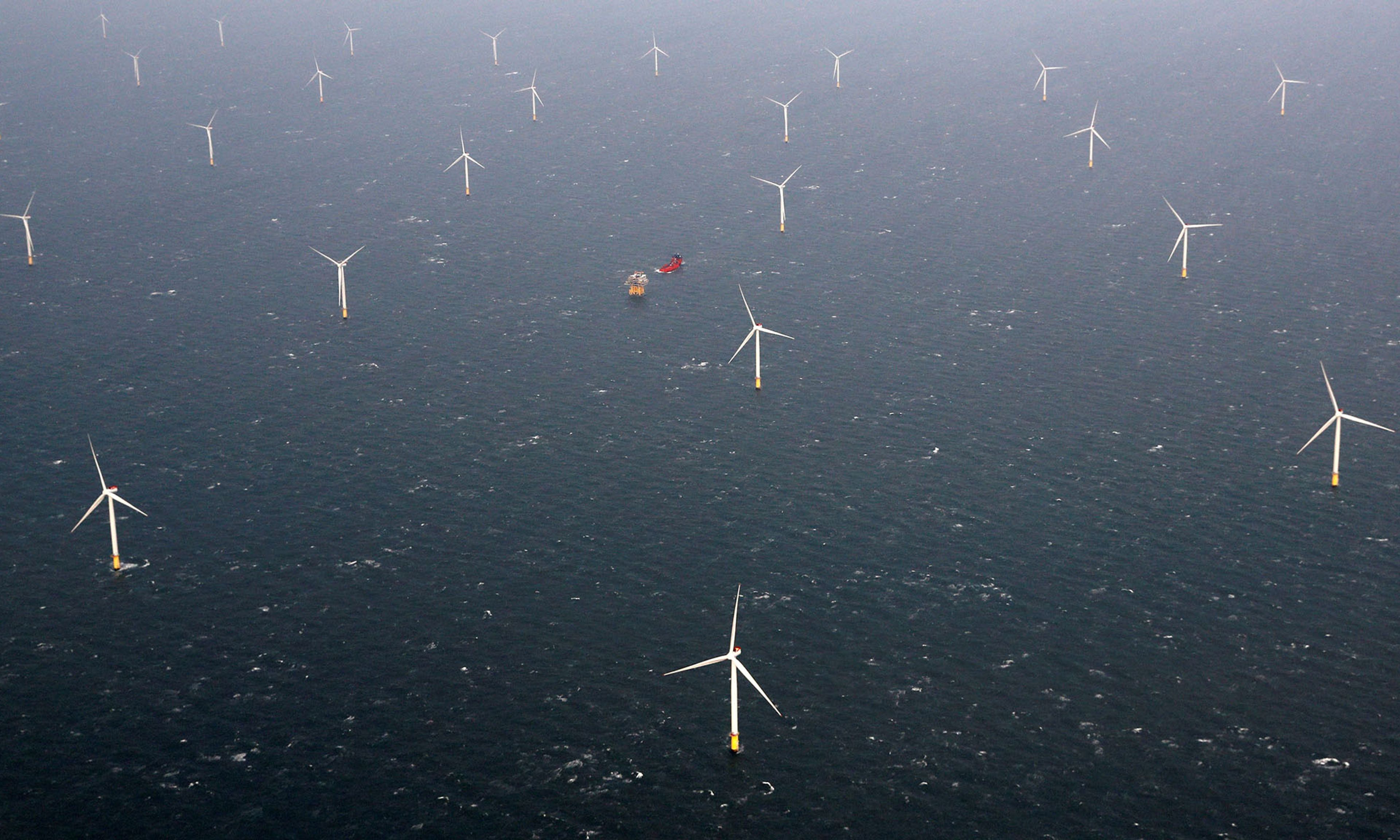
A view of Statoil's Dudgeon offshore wind farm near Great Yarmouth, Britain, November 22, 2017.
It was inevitable that Ed Miliband, the millenarian fanatic presiding over Britain's net zero policies would seize on the disruption to energy markets caused by the Iran war as a kind of vindication. And so he has.
But first some background. That the U.K.'s "race" to net-zero greenhouse gas (GHG) emissions by 2050 risked triggering an economic and political crisis was obvious long before Labour’s election victory in July 2024. But rather than offer a change of direction, the party doubled down, promising to speed up the pace once in power. And that is what it has done. The result has been a relentless accumulation of ruin, made more devastating by the way that each turn of net zero’s ratchet renders the economy more fragile.
One reason that voters bought into Labour’s plans was the promise of lower energy prices. As it became evident that not only would this not be the case, but also that the total cost of net zero would be far higher than people had been led to believe, the government adopted a more defensive stance. “Moving to clean energy,” Miliband maintained, “was the right choice for energy security.” The U.K. would no longer be at the mercy of “rollercoaster” fossil fuel markets controlled by petrostates and dictators.
This was never credible, and with the rollercoaster now fueled by a new war and rattling along at a terrifying rate, Brits are still locked in screaming, and not with pleasure. How could this be? To be sure, the U.K. has not yet reached net zero, but, observes Dieter Helm, a distinguished British economist, the country:
should be basking in the success of “getting out of gas.” We do after all have a lot of renewables. These, we have been told, are nine times cheaper than gas. We don’t have much nuclear left, and we have got out of coal, so all our bets are in the renewables basket. We should be well on our way now to being a “clean-energy superpower,” relying on “home-grown energy” that should be bringing down energy bills…
Instead, writes Helm, no “denier” but a longstanding critic of the U.K.’s route to decarbonization, Britain “having got out of coal, and [bet] on intermittent low-density and geographically distributed renewables” has become “more rather than less dependent on gas for our energy security.” The effect of the melee in the Gulf has revealed “how threadbare Britain’s energy security actually is.”
According to Helm, the U.K. “should be in a much better position. It has oil and gas reserves in the North Sea, and Norway nearby to provide over 30% of Britain’s gas, and it has good wind flows in the North Sea too.” Helm is more enthusiastic about wind power’s steampunk technology than I (low bar), but he is also more honest than the British government (low bar) about how relying primarily on an intermittent (the wind doesn’t always blow, the sun doesn’t always shine) source of energy involves ensuring that there is adequate baseload power. The U.K.'s insufficient nuclear energy resources and its aversion to coal must mean putting “aside the simplistic slogans about getting out of gas” and recognizing “that Britain will be dependent on gas for at least another couple of decades and probably more.”
As Helm explains, “it is not renewables instead of gas; it is renewables and gas:
Energy security depends upon it just as it depends on all those foreign supply chains of critical minerals and especially rare earths, and on all the solar panels and wind turbines made in China and elsewhere. If the Iran war has displayed that the emperor of the clean-energy superpower has no clothes, wait to see what happens if and when China invades Taiwan.
Brussels is beginning to react to the dependency on China created by its decarbonization drive and has, as Reuters reported this month, proposed that there should be “low-carbon and ‘Made in EU’ requirements for public procurement of, or subsidies for, making aluminum, cement and steel, and technologies including wind turbines, electrolyzers, or electric vehicles.” E.U. Commission Executive Vice-President Stéphane Séjourné told a press conference that if nothing is done, “it's quite clear that very soon, 100% of clean tech technology will be produced in China . . . It's quite possible that our cement, steel industries will be offshored completely in the next few years.”
As I noted the other day:
To reduce and eventually eliminate that dependency is well worth doing, but there is a catch. Claims that “renewables” are a source of cheap energy rest at least to a degree on the fact that so many of the components used to make renewables (sort of) work have been made in China, where costs are lower, thanks in part to Beijing’s mercantilism. When it comes to pricing, the EU’s mercantilists will not be able to match Beijing’s. The result will be that the price of renewable energy, which (if calculated properly) is already high, will rise even further, increasing the pressure on Europe’s industries — and its people — yet more.
The answer is for the EU to scrap or substantially rework its commitment to net zero, but that’s not going to happen anytime soon.
Miliband does not seem overly bothered about reliance on China. After complaints about the secrecy in which it had been shrouded, he recently released details of a (non-binding) memorandum signed in Beijing last year, which envisaged greater levels of Chinese investment in Britain’s green energy infrastructure.
What could go wrong?
The potential threat to British energy security posed by racing to net zero does not stop there. International undersea interconnectors, cables between the U.K., continental Europe, and Ireland, typically furnish Britain with 10-15 percent (the share varies from day to day and year to year) of its electricity. That’s not a comforting thought when Russian aggression in the “gray zone” just below outright warfare has already included cutting underwater cables elsewhere.
Helm adds that “North Sea wind farms are perfect targets for swarms of drones, the new weapon of choice in aggressive attacks.” As if that were not enough, these installations may quite literally stand in the way of effective missile defense.
Throwing yet more anxiety into the mix, Helm notes that a single pipeline from Norway supplies 30 percent of Britain’s gas (total imports from Norway, transported by several pipelines, account for 35 percent, or more in some years).
The U.K. has, according to Helm, “perhaps one boat that patrols all this offshore infrastructure.”
But surely Britain has plenty of gas in storage? No, not unless two days’ supply counts as “plenty.” Twelve days is not much more plentiful, but that is the most gas that can be stashed away, compared with an E.U. average of a little over three months. This is due to short-sightedness — and to economics.
Helm:
In the “bad old days”, there were big seasonal swings. Hence a gas storage facility could be filled cheaply in summer, and then sold down at higher prices in winter. The economics of renewables with zero marginal costs and the rapid decline of energy-intensive industries have undermined this. Hence the commercial case for storage has collapsed. The result is that just when we need storage, we will have almost none.
The rest of the U.K.’s imported gas arrives by LNG tanker, mainly from the U.S., but in the event of a global natural gas squeeze, much of the LNG destined for Britain, little of which is supplied under long-term contract, would shoot up in price or be shipped to other destinations, notably in Asia, as is happening now.
Britain’s most secure source of natural gas is its sector of the North Sea (the same is true for oil). Around 40 percent of its natural gas comes from there, but that share is falling. Those oil and gas fields are -- to use the jargon -- “highly mature,” and the British government's attitude, a mixture of hostility and greed, is hardly conducive to prospects of slowing their decline. Needless to say, fracking Britain's shale gas reserves, which may show some promise (opinions vary) in formations such as the Bowland Shale, is barred.
If the U.K. is indeed going to be using gas for a while, Helm does not believe it makes sense “to close off the development of Britain’s own North Sea gas reserves and penalize existing production with extremely high taxes.” The Danish government would agree. Denmark — ironically the country that pioneered modern wind turbines — has now invited gas producers in its portion of the North Sea to “explore” extending their licenses beyond 2042, the date by which most were due to expire, although a deadline to halt all fossil fuel extraction by 2050 remains (so far?) intact.
In an article last month, Bloomberg’s Javier Blas quoted Denmark’s climate and energy minister:
I would have preferred that Europe could make do with green energy. But the reality is different, and I fundamentally believe that it is better for Europe to get gas from Denmark than from countries outside our continent.
Ah, reality.
Even the Tony Blair Institute for (sigh) Global Change, which continues to advocate net zero by 2050, is arguing for a more pragmatic approach to Britain’s North Sea oil and gas:
Current policy is accelerating that decline beyond what is economically or strategically necessary. The Energy Profits Levy (known as the windfall tax) raised the effective tax rate on oil and gas producers to 78 per cent (and even higher for many operators), which is among the highest globally.
Coupled with the ban on new exploration licenses and heightened regulatory and litigation risk around environmental assessments, this has sharply increased policy risk and driven capital [away].
And, yes, it imperils security too:
Even as UK production declines, the country will continue to consume oil and gas for decades. Allowing domestic production to fall faster than demand simply increases exposure to international markets and geopolitical risk, without reducing global emissions.
In a striking example of tunnel vision, Shaun Spiers, the executive director of the Green Alliance think tank, told The Guardian that there was “no need to rethink a clean power plan that’s working – the U.K. generated record-breaking amounts of renewable energy last year.”
Define “working.”
And then there is this:
However fast we build clean power, Britain will still need gas well into the foreseeable future: to heat homes and power industry where electrification doesn’t make sense for households and businesses, and to help keep the electricity system balanced. So it is entirely sensible to support continued domestic oil and gas production in the North Sea. If we do not produce that gas here, we will still need it. We will simply import more of it.
Who is spreading such heresy?
Tara Singh, the CEO of RenewableUK, that’s who.
RenewableUK?
The trade association for Britain’s renewable energy industry.
Oh.
Helm:
The anti-North Sea oil and gas approach is best regarded as a mix of ideology and expediency. The ideology stems from the remarkable simplicity of the idea that Britain can continue as a major world economy relying overwhelmingly on wind and solar, and the hope of further nuclear in due course… The aim appears to be the first country to be overwhelmingly based upon renewables and as quickly as possible. It is a piece of progressive ideology with little evidence to support it and little environmental benefit. It is one hell of a bet, and it is one that increases emissions by using at the margin the much more polluting US shale-based LNG over North Sea pipeline gas.
The expediency arises from the desperate fiscal position Britain has got into. It needs the money and can therefore justify higher taxes.
If Helm is right about “expediency,” the government is taking an irresponsibly short-term view. Tightening the garotte on the country’s North Sea oil and gas businesses will, directly or indirectly, incur costs that are likely to exceed any quick boost to the state’s coffers.
The damage inflicted on Britain’s security by net zero policies is worsened by their effect on an economy in no condition to handle them. In a February 2025 Capital Letter, I wrote that “manufacturing has shrunk by 8 percent since the beginning of 2021, chemicals are down by over 37 percent, and oil and gas by 44 percent.” Nothing has improved since then. Car production, which has sunk to a level not seen since the early 1950s, has been hit not only by the high energy costs associated with the race to net zero but also by attempts to “force” or bribe Brits to switch to electric vehicles.
Helm:
High energy prices have led to a cascade of exits from energy-intensive industries, and in short order. Gone is Grangemouth, a refinery in Scotland, one in Hull, most of the steel industry, the fertiliser industry, and the fibreglass industry. Our ability to produce the petrochemicals and refined fuels is now more dependent on imports. We don’t have our own steel in the volumes and of the quality we would need for a rapid militarisation.
The U.K.’s shrinking industrial base is undermining the country’s ability to defend itself or cope with severe supply chain disruptions.
And the race to net zero is also slowing the wider economy, whether by increasing costs or fostering enormous malinvestment. But government spending grows at a brisk pace regardless, if not in every department. Defense spending has failed to keep pace with an increasingly dangerous geopolitical environment. That is set to change, but how it will be paid for is an ugly question. Britain’s debt-to-GDP ratio stands at around 100 percent, its budget deficit is some 5.2 percent, and tax as a percentage of GDP is at its highest for forty years. Unsurprisingly, borrowing costs are rising. Another ugly question: What is to be the source of the reliable energy required to power the AI needed for the country’s defense and, for that matter, much of its (supposed) future economic growth?
So what now? Some scapegoating (oil company price gouging!) is on the agenda, but a drastic course correction, let alone abandoning Britain’s futile participation in the race to net zero (less than 1 percent of global GHG emissions come from within its borders), still seems out of the question.
In fact, Miliband has the opposite in mind. Over the weekend, he argued that “global events demonstrate[d] the need to go further and faster in our drive for clean power, because there can be no energy security while we are so dependent on fossil fuels.”
“Further and faster.”
Kool-Aid will be served.
The Capital Record: Sound & Vision
We released the latest in our series of podcasts, the Capital Record. Follow the link to see how to subscribe (it’s free!). The Capital Record, hosted by financier David L. Bahnsen, makes use of two formats to deliver Capital Matters’ defense of free markets. The original podcast continues, but if you want to watch David talk, please click on the YouTube link.
The Crazy Things People Say (Podcast/YouTube)
Do financial transactions all add up to zero? Should we be more concerned with piety than technique? Is a business going out of business a good thing if the founder treats his people well? Does money serve a greater purpose if we apply nice-sounding adjectives to our marketing pitch? Are all views of human dignity okay as long as they end with humans having dignity? On today’s Capital Record, David analyzes a plethora of things he literally heard in the last few days alone!
The Capital Matters week that was...
Regulation
Federal meddling in refrigerators, washing machines, air conditioners, furnaces, water heaters, dishwashers, and others began in the 1970s. The 1973 Arab oil embargo sparked a series of ill-advised congressional responses that may have inflicted more damage than the embargo itself. Some persist to this day, including the Energy Policy and Conservation Act of 1975 that created a program for regulating energy use in home appliances. It and subsequent amendments set out initial energy efficiency standards and required the DOE to periodically consider making them more stringent — a one-way ratchet…
Jimmy Lai
[T]here has been a less well-publicized angle to Lai’s ordeal — one that is not intuitive for many observers. Lai’s suffering clearly shows that a free-market system and private property rights are essential guarantors of freedom of speech, of religion, and of the other civil liberties that we take for granted in the West…
Litigation
The debate over whether Tylenol causes autism has entered the courtroom. A federal appeals court is considering a case that could affect not only one of America’s most widely used medications, but also the integrity of scientific evidence in court…
Oil
Since the commencement of the aerial invasion of Iran by American and Israeli forces twelve days ago, there has been speculation about a 1970s-level oil shock. Some of this chatter is ill-informed because it fails to account for drastic changes in energy markets over the past half century. Nevertheless, an effective shutdown of the Strait could trigger something along those lines…
Renewable Energy
An argument long advanced by Europe’s climate policymakers has been that renewable energy would be a critical step forward to independence from the whims of foreign despots (unless, until 2022 or so, they were Vladimir Putin, but let’s not talk about that).
How’s that drive for independence going?
Nuclear Power
In 1990, about 30 percent of the EU’s electricity was generated by nuclear power, a share that has fallen by about half since then.
The EU’s top bureaucrat, Commission President Ursula von der Leyen, has now admitted that it was a “strategic mistake . . . for Europe to [have turned] its back on a reliable, affordable source of low-emissions power.”
Protectionism
The White House recently released America’s Maritime Action Plan (MAP) to revitalize America’s maritime industry. It proposes a variety of regulatory modifications, subsidies, government financing options, and fees to encourage domestic shipbuilding. Although it includes a wide variety of proposals, two of them, when taken together, show the Trump administration’s hostility to free trade, as well as a general naïveté about the plan…
The Armaments Industry
Whether it is because of the need to replace equipment used in the Iran conflict, or the increasingly dangerous geopolitical situation, or European plans to build up defense capabilities less reliant on the U.S., the armaments sector seems set to rapidly expand for quite some time (at least — and this is a not insignificant at least — if stretched budgets can find room for it)…
Housing
As Democrats and Republicans jointly wrote their 21st Century ROAD to Housing Act, many hoped the bill would be focused on lower government barriers to home construction. The House and Senate have yet to agree on a final product, but things aren’t looking good. On Thursday, senators heeded the demands of both President Trump and Democrat Elizabeth Warren and included additional restrictions on private investment into single-family rental housing.
Those restrictions will ultimately make housing less affordable, and their inclusion marks a growing trend of ill-considered, knee-jerk populism, or “slopulism” as online critics have taken to calling it…
To sign up for The Capital Letter, please follow this link.

About the Author
Andrew Stuttaford is the editor of National Review's Capital Matters.
Featured Tags
Advertisement
Advertisement


Comments