Share this story
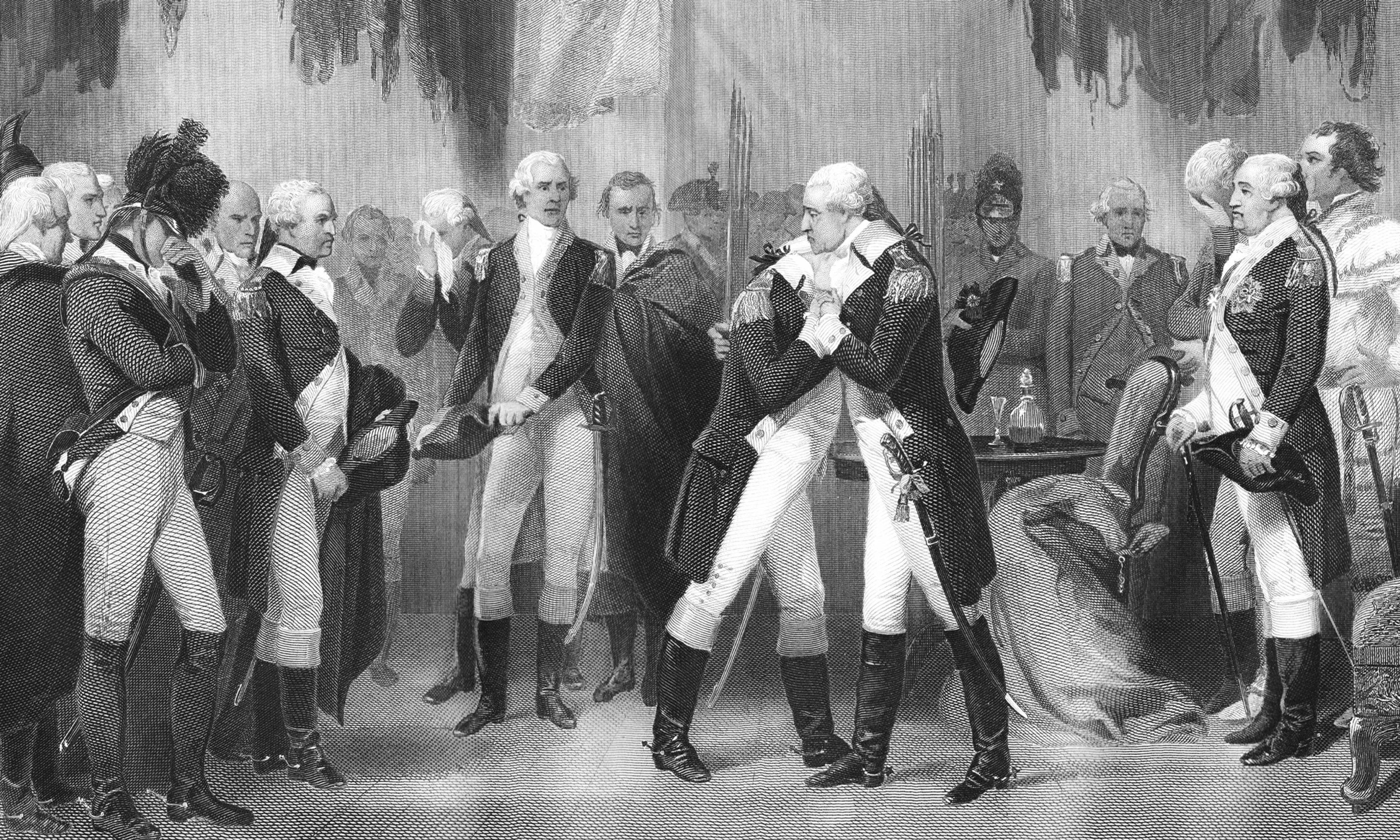
T. Philibrown, <i>Washington’s Farewell at Fraunces Tavern</i>, 1866, engraving after a painting by Alonzo Chappel.
America’s important cities at the time of the American Revolution (there were not many) were each occupied at some point by the enemy. That is what happens when a nation clinging to a coastline fights a maritime power. Of them all, my city fared worst.
In 1776, New York covered only the southern end of Manhattan Island. The rest of what is now the five boroughs was woods, fields, farms, and villages whose names now stand for neighborhoods. The harbor and Staten Island lay to the south, the Hudson River to the west, the East River and Long Island to the east.
One of George Washington’s generals, mindful of the city’s exposed position, advised him simply to torch it and withdraw. But Congress had ordered him to defend it, so he tried. He had 19,000 troops; the British ultimately assembled 32,000 troops, with ten ships of the line and numerous smaller vessels. They landed on Staten Island in July, then in August moved to Gravesend at the southwestern corner of Long Island. On the 27th they smashed an American line strung along an east–west ridge; Washington watched the debacle from Brooklyn Heights. Shielded by darkness and fog, the survivors evacuated to Manhattan on the night of the 29th -- a providential escape, but retreats do not win wars. On September 15, the British landed at Kip’s Bay, three miles up Manhattan on the East River. Pushed north, the Americans won a skirmish at Harlem Heights on the 16th. But at the end of October, further British advances to their east and north persuaded Washington to leave Manhattan, posting a garrison in a fort at what is now Washington Heights. The enemy captured that, and the 3,000 men holding it, in November.
Washington restored his military reputation at the end of the year with surprise victories at Trenton and Princeton. New York suffered. As Britain’s wartime headquarters, it became a cockpit of espionage. Captain Nathan Hale, inserted as an agent, was captured and hanged. The Culper Ring, composed of local residents who led double lives, fed information to Washington throughout the war. Benedict Arnold’s handler, Major John André, ran him from New York, and after his treason was exposed, he lived for a time in the city. Washington hatched a plan to kidnap him, which failed when Arnold’s new masters unexpectedly sent him out of town.
The city’s population fluctuated as fleeing patriots were replaced by incoming loyalists. British officers lived well enough, occupying the best houses, racing horses. Others did not. One-third of the city burned, in a fire possibly set by patriot arsonists. American POWs held in ships moored in the East River died like flies. Washington dreamed of winning the city back, with French help after the alliance of 1778. But, in 1781, the comte de Rochambeau told him that the French West Indies fleet would sail only as far north as the Chesapeake. Yorktown became the target instead. Peace talks took time; the British would not leave until two years later.
What is left now of those days? Bowling Green, a small park at the southern end of Broadway, held an equestrian statue of George III, which a patriot mob pulled down after a public reading of the Declaration of Independence. They also knocked the crown-shaped finials off the posts of the park’s iron fence. The fence remains, the posts rough to the touch. Fraunces Tavern, the 18th-century watering hole on Pearl Street, has been facelifted many times, but enough original structure is left in it to justify its landmark status. The home of Roger Morris, a British officer, briefly served as Washington’s headquarters. Turn the corner in a West Side Story neighborhood, and there it sits, white, pillared. The British left an excellent map of Manhattan’s natural features, which builders still consult when they want to know whether they are plunking a skyscraper over a buried marsh.
New York does not keen over its long-ago defeat, as Richmond used to do, nor does it particularly remember its past. We leave that to Boston and Philly; we’re here to make money, until Zohran anyway. Later wars passed us by, until that summery autumn day when al-Qaeda killed 3,000 of us. The nightly sessions of mourning and discussion in Union Square were overseen by an 1856 statue of Washington, riding south to reclaim the city from the departing British in November 1783. Let’s hope, never again. We shall see.

About the Author
Historian Richard Brookhiser is a senior editor of National Review and a senior fellow at the National Review Institute.
Featured Tags
Advertisement
Advertisement

Comments