No, Mr. President, Section 122 Tariffs Won’t Work Either
Written by Phillip W. Magness & Marc Wheat
Despite Donald Trump’s claims, history shows that Section 122 does not justify his new tariffs.
Share this story
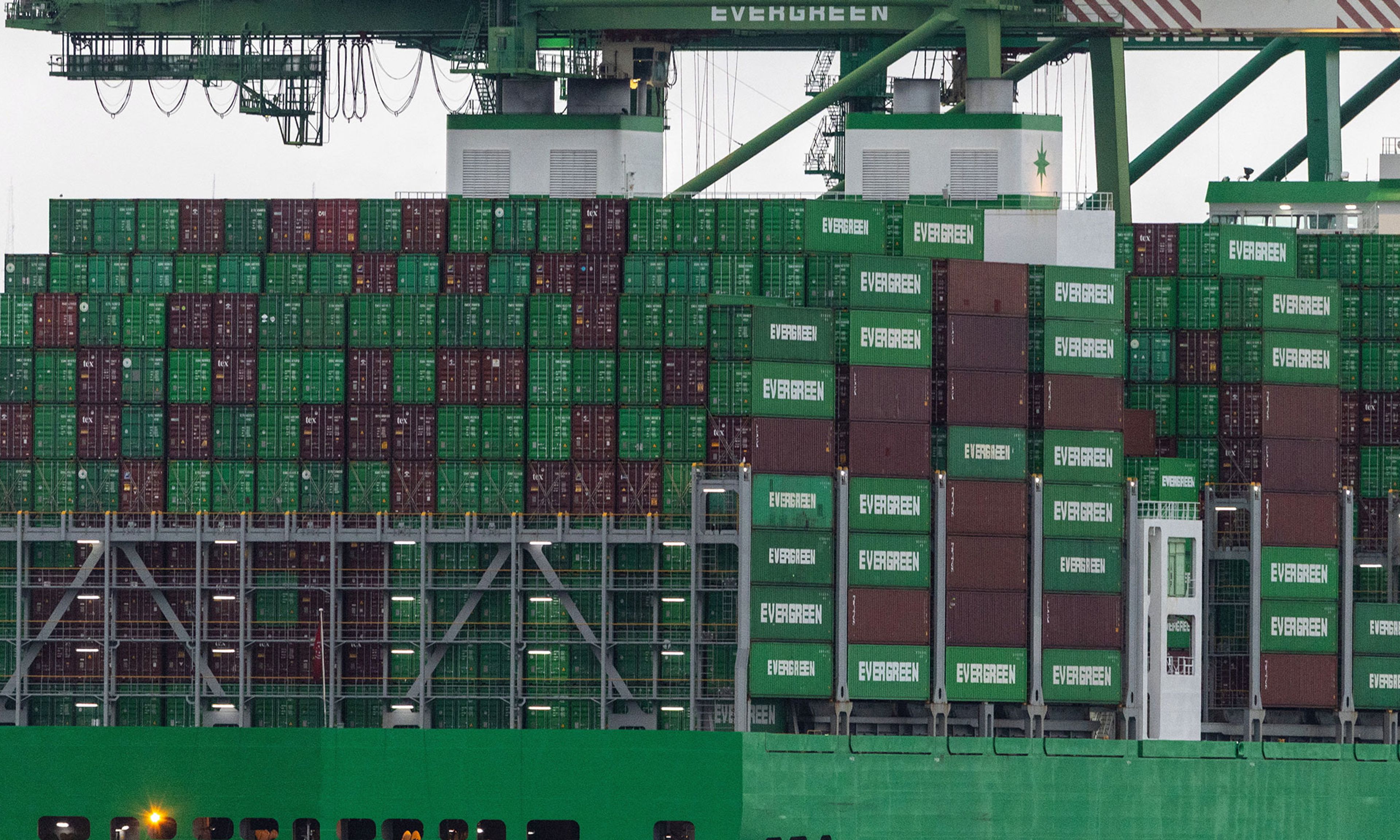
Shipping containers stacked on a cargo ship at the port of Oakland in Oakland, Calif., February 24, 2026.
On February 20, the Supreme Court ruled in Learning Resources v. Trump that the International Emergency Economic Powers Act (IEEPA) does not confer upon the president the power to impose tariffs. Obviously prepared for the loss, in the same news cycle, the president announced a 10 percent tariff under Section 122, which he increased to 15 percent only hours later. The problem? Section 122 does not empower the president to impose these tariffs either.
Section 122 allows a tariff lasting no more than 150 days to address a narrow set of problems, the most pertinent of which are “large and serious United States balance-of-payments deficits” (the other two cases — an imminent “depreciation of the dollar in foreign exchange markets” and creating an agreement with other countries to correct an “international balance-of-payments disequilibrium” — are less relevant to Trump’s arguments). A balance-of-payments deficit was essentially the natural economic consequence of a fixed exchange rate system where the value of the dollar was pegged to gold and other foreign currencies were pegged to the dollar. Since the direct convertibility of the U.S. dollar to gold was ended by the Nixon administration and never came back, Section 122’s balance-of-payments provision has never been used.
When prices are fixed by something other than market participants, surpluses or shortages inevitably result; a balance-of-payments deficit occurred when the official reserves of the United States, used to maintain the fixed exchange rate, were drawn down by the pressures of an overexpansion of the supply of dollars relative to the foreign demand to hold them. If sustained, this pattern could deplete the government’s reserve holdings in gold or other currencies, causing a balance of payments crisis. Under the Bretton Woods system, in place from 1945 to 1971, other governments could exchange their holdings of dollars for gold at $35 per ounce, drawn from U.S. government reserves.
Central banks have never been good at maintaining fixed exchange rates. Instead, their fixed-rate arrangements tend to break down, because they can’t resist overissuing their own currencies or simply because speculators fear they won’t stick to their commitments. The Bretton Woods system was no exception. Under pressure to help finance the Vietnam War and Great Society, the Fed created more dollars than foreign central banks were willing to accumulate. Instead, they cashed in dollars for gold.
When foreign governments chose to swap dollars for gold, the result could cause a “large and serious” drain on the United States’ official reserves. On its Official Reserve Transactions ledger, the U.S. Department of Commerce tracked the drain on its official reserves, which were known as “balance-of-payments deficits.”
For most of the Bretton Woods period, the United States had a small but steady balance-of-payments deficit. Walter Heller, John F. Kennedy’s chair of the Council of Economic Advisers, famously alerted Congress to this persistent deficit in 1963. Under such conditions, he warned, a “dollar glut” was beginning to emerge. Exchange rate targets could no longer be maintained with increased foreign dollar holdings alone, and the “conversion of a portion of the foreign dollar accumulation into gold has resulted in a persistent drawing down of our gold stock.”
In August 1971, a “large and serious” drain on the United States’ official reserves led to just such a crisis, compelling Nixon to suspend the dollar’s convertibility into gold — the so-called “Nixon Shock.” This crisis had been many years in the making. A balance-of-payments deficit existed for most years between 1950 and 1971 under the Commerce Department’s measures.
Additionally, the United States maintained a small trade surplus, on average, throughout most of this period, with the exception of a few quarters in 1971-72. This separate measure, defined as the net difference between the imports and exports of goods and services, is the object of Trump’s current focus. Not until 1976, when balance-of-payments deficits were no longer possible due to the termination of the fixed exchange system, did the United States begin to experience frequent trade deficits.
It follows that it’s only by mixing up trade and payments deficits that the Trump administration can pretend that Section 122 allows the president to impose tariffs today.
The difference between a trade deficit and a balance-of-payments deficit was well known at the time. Paul Samuelson’s economics textbook — the most used college economics textbook in that era — had its own section on balance-of-payments deficits. The 1973 edition of this book used the Commerce Department’s measure and showed a deficit in most years from the 1950s to the early ’70s.
When Congress drafted Section 122 of what eventually became the Trade Reform Act of 1974, it clearly understood the difference between a “balance-of-payments deficit” and a balance-of-trade deficit. “A large decline in the U.S. net international monetary reserve position,” the bill’s authors explained, “would be evidence of a serious balance of-payments deficit.” An accompanying House committee report likewise takes “balance-of-payments deficit” to refer to a depletion of official reserves. (The same report also made clear that Section 122 was not to be used “for the purpose of protecting individual domestic industries from competition.”) The bill’s authors insisted, finally, that only a “substantial” balance-of-payments deficit that was likely to continue in “the absence of corrective action” could justify a Section 122 tariff — “a small or even a large balance-of-payments deficit of short duration” wouldn’t suffice. The Senate report on the bill even included a table depicting separate columns for the “trade balance” and the “balance of payments” from 1960–1974 to illustrate the distinctions in how each was measured.
If Section 122 can only serve to help presidents deal with balance-of-payments crises, why did Congress include it in a Trade Reform Act passed in 1974, when such crises were no longer possible? The answer resides in the section’s origins.
After he closed the gold window in August 1971, Nixon, anticipating a possible renewal of gold payments, also imposed a temporary 10 percent tariff aimed at reducing imports so that fewer dollars resided in foreign hands — a source of the strain on the now-shuttered gold window. That tariff triggered a lawsuit by importers who challenged his authority to impose it. The suit in turn prompted Nixon to take steps to reinforce his and future presidents’ power to enact similar tariffs. But first he had to try to salvage the fixed exchange rate system.
The Nixon Shock sealed the fate of the Bretton Woods system. Nixon temporarily shored up the currency peg under the Smithsonian Agreement of December 1971, by convincing a group of Western European countries and Japan to fix their exchange rates to the dollar at a level of $38 per ounce of gold, albeit without a gold window conversion option. The new agreement proved short-lived though. In February 1973, the United States announced a 10 percent dollar devaluation against the price of gold. Other countries responded to this action in March 1973 by unpegging their currencies and letting their values float on a market exchange.
These events provided the impetus for Nixon to request new authorities from Congress in the international arena. In an April 10, 1973, message, Nixon asked Congress to begin a comprehensive overhaul of the statutes governing international trade. His message alluded to “building on the Smithsonian Agreement,” suggesting that he intended to negotiate a successor exchange rate regime in the months that followed. Nixon stated that he needed new trade policy authorities to bring these reforms to fruition. Among the powers he requested was a formal statutory provision to address “international payments imbalances.” This included the ability to impose “import restrictions on a temporary basis to help correct deficits or surpluses in our payments position.”
Nixon specifically requested this authority because of the still-pending lawsuits against his previous 1971 tariff, and because the recent collapse of the Smithsonian Agreement left an open question about how the value of currencies would be determined. The Senate’s report confirms this motive, noting that the lawsuit “could involve substantial loss of revenue to the U.S. Treasury” and seeking to mitigate this risk in the future by giving Nixon’s actions “explicit statutory authority.”
Congress responded in October by introducing what became the Trade Act of 1974, including Section 122. At the time, members of Congress likely thought a president would need the tools Nixon asked for in order to establish a successor fixed exchange rate regime after the Smithsonian Agreement collapsed. Nixon would never get to use his desired tools. His bill was still advancing through Congress when he resigned in August 1974 due to the Watergate scandal, so it was left to Gerald Ford to finally sign the measure into law. He did so in January 1975, by which time it was clear that fixed exchange rates were not coming back. Instead, the U.S. and its main trading partners settled into the floating exchange rate system that remains in place today.
Thus, Section 122 was already obsolete when it first became law. Section 122 does not empower a president to impose tariffs in response to a common trade deficit. In fact, the solicitor general, the attorney who represents the United States government in court, argued in Learning Resources last year that “trade deficits” are “conceptually distinct from balance-of-payments deficits,” and that President Trump’s IEEPA tariffs did “not identify or focus on balance-of-payments concerns of the type addressed by Section 122.”
As noted, the trade deficit to which the president and others so often refer is merely the difference between the value of exported goods and imported goods. When a foreign seller receives dollars as payment for its goods, it cannot exchange those dollars for gold. Instead, it can hold them, trade them for a different currency at the market rate, or reinvest them in the United States.
Because the value of the dollar is no longer tied to a fixed currency peg but is instead determined by the market, the conditions for Section 122 tariffs are no longer possible. As Milton Friedman explained all the way back in the 1960s, “A system of floating exchange rates” — that is, a system in which the value of currency is determined by the market like we have today — “eliminates the balance-of-payments problem.”
This technical economic distinction is not beyond the competence of courts to consider. American courts rightly seek to avoid in engaging in politics. The president will undoubtedly seek to take advantage of this fact by arguing that courts simply have no business questioning his determination that there is a “balance-of-payments” deficit because that determination is a political one left to his discretion by Section 122.
For the courts to accept this argument would be a dereliction of their duty to “say what the law is.” Despite some claims to the contrary, the role of the courts to assess the legality of the actions of the other branches, known as judicial review, was well established at the time of the Founding.
And, since the earliest days of our Republic, courts have relied on economists to settle disputes over technical economic terminology. In 1796 in a case called Hylton v. United States, Justice William Paterson consulted Adam Smith’s An Inquiry into the Nature and Causes of the Wealth of Nations, celebrating its 250th anniversary this year, for definitions of competing types of taxation.
If courts fail to play their crucial role as a last redoubt against illegal government action, the liberty of the people that government exists to secure will be lost. The Court’s decision in Learning Resources was an important but limited victory. Because Congress has chosen not to act to hem in the president’s unconstitutional actions, courts will have to continue to perform their role in our constitutional system so that the president will be constrained to his.
Phillip W. Magness is a senior fellow and the David J. Theroux Chair in Political Economy at the Independent Institute. Marc Wheat is the general counsel for Advancing American Freedom.

About the Author
Phillip W. Magness is a senior fellow and the David J. Theroux Chair in Political Economy at the Independent Institute.
About the Author
Marc Wheat is the general counsel for Advancing American Freedom.
Featured Tags
Advertisement
Advertisement

Comments