Nostalgia, the Not-So-Great Pastime
Written by Armond White
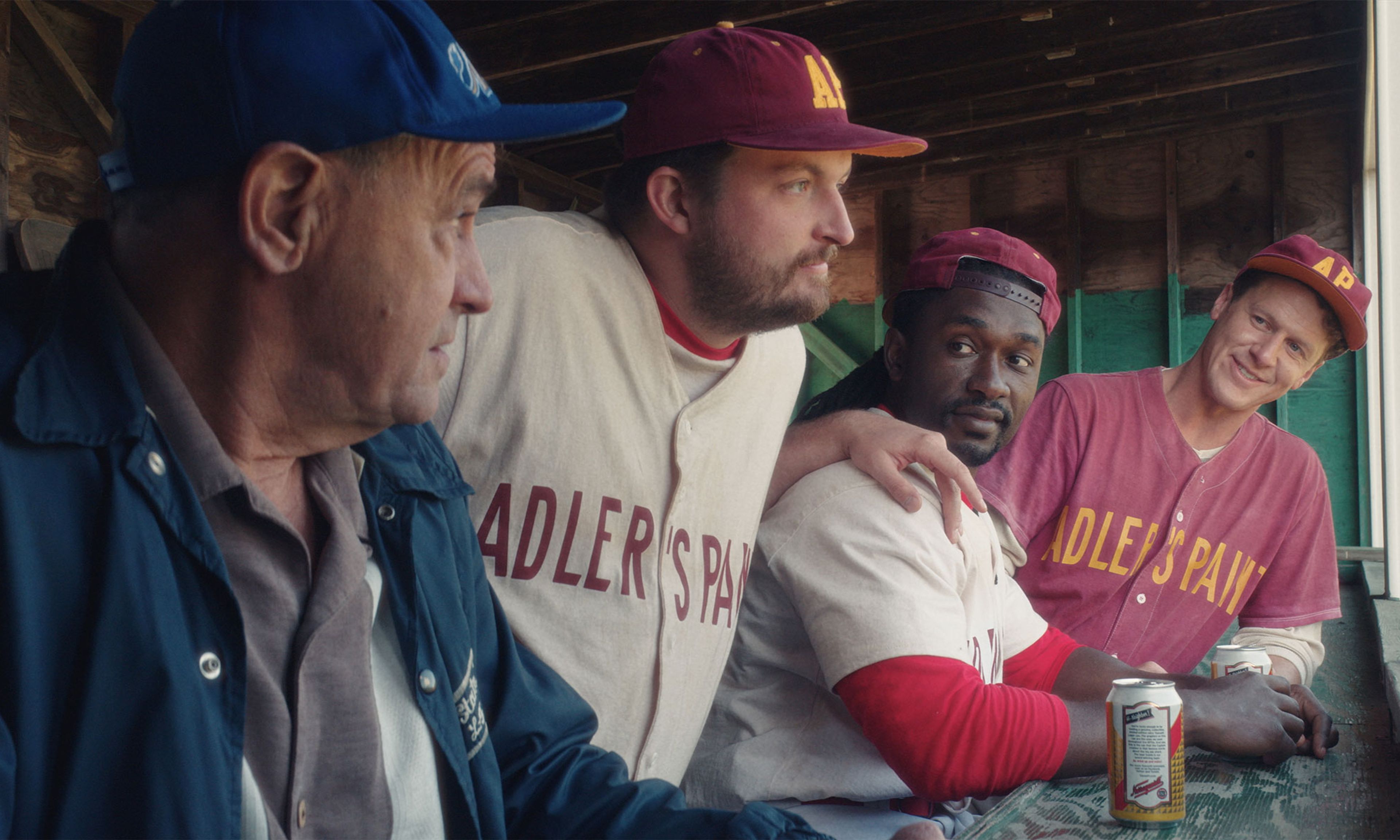
Eephus mourns America’s last baseball game.
Share this story
<i>Eephus</i>
Sports, a common denominator that nullifies the diversity, inclusion, and equity (DIE) movement, establishes ambition and competition as all-American virtues. Sports is the subject of Eephus, a surprisingly good movie for 2025, which was an exceptionally poor year for American films. Yet reviewers have praised Eephus (named for an inside-baseball term of the 1930s for a slow pitch falling oddly through a batter’s strike zone) for being merely a baseball movie.
Writer-director Carson Lund uses baseball to observe American male social habits now deemed politically unfashionable. Set in the 1990s, Eephus recalls two New Hampshire amateur baseball teams — Adler’s Paint and the Riverdogs — playing their last game against one another before their field is replaced by a new school edifice. Surely Lund recalls the small business joke in the beloved 1976 The Bad News Bears where a Little League team was sponsored by Chico’s Bail Bonds. Such insight makes Eephus an affectionate, if morose, work of nostalgia.
Lund ignores specific fraternal organizations that once defined a community to portray men who are politically neutral. They’re just guys hanging out, sensing that something in their lives is about to change. It raises one question: What unites them?
The answer recalls the unarticulated alienation that made Bogdanovich’s The Last Picture Show so poignant. Lund observes routine bonding and competition. No wonder movie nerds love this film; it spares them from dorky embarrassment. Lund features the raucous adolescent badinage that persists through adulthood and becomes the lingua franca of masculine camaraderie. During a long game played from sunup to sundown, Lund’s melancholic tone clashes with his salutary perspective. Ambivalence about what used to be considered the essence of American camaraderie makes Eephus, yes, another Millennial film lamenting America’s vanishing honor.
It’s a depressing liberal viewpoint — from the voice of documentarian Frederick Wiseman narrating period radio commercials for local businesses (“Next time you’re in Nashua . . .”) to the multiculti but still nonspecific team rosters. All the players are specific types: aging, achy, smart-ass, accommodating, genial, grumpy — and each believably cast, unlike the actorly ensemble featured in Katherine Dieckmann’s Diggers. They remain anonymous, as if lost to the near-forgotten past.
Lund structures this reverie like a fan’s notes: “First Pitch,” “Afternoon,” “Golden Hour,” “Twilight,” “Nightcap.” Each segment surveys behavioral tics, the intervention of home obligations, and casual athleticism: “I can’t hit,” gripes middle-aged but still willing Troy (David Pridemore), who knocks a ball into the woods. Seriously focused Merritt (Nate Fisher) shares wisdom: “Eephus makes him lose track of time. It’s kind of meant that way.” Lund commemorates good American jock vernacular inspired by gods: Yogi Berra’s “It’s getting late early.” Satchel Paige’s pitching philosophy: “Keep the ball away from the bat.”
Sometimes Lund gets obviously poetic — when a little girl sings “Take Me Out to the Ball Game” between innings, or the memorialization of a home run by black teammate Preston (Jeff Saint Dic) into a slo-mo moment with dreads bouncing. Such stuff can be as cloying as Field of Dreams, but Eephus is preferable to that.
Nothing here matches the spontaneous fun of the out-of-nowhere ballgame in Adam Sandler's The Ridiculous 6 — a true homage. But the project is too modest to achieve a cinematic equivalent to that classic Roger Angell passage extolling idolized New York Yankee Don Mattingly:
When he swings the bat, his hips precede it, in a perfectly timed, whiplash arc. . . . He stands in there with his bat held high, almost over his head, and his hands pulled back, and his weight on his right leg, and his left foot turned in a little, and then he takes this little rocking half-step with the left foot and starts the bat forward.
Instead of eroticism, Eephus brackets its story with solemnity — when announcer Franny (Cliff Blake), an aged fan, repeats Lou Gehrig’s famous echoey farewell, “The luckiest man on the face of the Earth.” Cinematographer Greg Tango’s evocative moment where the guys circle their cars so the headlights can illuminate the nighttime field, then disperse in an almost funereal parade, portrays a cultural passage. “Let’s just finish this thing to say that we did,” a departing player says. And Franny’s esoteric scorekeeping figures (in pencil) mark the moment.
That ballgame in The Ridiculous 6 provided an antic definition of American camaraderie through sports. Lund’s portrait counters current demoralization. Somehow, by taking national decline more nostalgically than Sandler’s jape, Eephus feels less genuine.
https://www.youtube.com/watch?v=7g-bxQwmU0s
About the Author
Armond White is National Review’s culture critic and the author of New Position: The Prince Chronicles and Make Spielberg Great Again: The Steven Spielberg Chronicles.
Featured Tags
Advertisement
Advertisement



Comments