<i>Nouvelle Vague</i> Finds the Secret of Filmmaking
Written by Armond White
Richard Linklater salutes Godard, redeems himself.
Share this story
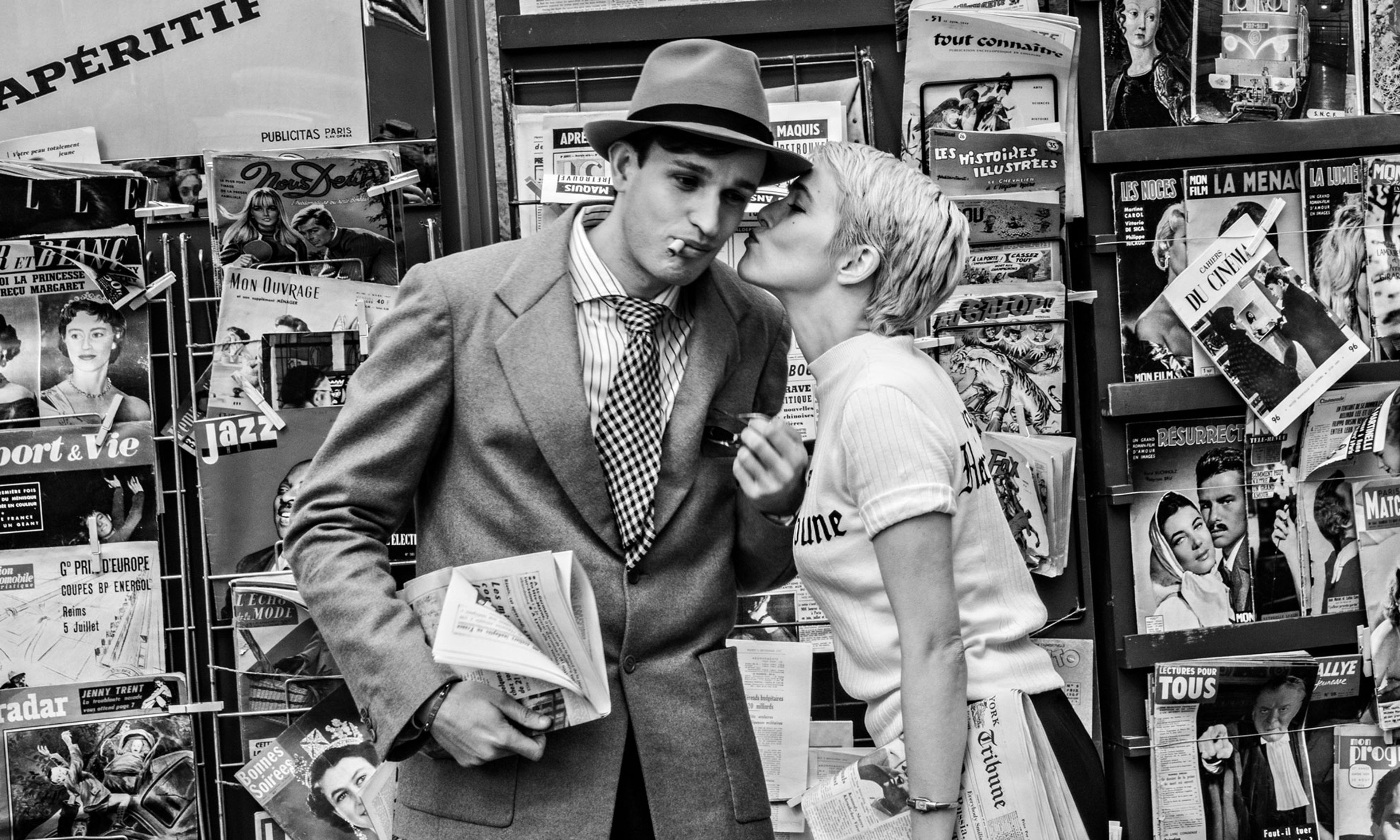
Zoey Deutch and Aubry Dullin in <i>Nouvelle Vague</i>
Salutations to Richard Linklater, the Texas-born filmmaker known by many inept, banal indie indulgences (Dazed and Confused; the Before Sunrise, Sunset, Midnight trilogy; and even worse films), for hoisting Nouvelle Vague, his French-language tribute to the making of Jean-Luc Godard’s Breathless. Until now, I thought Linklater’s approach to cinema had nothing in common with my own interest in movies, but Nouvelle Vague conquers my dread. It is irresistible.
Filming in black-and-white, Linklater re-creates the late 1950s era when Godard and his film-critic colleagues Claude Chabrol, François Truffaut, Jacques Rivette, and Eric Rohmer at the Cahiers du Cinema magazine crossed over into feature filmmaking; they initiated the French New Wave (Nouvelle Vague). Gorgeous images shot by David Chambille painstakingly preserve the final flowering of spectatorial choice — when filmmakers and audiences could opt for either color or monotone -- also the last moment of film fiction’s link to both photojournalism and classical cinema.
Linklater introduces each major player connected to the gestation of Breathless, with their names on screen as they look into the camera — as if staring at us. (It’s the same magnetism of Brigitte Bardot’s close-ups in Viva Maria!) This gives the film immediacy, letting the New Wave’s fabled history confront the present. And if you don’t know those great names, the challenge is akin to the aesthetic revolution through which the New Wave — particularly Godard’s Breathless -- changed movies forever.
This casually brash approach is inspired. Nouvelle Vague respects the fact and the glory of its enormous subject (perhaps especially following Godard’s death in 2022). Linklater knows he’s capturing a turning point in cultural history and that Breathless is still radical and wonderful. So he shows his most surprising command of craft since the animated film Waking Life (2001). His rigor, precision, and humor convey such purpose that Godard and his stars Jean-Paul Belmondo and Jean Seberg can be represented by acceptable facsimiles (respectively Guillaume Marbeck, Aubry Dullin, and Zoey Deutch).
Unlike the cast in Michel Hazanavicius’ Godard Mon Amour (Redoubtable) biopic, these actors provide unexpected Brechtian distance. They evoke the familiar icons; thus we experience Breathless anew. When Godard directs his finale, he says, “Let’s make the saddest shot in the history of cinema. Right up there with Bergman, who does a superb job in Monika” -- the combination of reenactment and outright cinephilia is intoxicating.
Linklater reveals his own cinephilia (love of cinema). His recent Blue Moon, a mawkish eulogy to songwriter Lorenz Hart, suggested that Linklater’s emotional and esthetic connection to cultural heritage was nil. Dedication is implicit in the title Nouvelle Vague, not The New Wave, and evident in the script by Holly Gent and Vince Palmo Jr. that was translated into French by Michèle Halberstadt and Laetitia Masson. It impressively recalls legends about the making of Breathless while compressing many of Godard’s most remarkable pronouncements and aperçus. Marbeck is never seen without Godard’s trademark sunglasses yet conveys the agile intellect the world assumed it knew — emphasis on agility, for a wit as charming as he was irascible.
Godard’s commitment to making his feature debut behind Truffaut, Chabrol, Rivette, and Rohmer verged on an obsessive prodigiousness that drives the film — true to the unique ludic quality of the nouvelle vague. A sense of rationality and persistence complements what we know about both the narrative and lore of Breathless. The connecting anecdotes come alive in Godard’s interaction with Raoul Coutard (Matthieu Penchinat), his cinematographer, a former military cameraman who knew his stuff but was waiting for his art destiny. Coutard’s gruffness matches Godard’s. They agree on the lightweight Éclair camera for mobility, manipulating and utilizing Ilford film stock, and more: “I’m trying to capture reality at random,” Godard tells him. “Let’s continue our search for the instantaneous and the unexpected.” Showing art as work, Linklater confirms the Godardian gift that Columbia University’s film scholar Stefan Sharff singled out, noting, “That’s not genius, that’s talent.”
In his admiration for Breathless, Linklater avoids the trap of sentimentalizing talent or genius, perhaps by insisting on what he knows from his own filmmaking experience: compromise, the mix of personalities, and the necessity of holding on to a vision that Godard, both practitioner and scholar (writing under the film critic pseudonym Hans Lucas) learned from film history. Godard revived D. W. Griffith’s silent-era improvisation for the era of synch-sound. A marvelous scene with his producer Georges de Beauregard (Bruno Dreyfürst) reveals that the impresario for the Cahiers critics’ transition to filmmaking was affectionately called Beau Beau: “I have nothing written down. I wouldn’t show it to you if I did,” Godard tells him. “I don’t take days off.”
Godard’s extraordinary guts, courage, nerve, and arrogance are evident with every viewing of Breathless. The French New Wave and Breathless itself derive from the transactional show business miracle described when Godard tells Beau Beau, “I couldn’t dream of working with a producer who could not be a friend.”
It’s extraordinary for an American filmmaker spoiled by the anti-intellectualism of Hollywood and amateurishness of the indie movement to appreciate the ingenuity and grace of the art movement that Godard’s Breathless represents. What a heady pleasure to see Linklater catalogue Godard’s understanding of Western thought and aesthetics, faithfully reproducing his philosophical pith — as in the nearly enchanted sequences when Godard meets with Robert Bresson in a Paris subway or his idol Roberto Rossellini holds forth: “Cinema is a moral affair. There is no technique for grasping reality. Only a moral position can do so. Filming should only be done in a state of urgency and necessity. No mysticism. I’ll be watching.” That profundity can only be bested by the commonsense way Linklater follows it.
Linklater never imitates Godard; the Before Sunrise trilogy was failure enough. Instead, he re-creates privileged Breathless moments from reverse points of view. The ultimate delight of Nouvelle Vague recalls F. Scott Fitzgerald’s The Last Tycoon: Linklater appreciates that even as early as Breathless, Godard held in his head “the whole equation” of cinema and business, art and politics, exploitation and morality.
Not since Minnelli’s Band Wagon has any film detailed the charm and mystery of production process, as when Seberg and Belmondo discuss performance strategies. (Deutch’s particular triumph is showing Seberg’s art ethic without violating the memory of her beauty and fate.) They wrangle with Godard when creating the intimate bedroom tête-à-tête — from Faulkner quote and Sam Fuller homage to Godard’s pratfall response to Seberg’s mockery. A game where Belmondo and Seberg improvise Joy, Tranquility, Surprise, Confusion, Sadness, Disgust, Fear, Horror, Despair, and Joy again captures their contrasting acting styles — and Godard’s spirit. Linklater, plus the many loyal French cinephiles in the end credits, take a bow.
https://www.youtube.com/watch?v=UufRzKVFseg
About the Author
Armond White is National Review’s culture critic and the author of New Position: The Prince Chronicles and Make Spielberg Great Again: The Steven Spielberg Chronicles.
Featured Tags
Advertisement
Advertisement


Comments