Share this story
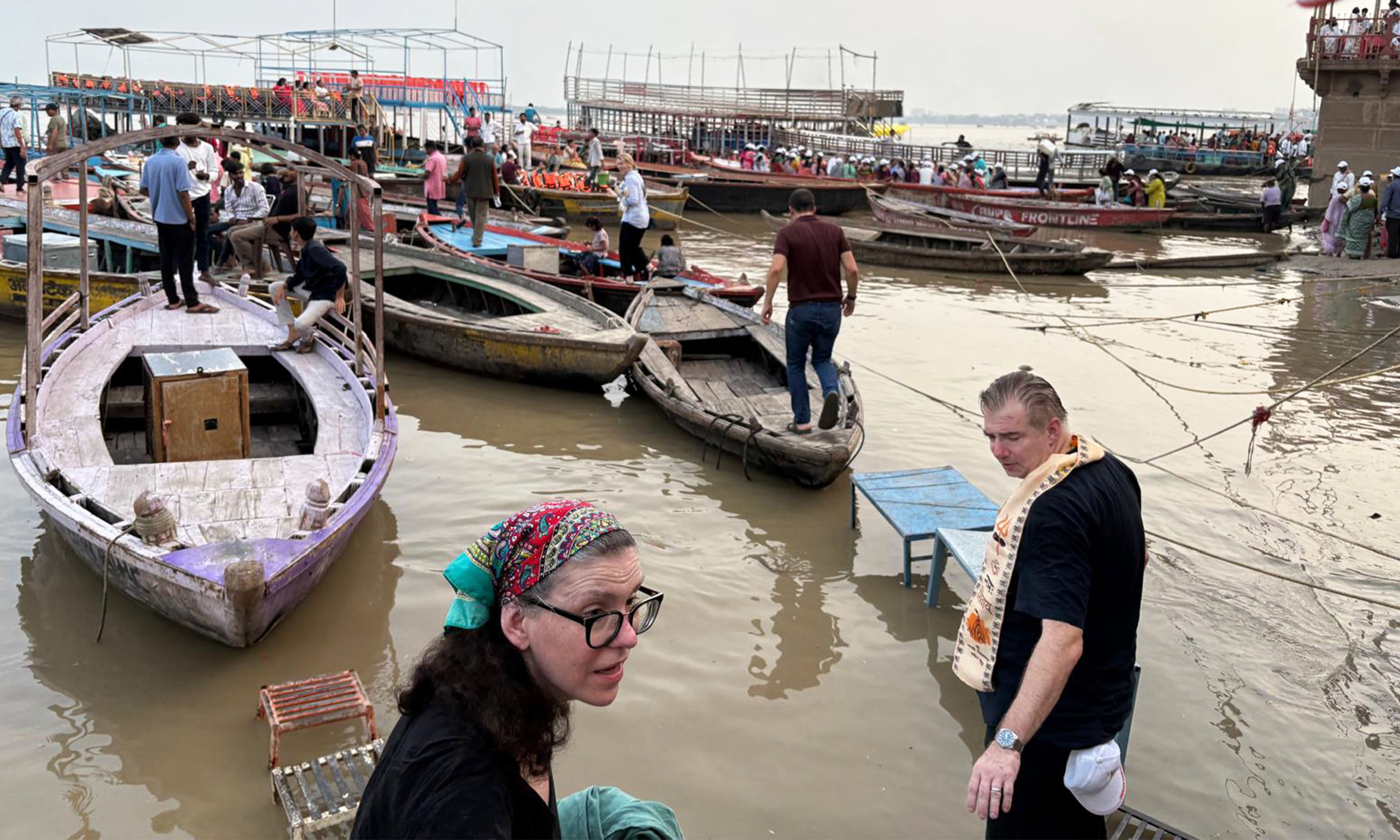
<i>Washington Post</i> columnist Megan McArdle and our intrepid correspondent put their balanced reporting to the test on the Ganges in Varanasi, India.
Nagpur and New Delhi, India — As October began, from a stage under the hot sun in Nagpur I watched thousands of Indian men, in white short-sleeved dress shirts, brown pants, and black caps, line up and demonstrate martial arts and yoga. It was part of a vast, elaborate ceremony celebrating the 100th anniversary of the founding of the Rashtriya Swayamsevak Sangh, or RSS, which Wikipedia ominously describes as a “right-wing” Hindu nationalist “paramilitary organization.”
Then the announcer proclaimed the names of the distinguished guests in attendance, including a former South African health minister, a royal Brahmin from Thailand, and “Jim Geraghty of National Review.”
Every now and then in life, you can almost feel the freeze frame, followed by the voice-over: “Yup, that’s me. You’re probably wondering how the heck I ended up here.”
The fine people at the Hudson Institute, including Walter Russell Mead, and the Foundation for India and Indian Diaspora Studies thought it would be a good idea to bring me and a few other Washington journalists to the subcontinent for a bit more than a week to meet Indian government officials, discuss the state of U.S.-Indian relations, and see some of the wonders of this country.
I am proud to report that, as far as I can tell, I didn’t make anything worse.
U.S.-India relations are in a rough patch after a period of smooth sailing. Since 9/11 or so, we’ve been hearing predictions that the U.S. and India are about to form a lasting and serious partnership -- two former British colonies, one English-speaking and the other with English as a major language among many, turned nuclear-armed democracies menaced by Islamist terrorism. In 2019, President Trump welcomed Indian Prime Minister Narendra Modi to the “Howdy Modi” summit at NRG Stadium in Houston, with 50,000 in attendance and the prime minister high-fiving spectators in the crowd like a Super Bowl champion.
And yet . . . that new era of a grand U.S.-India partnership always seems just over the horizon. (The Indian government really does not like the term “alliance,” inferring unwanted obligations to other countries or a loss of sovereignty from the term, so they discuss their foreign policy entirely in terms of “partnerships.”)
The Indians aren’t thrilled about Trump’s new tariff regime, but they’re willing to negotiate new terms, and those negotiations are, as of this writing, still ongoing. One of the recurring complaints I heard on my trip was the Indian sense that Trump himself doesn’t seem to know what he wants from negotiations. (Japanese trade negotiators have made a similar complaint.) In May, Trump claimed that India “offered us a deal where basically they are willing to literally charge us no tariff.” The Indian government disputed Trump’s characterization of their offer; Trump repeated it again in September, fuming that “they should have done so years ago” but not elaborating on why he hasn’t accepted the offer that’s allegedly on the table.
On August 7, Trump imposed a 25 percent retaliatory tariff on India and, a few weeks later, imposed an additional 25 percent tariff on the country for purchasing Russian oil. In a meeting in New Delhi under Chatham House rules -- meaning I can tell you what was said but not who said it -- a high-level economic adviser to Modi characterized his government’s response to Trump’s tariffs as “not escalation, but we have stood our ground.”
The economic adviser characterized the tariffs as a minor headache, a relatively small factor in the $4 trillion Indian economy. “Instead of having 7.5 percent growth,” he said, “we’ll grow at about 6.8 percent” this year. He emphasized that India is not interested in a deal that leaves a low level of U.S. tariffs in place as some sort of symbolic tribute to Trump or concession for past tariffs on U.S. goods. “We would not take 15 percent, like Europe did.”
That “we won’t be like Europe” attitude is worth keeping in mind. Since Trump has returned to office, visiting leaders of allied nations have accepted the necessity of showering him with gushing praise and flattering his ego. Because of the Indian electorate’s sensitivity to being seen as subservient to Western powers -- thanks a lot, legacy of colonialism -- Modi can never appear to be sucking up to the American president. From all evidence, Modi respects and even likes Trump, but he can’t allow himself to be seen as deferential to him.
What really drives the Indians up the wall is when Trump talks about Pakistan. The two countries had a brief but intense shooting conflict in May (see Clifford Smith’s “The Kashmir Conundrum” in NR’s October 2025 issue). The Trump administration, understandably concerned about two nuclear-armed, longtime rivals firing cruise missiles and ballistic missiles at each other, reached out to both countries, looking for a path to de-escalation and a cease-fire. While the precise details are murky, on May 9, as one report summarized it, a “combination of military escalation alongside U.S. pressure and inducement appear[ed] to have led Pakistani leaders to signal that they would cease additional hostilities if India did so as well.”
Since then, Trump has repeatedly boasted that he ended the war, an exaggeration that irks the broad swath of Indian policymakers who loathe any notion of some outside force imposing a peace plan on them and their most hated rival.
Even more infuriating to the Indians, Trump keeps gushing about Pakistani General Syed Asim Munir, who was promoted to field marshal -- just the second man to hold that title in Pakistani history -- in May for his leadership during the conflict. Trump has called Munir a “very great guy” and “my favorite field marshal from Pakistan.” This may well be standard-issue Trump off-the-cuff schmoozing, but India’s press characterizes Munir as “an unapologetic jihadist” and “an existential threat” to the country.
Munir is apparently the kind of guy who will attend a black-tie event for the Pakistani-American community in Tampa, Fla., and casually declare, “We are a nuclear nation. If we are going to go down, we will take half the world down with us.”
Modi and his Bharatiya Janata Party remain popular, even if his coalition won a slightly smaller share of the vote and fewer seats last year than in 2019. In the last national election, Modi and the BJP’s alliance received more than 235 million votes. In 2024, just under 155 million Americans voted in the entire election. And India counted all its votes faster than the state of California finished its tally -- although, let’s face it, that’s not a high bar to clear. The BJP’s big-tent alliance with other parties, the National Democratic Alliance, enjoys a majority in both houses of the Indian national legislature and runs the governments in 21 of 28 Indian states.
In other words, Modi is the only game in town, and he’s not going anywhere for a while. He became the second-longest-serving Indian prime minister this summer and reportedly wants to break the record of Jawaharlal Nehru, who served from 1947 to 1964. Modi has already annexed one of Nehru’s signature accomplishments: The Nehru jacket, the men’s tailored coat with stand-up collar, is now often referred to as a “Modi jacket.”
Modi joined the Rashtriya Swayamsevak Sangh, a Hindu nationalist organization with 5 million members, at age eight. The RSS, which has been called “boy scouts with attitude,” is an umbrella organization with its hands in all kinds of key groups around India -- from Modi’s party to a wide variety of trade unions, religious groups, charities, and the country’s biggest cancer research and treatment hospital in Nagpur.
RSS chief Mohan Bhagwat warmly welcomed us at the organization’s Nagpur headquarters and contended that when he and other RSS leaders use the term “Hindu,” they do not mean it in the religious sense but as a synonym for the Indian people.
“There is no non-Hindu Indian, there is no non-American American,” Bhagwat said. “Hindu refers to all the people of India, not just those of the Hindu religious faith. . . . Christian, Muslim, you are the sons of this land, the same descendants of our ancestors.” Many of India’s Muslims -- 14 percent of the population, 172 million people -- are unconvinced of the RSS pledge of peaceful mutual coexistence. Nationalist movements have a long history of turning against religious minorities.
Within the facility in Nagpur, and all over India, you see swastikas. The right-facing swastika (of which the Nazi symbol is an evil variant) represents the sun, prosperity, and good fortune; the left-facing “sauvastika” represents night and Kali.
Nagpur boasts that it is the “tiger capital of the world.” After all our RSS meetings, we drove about two-and-a-half hours to the Tadoba Andhari Tiger Reserve. Alas, the only tiger I saw was the logo on a Singaporean brand of beer, though we kept running into other tourists who showed us pictures of the ones they’d seen. I did see a sign by the reserve’s crocodile-laden lake reading, “Absolutely no swimming. Survivors will be prosecuted.”
Longtime readers will recall my trips to Ukraine and my blistering contempt for the Russian invasion and Vladimir Putin, which is so intense that I can’t root for the Washington Capitals hockey superstar Alex Ovechkin. Alas, the Indian government is almost as friendly to Putin and his regime as Ovechkin is.
Some of this reflects old Cold War ties; Nehru adopted a policy of “nonalignment” between the West and the Soviet Union, which was a polite way of being more friendly to Moscow than to the U.S. But the invasion created a new and lucrative economic opportunity for India, because Russians suddenly couldn’t directly sell their oil to countries enacting sanctions.
From the start of the war in February 2022 to March 2025, India spent $238 billion on crude oil and coal from Russia at cheap prices. The good news on this front is that when U.S. sanctions on Rosneft and Lukoil finally kicked in this November, five key Indian refiners paused orders for Russian oil intended for December arrival, accounting for about 65 percent of India’s Russian oil imports. On November 6, when asked about tariff negotiations, Trump told reporters that Modi “stopped -- largely, he stopped buying oil from Russia.”
“The way India sees it, Russia has been a tried and tested friend,” Jayadeva Ranade told me. Ranade is considered India’s preeminent expert on China and spent much of his career in the Research and Analysis Wing, his country’s foreign-intelligence service. He noted that a key Indian objective is to keep Russia from growing too close to the Chinese. “We treat Russia the way we have been treated, which is that Russia, whenever it has assisted us, has not demanded anything in return.”
On September 3, 2025, Xi Jinping and the Chinese government celebrated the “Chinese People’s War of Resistance Against Japanese Aggression and the World Anti-Fascist War,” or what everyone else calls the Allied victory in World War II. Xi invited many world leaders to the country’s largest-ever military parade in Tiananmen Square in central Beijing. Modi attended, along with Putin, North Korea’s Kim Jong-un, President Masoud Pezeshkian of Iran, and President Aleksandr Lukashenko of Belarus. Watching Modi stand alongside those guys felt like watching Tom Hanks attending a Hell’s Angels rally.
Unfortunately, all around New Delhi, experts told me that Modi was likely to continue to play footsie with Putin. That Modi economic adviser said the Indian government sees Russia as “a very old friend, and we do not have a transactional view towards our partners.”
At a think tank briefing, an Indian foreign policy scholar brought up the tired old charge that NATO had somehow provoked Moscow into an invasion full of bombing runs on kindergartens by expanding to Russia’s borders. Readers, I don’t think I get enough credit for not losing my temper; I didn’t even cough “bullsh**” under my breath. Look at a map, pal. NATO has been on Russia’s border since Norway joined in 1949. Poland joined NATO in 1999, and it borders Kaliningrad. Nobody “provoked” Putin into doing anything.
Add it all up, and the shapers of India’s foreign policy keep demonstrating an enormous blind spot for Putin’s atrocities.
Our hosts wanted to make sure we experienced more than just meetings with government officials and think tank types, so we spent a bit more than a day in Varanasi, sometimes nicknamed the “Vatican of India,” or sometimes India’s “Holy City of Death.”
According to Hindu belief, Varanasi was founded by Shiva, one of the principal deities in the faith. Depending on which version of the story you believe, either Shiva or his wife Parvati dropped an earring in the river there and never found it, making it a holy spot.
Hindus cremate their dead, and they believe that if a deceased person’s ashes are laid in the Ganges at Varanasi, his soul will be transported to heaven and escape the cycle of rebirth. So it is a huge deal for many Indians to either cremate their loved ones and bring their ashes to Varanasi or bring their bodies to Varanasi to burn right there on the riverbank. We in the West are usually skittish about being around dead bodies, so it is less than reassuring to know that not every human body gets fully cremated before being tossed into the Ganges, and some families can’t afford cremation and just throw the corpse in there.
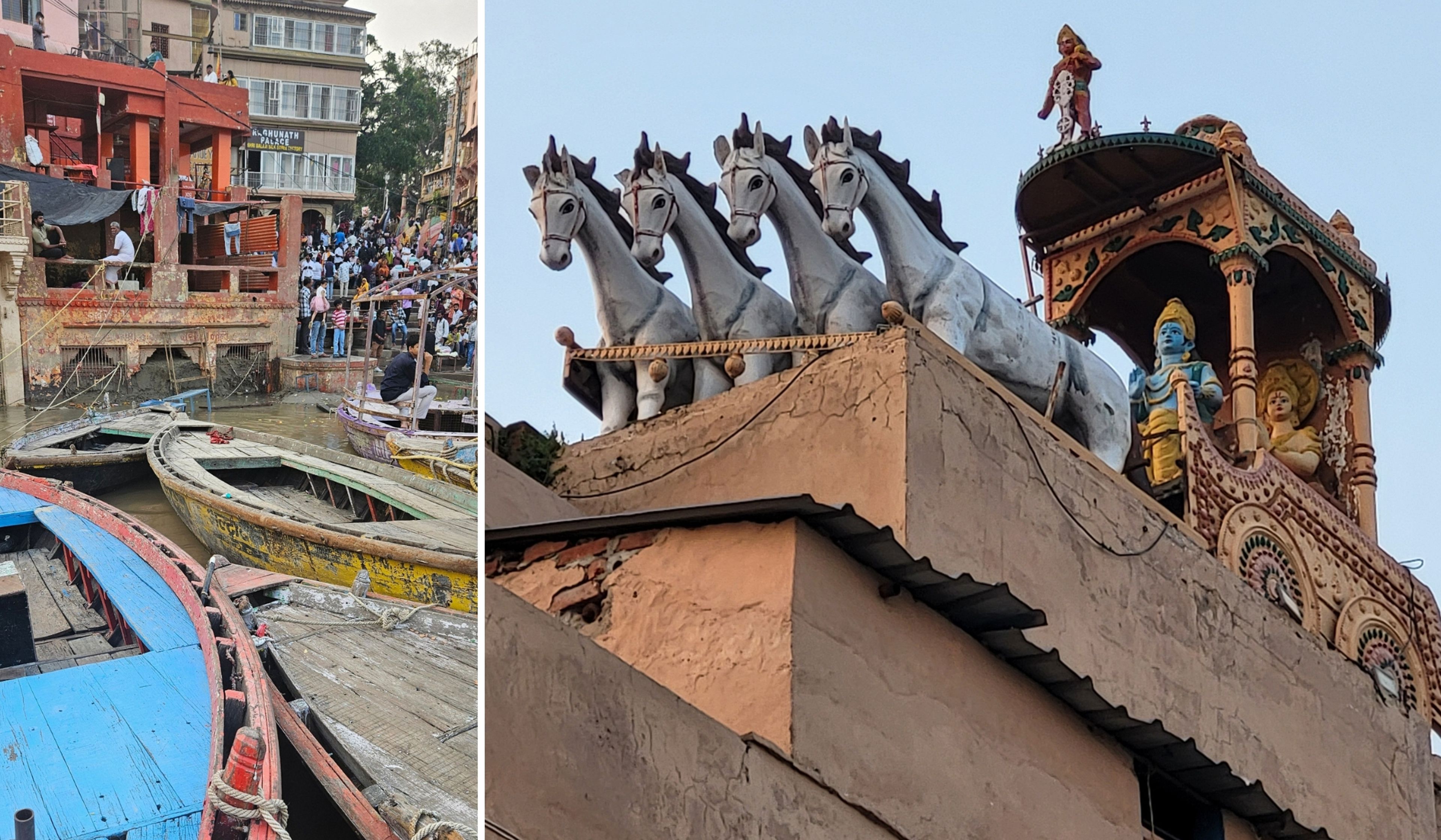
In addition to being one of the world’s holiest sites, the Ganges River is, I regret to inform you, one of the most polluted bodies of water in the entire world. As one Harvard Divinity School report noted, “Almost five billion liters of sewage flow into the river every day, only a quarter of which is treated. By Varanasi, the Ganges is an open sewer. Fecal bacteria at this point is 150 times higher than the safe level for bathing, let alone drinking.” (And mind you, that’s before all the human remains get thrown in by mourners.) Nevertheless, we did see a mother and child bathing in the river.
Our guides had organized a boat ride for us, but there are no proper dock facilities at this spot in Varanasi, just boats tied to each other, sometimes five or six abreast. To get to our boat, we had to jump from one to another. Of course, when you step on one side of a boat, it sinks a little while the other side rises, so it was like jumping on rickety seesaws. Thankfully, one by one, my little band of journalist colleagues made it, with only one open-toed shoe forced to step on a milk crate submerged one inch below the water level.
And yet, after a few minutes on the river, somehow the experience was strangely magical. Most of the buildings and ghats -- riverfront steps -- along the Ganges in Varanasi are hundreds of years old; a century or two ago, this place didn’t look all that different. We saw the cremation fires, which burn round the clock, and great piles of wood. Death never takes a holiday.
The oldest Hindu scriptures, a millennium or so before Christ, mention cremation as a sacred rite. For a long time -- long before the United States existed -- the Indians have done their own thing, and they aren’t all that interested in outsiders telling them how to change.
For American policymakers, that means our partnership is going to have some good days and some bad days. But in a dangerous world, that will have to do.

About the Author
Jim Geraghty is the senior political correspondent of National Review.
Featured Tags
Advertisement
Advertisement
Comments