Share this story
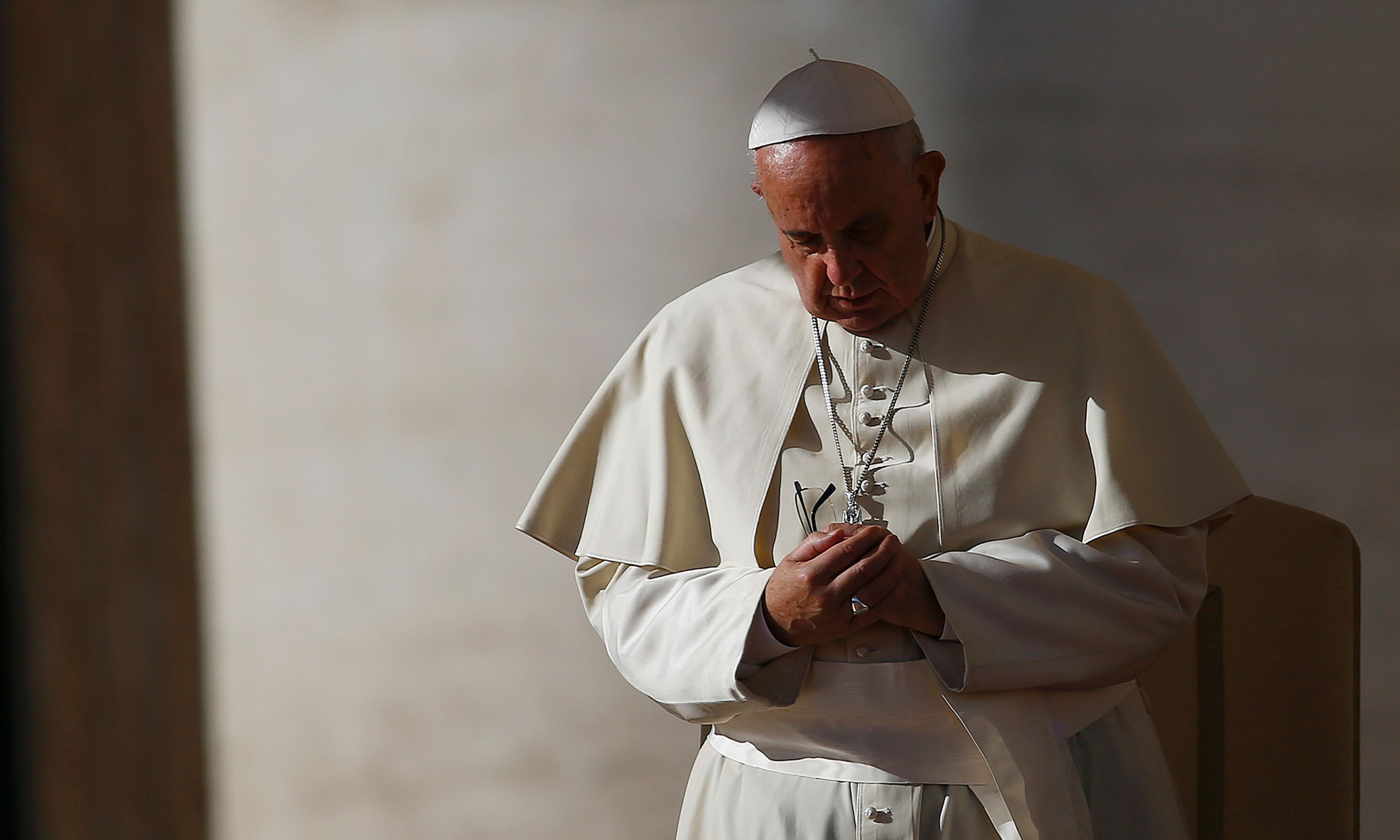
Pope Francis leads his Wednesday general audience in Saint Peter's square at the Vatican, November 19, 2014.
We join with so many millions in praying for the repose of Pope Francis. He was the first pope to take the name of that beloved saint, the first Jesuit pope, and the first pope grounded in the Western Hemisphere. His pontificate will be remembered for its welcoming words, and the pontiff’s many humane gestures — from tipping the hotel staff himself immediately after his election, to embracing the lame, and advocating for the dignity of immigrants at a time when some would-be leaders in Europe advocated sinking them into the Mediterranean. We also join in the prayers for the College of Cardinals, who must pick a man who will, inevitably, become a symbol of Christianity’s present life in the world, and of religion itself.
But if charity in the days after death requires us to be respectful, the period of interregnum also requires clarity and truth. Pope Francis was a man of the church in the 1970s, at times provocatively iconoclastic and informal in his attitudes and speech. This led to quotable homilies and memorable insults. He criticized “airport bishops” and accused journalists of “the sickness of coprophilia,” being aroused by feces. Pope Francis was also a product of a Jesuit order in fantastic and decadent decline, often needlessly characterizing orthodox Christian belief as an enemy of charity or an obstacle to the corporal works of mercy. This error repeatedly led him to a profound anthropological pessimism. As an example, he tasked theologians and church leaders with finding a way to permit divorced Catholics to receive Holy Communion even as they remained in second marriages, which the church considers adulterous. The resulting document partially fell to the heresy of Gallicanism (national religion), allowing national conferences of bishops to establish their own interpretations of Saint Paul’s call to receive “worthily.” It led the pope and his theologian friends to speculate openly and offensively that perhaps more than half of all Catholic marriages were in some way invalid. (The church used to have confidence in the validity even of pagan marriages.) The pope endorsed Cardinal Kasper’s theology, which held that some forms of obedience to God’s law are not for “ordinary Christians,” only heroic ones, effectively denying Saint Paul’s assertion that God’s grace is sufficient to help sinners live holy lives.
Pope Francis’s pontificate began with high hopes of curial reform, to address financial scandals and remaining problems of governance related to the child-abuse crisis. These were the scandals that reportedly chased Benedict XVI into retirement, for fear that after a stroke or the onset of senility, he could be overwhelmed and outmaneuvered by the corrupt. Financial reform, led by the Australian Cardinal Pell, was stymied by Cardinal Angelo Becciu, who was later indicted for corruption. And though he would dramatically and abjectly apologize for the church’s role in abuse scandals, even some that did not happen — as in the Canadian schools scandal — abuse scandals regularly cast a shadow on Pope Francis. The pope’s office intervened in Father Inzoli's trial, until it became unsustainable. Francis ended the limitations put on Cardinal McCarrick by Pope Benedict, only taking action against him when it became a public matter. His pontificate has been a major patron of the disgraced artist Father Rupnik, who sexually abused nuns and then offered them sacramental pardon for sins committed with him. He scolded lay people who objected to his promotion of Bishop Gustavo Zanchetta in Argentina, later convicted of abuse. No greater testament to the failure of Francis to hold his brothers accountable can be had than that at his death, the role of Camerlengo falls to Cardinal Kevin Farrell, who was a close assistant of the disgraced Marcial Maciel and Cardinal Theodore McCarrick and now implausibly claims total ignorance about the character of those two men.
Pope Francis made a special habit of denouncing “rigid” young priests, especially those who were bringing back traditional clerical garb — fiddleback chasubles, or full cassocks — or liturgical practice. This culminated in a dramatic and self-defeating reversal of Pope Benedict’s lifting of the ban on the Traditional Latin Mass. Complaining that adherents of the Traditional Latin Mass were fostering a separatist attitude, Francis sought to prohibit them from celebrating in parishes that also practice the post–Vatican II liturgy. In fact, the opposite had been the case — Pope Benedict’s relaxation of restrictions had decreased the radicalism and alienation of tradition-minded Catholics.
Francis’s revision of Catholic teaching on the death penalty, though in continuity with recent predecessors, struck many Catholics as discordant with earlier teaching.
Despite all this, perhaps the most lasting legacy of the Francis pontificate will be the images it produced. First, of his Urbi et Orbi blessing on March 27, 2020, during the midst of the Covid-19 pandemic. The image of the solitary pontiff lifting the monstrance into the darkest of dark nights was a gesture that acknowledged and in some ways healed those suffering isolation and grief. It was the ideal image of a pontiff, lifting up the source of life itself, and rebuking the darkness. Second, the final image of him passing through the crowds at St. Peter's on Easter, just hours before his death. In each instance, the duties of the office transfigured the man into a sign and symbol of hope in the face of death.
The College of Cardinals now has the duty to choose Francis’s successor. We know from wide reporting that many cardinals are tired of the feeling of civil war in the church over doctrine and liturgy. But we hope this feeling does not lead them to select for inoffensiveness and mediocrity or ideological balance. They should look to Jesus's choice of Peter, who, though he stumbled and denied Christ, never gave in to despair. Peter was a sturdy man, boldly vowing to die for his Master, or crying out for his help as he sank while walking on water. That is to say, the college should choose the man among them who, whatever his qualities, puts himself closest to our Savior.

About the Author
The Editors comprise the senior editorial staff of the National Review magazine and website.
Featured Tags
Advertisement
Advertisement

Comments