Populism Is Having a Moment in Australia
Written by John Gustavsson
Will it last? Only if the country’s One Nation party can avoid the pitfalls experienced by other populist parties.
Share this story
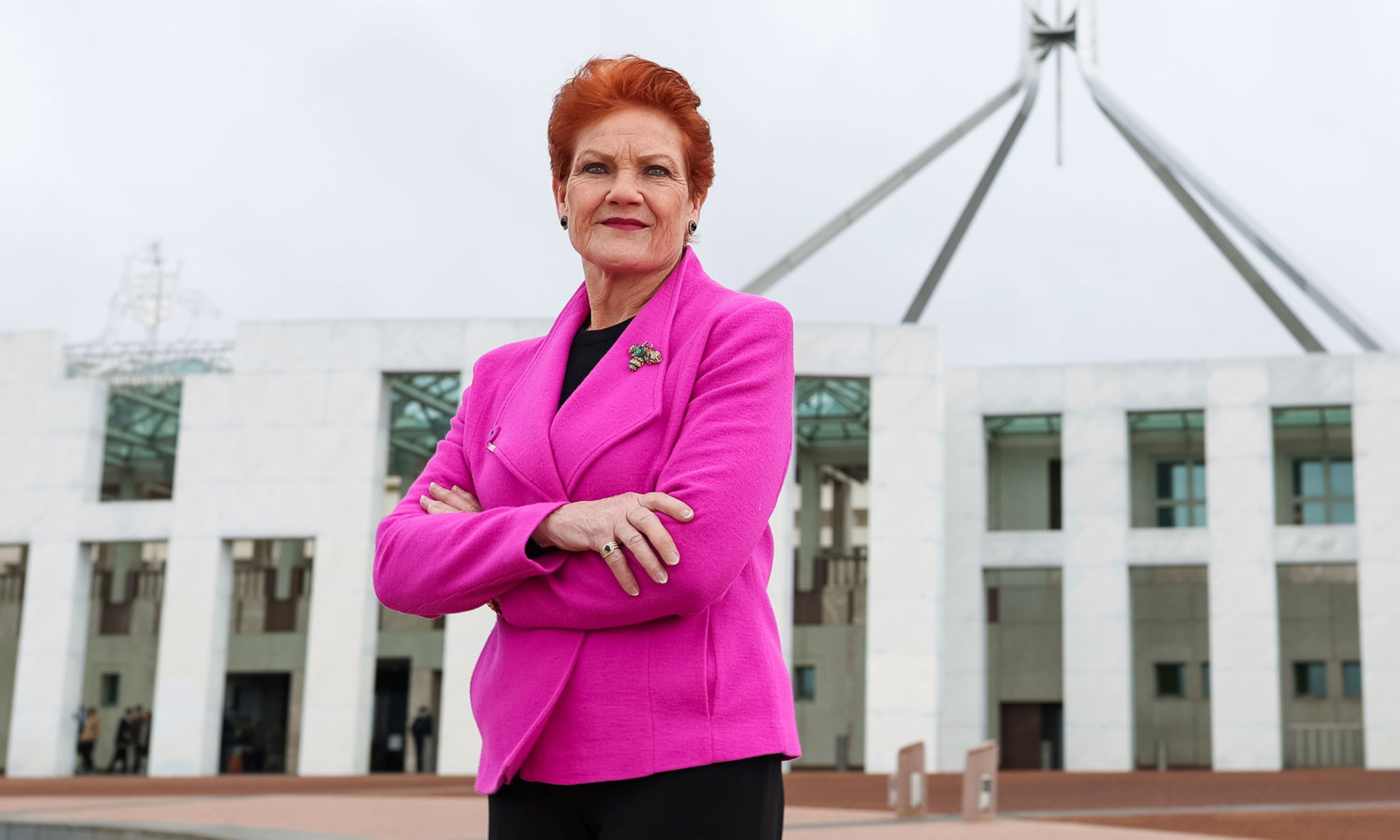
One Nation leader Senator Pauline Hanson in front of Parliament House in Canberra, Australia, July 28th, 2025.
Australia has long been immune to the populist, anti-immigration politics that have taken hold in much of the Western world. But that is now changing, with the populist right-wing One Nation party rising to 25 percent in the polls — an astonishing surge from the country’s election of nine months ago, when the party received around 6 percent of the vote. Still, the question remains: Can One Nation mature into a party ready for government?
One Nation is not the new kid on the block. After being founded on an anti-immigration platform in 1997 by first-term parliamentarian Pauline Hanson, One Nation performed surprisingly well in the elections the following year, scoring over 8 percent of the vote. After that, however, Australia’s right-wing Liberal-National Coalition government took decisive action to curb immigration. Policies included setting up offshore detention centers in Papua New Guinea, as well as on the isolated island nation of Nauru, where asylum seekers arriving by boat were housed while their cases were processed.
Another policy change instituted by the Liberal-National Coalition caused asylees arriving via boat to be granted only temporary visas with limited rights (those arriving were not offered family reunification, for example). To show how serious they were, in 2001 the government ordered the Special Air Service to board a container ship carrying hundreds of refugees to prevent it from disembarking on Australian soil.
Following these reforms, the number of asylum seekers arriving by boat plummeted from more than 5,500 in 2001 to just one in 2002. With one of its central policy issues largely mooted, and facing internal turmoil, One Nation saw its vote share cut in half in the November 2001 election.
After this, and amid some legal troubles of her own, Pauline Hanson resigned from her party’s leadership. But her departure didn’t help her party’s performance — One Nation would continue to languish, winning less than 1 percent of the vote in three consecutive elections.
Under the left-wing Labour government that won Australia’s 2007 elections, the offshore detention policy was repealed in 2008, causing a spike in boat arrivals so severe that the same government was forced to reintroduce the policy just four years later.
But this proved to be too little, too late for Labour, which went on to lose the 2013 election; voters disaffected by the Left’s record on immigration once again turned to the mainstream right-wing Liberal-National coalition. Meanwhile, while asylum migration fell under the Coalition’s strict policies, other migration spiked post-pandemic as the government (unsuccessfully) sought to revive the economy by fast-tracking visas for skilled workers and student migrants.
In 2022–23, net overseas migration to Australia reached over half a million, meaning that almost 2 percent of the country’s population was made up of immigrants who had arrived in the previous year. The foreign-born share of Australia’s population now stands at 31.5 percent, higher than at any point since 1892. The majority of the new immigrants come from South Asian countries, most prominently India.
Crucially, these policies were implemented by a Liberal-National Coalition government. This, combined with the harsh lockdown policies introduced by that same government, hurt the Coalition’s credibility with rural and conservative voters.
Enter One Nation. One Nation voters correctly diagnose the elevated levels of immigration as a major contributor to the surging cost of housing, with average rents increasing almost 45 percent in five years (though it should be noted that NIMBY and environmental policies have arguably contributed as much or more to this rise). After Hanson’s return as leader in 2014, One Nation slowly began to grow again. The final months of the 2025 election campaign saw the party reach new polling heights. And following the election, rather than focus on the growing populist challenge — as it had after the 1998 election — the Liberal-National Coalition chose the centrist, self-proclaimed feminist Sussan Ley as its new leader in an attempt to win back the female voters it had lost in what was a landslide defeat to Labour.
Clearly, this was the wrong move: The general chaos and weakness of the official opposition provided fertile ground for One Nation to grow. The government’s response to the antisemitic mass shooting on Bondi Beach this past December — proposing stricter gun laws and cracking down even more on “hate speech,” rather than directly addressing radical Islam — supercharged this growth.
It seems that Australia and One Nation are following a similar script to that of the Britain, where after a landslide defeat in 2024, the Conservative Party now finds itself trailing Nigel Farage’s Reform UK in the polls.
These two parties, however, also share similar weaknesses — weaknesses that are more pronounced in the case of One Nation. The first is purely technical: The next Australian federal election is not scheduled to be held until 2028. This gives both the government and, more important, the mainstream Liberal-National Coalition time to regroup and counter the threat — as both the Tories and the Coalition, who last week pushed out Ley as leader, are attempting to do.
Second, One Nation revolves around its leader, Pauline Hanson, even more than Reform UK revolves around Nigel Farage. In fact, the party’s full official name is Pauline Hanson’s One Nation. The party’s constitution dictates that Hanson, 72, is president for life and grants her far-reaching powers, including the right to appoint her eventual successor.
Right-wing populist parties tend to start off with certain ill-conceived ideas, which are then gradually shed as the party grows, gains more experience with parliamentary work, and attracts more experienced professionals. The Sweden Democrats, Italy’s National Alliance, and France’s National Rally are all examples of parties with troubled pasts but that nevertheless matured as the old guard gave way to new talent.
One Nation, sadly, has not followed this path. The party’s platform is staunchly protectionist, which is particularly absurd considering that Australia is running a trade surplus. Furthermore, since its founding, One Nation has proposed the creation of a government-owned People’s Bank, which would offer low-interest loans to prospective homeowners, small businesses, and farmers. Any American old enough to remember the subprime mortgage crisis should understand why this is a bad idea. Rather than merely criticizing excessive, self-flagellating environmental policies, Pauline Hanson has made it clear she believes that climate change is a hoax, and she embraces increasing the use of coal.
With nobody able to challenge Hanson, policies such as these cannot be effectively weeded out or refined through internal debate. The party’s program may struggle as voters begin to weigh One Nation as a potential governing party, rather than as just a protest vote. Australia’s ranked-choice voting system also puts the party at a disadvantage: As a polarizing party, One Nation is quite “transfer toxic,” with few voters having them as their second preference.
For now, One Nation can capitalize on immigration discontent, since Australia’s political mainstream, after years of carefully managing the issue to avoid giving fuel to populists, completely lost the plot. Only time will tell if this discontent can carry One Nation to victory in the next election, or whether the party’s internal weaknesses and immaturity will make this yet another false dawn for Australian populism.
About the Author
John Gustavsson is a writer from Sweden and holds a doctorate in economics. He is a former adviser to the Sweden Democrats in the European Parliament.
Featured Tags
Advertisement
Advertisement



Comments