President Trump Was Playing for Time in His Iran Speech
Written by John Fund
The little-known U.S. weakness is that it’s running out of high-tech munitions.
Share this story
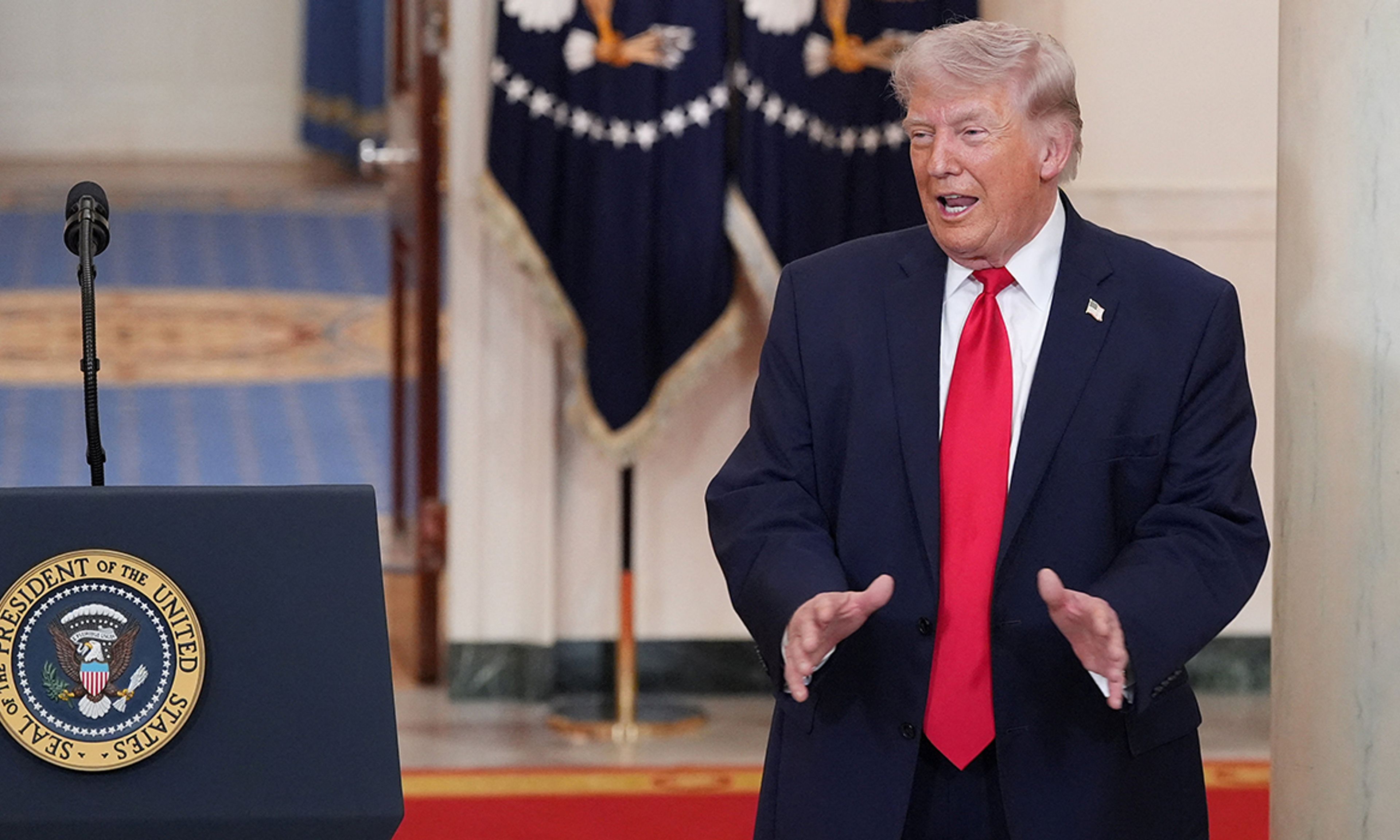
President Donald Trump gestures after delivering an address to the nation about the Iran war at the White House in Washington, D.C., April 1, 2026.
President Trump’s speech to the nation on the Iran war was both an update and an attempt to buy time. He needs it until he either concludes successful negotiations with Iran or decides to further punish it if the shipping lanes in the Strait of Hormuz remain closed.
Trump’s threat to further “decimate” Iran by destroying its economic infrastructure may be real enough. But it can’t be implemented until the USS George H. W. Bush Carrier Strike Group arrives in the Persian Gulf area between April 8 and 14. That adds the armament of a third U.S. carrier to the two already in position.
The price of oil is increasing, but the real price spike is in jet fuel, diesel fuel, fertilizer compounds, and liquid natural gas. Prices have just about doubled in those areas. The Financial Times reports on a “global wave of energy rationing,” with countries everywhere curbing fuel use.
Andrew Sissons of the British research foundation Nesta flatly says “the global supply of oil and gas is going to be down by maybe 20%. It’s a supply crisis.”
Trump needs to reinforce investor confidence that inventories outside the Persian Gulf are sufficient, at least for the next couple of weeks, to bridge the gap until the George H. W. Bush carrier group arrives in the Middle East and an endgame to the conflict becomes more clear.
That gap will also give the administration time to replace some of the vast stores of missiles and other munitions it has expended since the war began on February 28. The U.S. fired more than 850 Tomahawk cruise missiles in the first four weeks of conflict, along with more than 1,000 air-defense interceptor missiles. That rate will burn through a Tomahawk inventory that normally is replenished by a few hundred each year.
Making matters worse, U.S. weapons depots were already depleted after the Biden administration sent huge munitions shipments to Ukraine for use in its war against Russia.
Katherine Thompson, a former Trump Department of Defense official, says “the Trump administration unfortunately inherited a really crappy situation when it comes to the state of our munitions stockpiles.”
Napoleon once said “an army marches on its stomach” to explain how logistics determined military success. Today, the United States and its allies are depending on high tech in their 21st-century conflict with Iran. Sophisticated air-defense interceptors have blocked the vast majority of the missiles that Iran has used to retaliate. Aircraft-launched weapons have decimated Iranian targets.
But top American generals warned Pentagon leaders before the war that there was a danger that the military would deplete its stockpile of high-tech precision weapons if hostilities dragged on.
The Iranian regime is playing a waiting game, hoping it can survive until that happens. “We’re using (munitions) faster than we can replace them,” says Kelly Grieco, a former assistant professor at the Air Command and Staff College.
All this underlines the urgent need for the Pentagon to double down on the procurement and production of its weaponry.
The Pentagon has made reform of that process a top priority in the first year of Trump’s second term. It’s an enormous challenge given that the Pentagon’s fiscal year 2026 procurement requests alone top $1 trillion (not billion), including over $6.5 billion for munitions.
Pete Hegseth has declared that “at the War Department, business-as-usual is over.” In a tour of defense contractors last month, he excoriated “yesteryear” practices when “we could work at the glacial pace of just a few prime contractors and that was tolerated, a world with vendor-locked, over-budget, behind-schedule contracts.”
Central to Hegseth’s vision is a new plan for incorporating artificial intelligence throughout the military in order to cut through bureaucracy and spur innovation. The use of frontier AI already bore fruit in January, when the military used it to capture and remove former Venezuelan President Nicolás Maduro.
The Pentagon has told contractors that it plans to step up its acquisition of the most cutting-edge AI systems, and it recently sidelined Anthropic’s AI tool Claude over a dispute with the company over possible limits on its battlefield use.
But there’s no dispute over the valuable role that AI is playing in transforming the Pentagon’s outdated procurement process. A former Pentagon official in Trump’s first term told me that AI “can be the magic key to unlocking the clogged procurement pipeline that keeps us from delivering cutting-edge weapons and matériel to the front lines.”
Faster than we realize, AI is going to be used by the U.S. and its allies, as well as its adversaries, for military purposes, just as every other technology our species has invented has.
But for now, we are in a race against time. On the one hand, there is the ability of President Trump to coerce or intimidate the Iranian regime into ending the war on U.S. terms. On the other, there is the stark reality that the U.S. cannot sustain maximum pressure on Iran for that much longer before its weapon storehouses are depleted and its allies completely revolt against the U.S. over their sky-high energy prices.
[slideshow slideshow="1924783" /]

About the Author
John Fund is National Review’s national-affairs reporter.
Featured Tags
Advertisement
Advertisement



Comments