Puncturing the New Deal's Mythology
Written by Phillip W. Magness
False Dawn: The New Deal and the Promise of Recovery, 1933–1947, by George Selgin (University of Chicago Press, $35)
Share this story
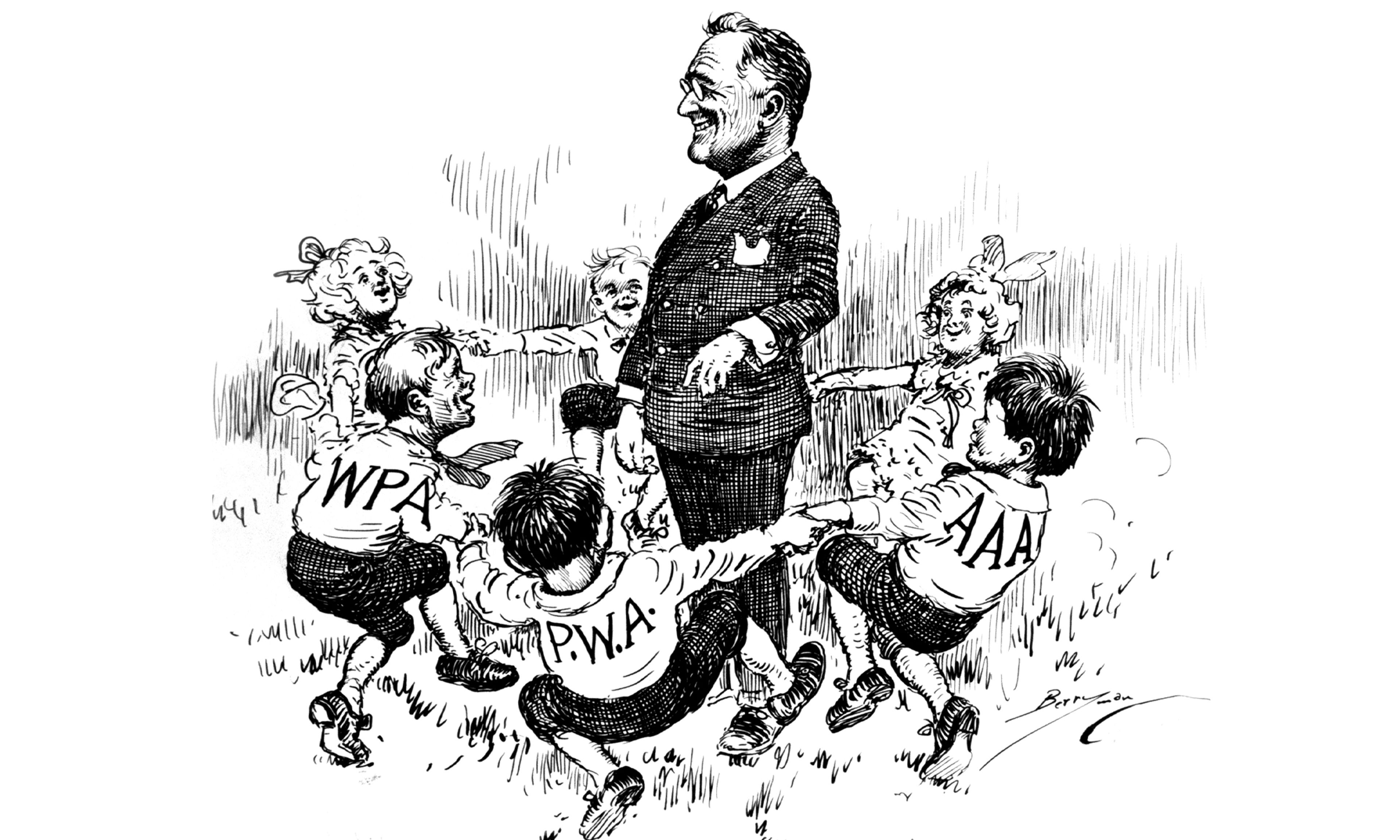
<i>Ring Around a Roosevelt — Pockets Full of Dough!,</i> by Clifford K. Berryman (1938)
The New Deal still has a pervasive presence in macroeconomic policy discussions, even though more than 90 years have passed since Franklin Delano Roosevelt launched this suite of government programs to combat the Great Depression. Its celebrants today usually hail from the progressive left, although a nascent strain of the “postliberal” movement also lays claim to the New Deal’s legacy. JD Vance recently touted Roosevelt’s approach to economic planning, which Roosevelt continued through World War II, as a model “of lawmakers wielding the market to the betterment of our people.” Both groups share a belief that Roosevelt succeeded in tempering the ravages of an unregulated market, allegedly at the root of the Depression, and agree that such tools should be redeployed today.
Critics of the New Deal are fewer in number, although they have occupied a place among American conservatives since the program’s inception. They see a failed exercise in centralized economic planning that cursed succeeding generations with an unprecedented expansion of federal power and commensurate levels of perpetual deficit spending. Roosevelt’s detractors rail against a politicized history profession that celebrates the New Deal for ideological reasons, while the program’s claimed efficacy at alleviating the Great Depression seldom faces serious interrogation.
George Selgin’s False Dawn: The New Deal and the Promise of Recovery, 1933–1947 attempts to make sense of these competing narratives by placing the New Deal under a microscope and asking whether it met its stated goal of economic recovery. Note that this objective was only one part of Roosevelt’s call for “relief, recovery, and reform,” although, as Selgin explains, it is the central question of the New Deal’s economic legacy. The other two objectives involve political values, whereas recovery can be measured empirically.
In taking up this charge, Selgin dives into a crowded academic literature that is largely pro-Roosevelt. In 2019, Senator Chuck Grassley (R., Iowa) sparked a firestorm in the history profession with a passing observation that the “New Deal in the 1930s didn’t work.” Several historians responded with indignation, proclaiming that there was a broad consensus over the alleged successes of Roosevelt’s recovery program. Few were more vocal in this assessment than Roosevelt biographer Eric Rauchway, a professor of history at the University of California, Davis. In a follow-up essay, Rauchway denounced claims about the New Deal’s failure as “myth,” “falsehood,” and an exercise in “bullsh**” uttered without regard for evidence or substance. Pointing to simple industrial-output data from the 1930s, Rauchway declared that “not only did the U.S. economy begin to grow during the New Deal; it grew rapidly.” Post hoc ergo propter hoc ensues, thus the New Deal simply must have been the cause of the recovery. Indeed, the only major fault Rauchway can bring himself to state about the New Deal is that it “should have been bigger, sooner,” thereby embracing the advice of John Maynard Keynes even more fully than Roosevelt is presumed to have done.
Selgin illustrates the folly of this narrative early on, though not by attacking it directly. Assessments by historians tend to speak of the New Deal as a cohesive whole -- a sweeping economic vision, deftly enacted and with clear results. Selgin inverts this narrative by separating the New Deal into its component programs and asking how each, specifically, performed its stated objective of economic recovery in its respective domain.
Scalpel in hand, Selgin takes his reader through a chronological progression of programs and policies that we collectively know as the New Deal. An economic historian of money, he opens his inquiry with the banking crisis at the outset of Roosevelt’s term in 1933 -- a suitable starting point, given that our best theories of the Depression’s origins pinpoint monetary mismanagement as the underlying mechanism. His study progresses through the Banking Act of 1933, the creation of federal deposit insurance, and Roosevelt’s decision to withdraw gold from private circulation. The New Deal’s famous “three letter” programs -- the National Recovery Administration (NRA), the Agricultural Adjustment Act (AAA), and the Reconstruction Finance Corporation (RFC, which Roosevelt inherited from Herbert Hoover and greatly expanded) -- are surveyed in depth next.
Selgin concludes by investigating two common questions about the later New Deal era: whether, and to what extent, Roosevelt adhered to a Keynesian prescription for business-cycle relief, and what role World War II played in economic recovery. After evaluating the evidence, each chapter concludes with a succinct assessment of the original question: Did that component of the New Deal contribute to economic recovery, and, if so, how?
Selgin’s analysis contains greater nuance than is typically found in anti–New Deal tracts from the right. He credits Roosevelt, for example, for the occasions when he corrected economic policy mistakes that preceded his administration. Yet the picture that emerges of the New Deal is far from the systematic and visionary program of its reputation -- it’s a case of stumbling through, with programs “concocted on the fly” under vague authorizing legislation and in the absence of coherent objectives from the chief executive.
This is not a new discovery, as Selgin acknowledges. Many eyewitness accounts from political insiders attested to its improvised nature. Raymond Moley, an adviser turned critic of FDR, dismissed the notion of a “unified plan” behind the cluttered assortment of policies known as the New Deal. Similar accounts appear in reminiscences of NRA architect Rexford Tugwell and Labor Secretary Frances Perkins -- two unambiguous supporters of the administration. Historians have simply opted to discount their testimony since it undermines the notion of the New Deal as a cohesive recovery project.
Selgin’s survey of programs is detailed, evenhanded, and revelatory. He documents how Roosevelt, an opponent of federal deposit insurance well into the banking crisis of early 1933, did a convenient about-face on the issue after essentially inheriting the famous “bank holiday” notion from emergency discussions in the closing days of the Hoover administration. In the wake of this stopgap measure to halt bank runs, Congress appended a more permanent deposit-insurance program to pending legislation. Selgin shows how an incensed Roosevelt threatened to veto this provision, only to later claim credit once he realized he lacked the votes to defeat it.
Roosevelt’s monetary measures, including the confiscation of private gold in 1934, exhibited a similar pattern of conflicting objectives and muddled instructions to the treasury. To the extent that the United States received a monetary stimulus, it came not from any policy design but from the exogenous factor of gold and other capital fleeing Europe for the safety of the United States as Hitler’s storm clouds gathered over the continent.
The New Deal’s ostensible recovery programs similarly suffered from an administration that implemented them on the fly, often with unintended consequences and counterproductive implications. Selgin resurrects a long-neglected study of the NRA by the Brookings Institution in 1935, documenting how its disorganization quickly led to capture by interest groups and to a “self-defeating” spiral of wage manipulation that likely harmed more Americans than it helped. Insofar as these policies posted successes, they tended to be sporadic and adventitious, whereas the missteps were many.
In perhaps the most surprising set of chapters for readers on the right, Selgin revives John Maynard Keynes’s reputation as a New Deal critic. It has become something of a convention among historians to portray Roosevelt and Keynes as transatlantic intellectual compatriots, advancing a new macroeconomic paradigm in concert to sweep away the laissez-faire tendencies of a previous era and replace them with proactive policy rooted in social science. While FDR certainly increased counter-recessionary spending, Selgin shows that he broke from Keynesian stimulus theory by insisting on commensurate increases in taxes and attempting to balance the budget at the precise moment that Keynes recommended deficit spending. Whether one accepts the wisdom of Keynes’s prescriptions or not is immaterial to the historical point that Roosevelt deviated substantially from the British economist’s theories, and likely had little affinity for or even knowledge of them as the New Deal played out.
In keeping with the book’s even tone, Selgin is charitable to the historians he engages. It is difficult to avoid the conclusion, though, that he has upended many long-standing conventions, and decisively so. Rauchway’s attempts to vindicate the New Deal’s economic performance come across as the amateur musings of a pundit when compared with the methodical analysis of False Dawn. In similar fashion, Rauchway’s portrayal of Roosevelt as a consistent economic theoretician, often operating in dialogue with Keynes, emerges as a battered wreck. The difference in both cases comes from Selgin’s stronger command of the underlying economic theory and greater attention to historical detail, even when they lead him to conclusions in tension with his own distinctively non-Keynesian outlook.
A topic as broad as the New Deal cannot be easily dealt with in a single volume, and Selgin accordingly leaves its entitlement programs such as Social Security to other authors. The choice is understandable, given that these measures played a tangential role in the immediate economic recovery.
I nonetheless call attention to one New Deal policy that is often overlooked by both its defenders and critics, despite tangible connections to the Depression and its aftermath. In 1934, Roosevelt signed the Reciprocal Trade Agreements Act (RTAA), authorizing the State Department to disentangle the mess his predecessor left him under the protectionist Smoot–Hawley Tariff of 1930. Unlike many other New Deal policies that emerged only after he took office, tariff reform was an explicit campaign issue for Roosevelt. He endorsed it in a nationally broadcast address from Sioux City, Iowa, that elicited a response from Hoover. Although tariff alleviation alone was insufficient to solve an existing depression that Smoot–Hawley had only worsened, the RTAA largely performed as intended. It reversed course on an inherited trade war and provided the model framework for the postwar liberalization of the international economy. Trade reform may constitute the lone exception to the haphazard economic experimentation of the New Deal, so thoroughly documented in Selgin’s book. Strangely, other New Deal policies attained greater fame despite their poor recovery records, if only because their backers dressed them in the political rhetoric of success.

About the Author
Phillip W. Magness is a senior fellow and the David J. Theroux Chair in Political Economy at the Independent Institute.
Featured Tags
Advertisement
Advertisement



Comments