Record-High Diesel Prices Spell Longer-Term Consumer Woes
Written by Roy Mathews
Better energy policy would help lower the price of diesel, thereby lowering transportation costs and consumer prices.
Share this story
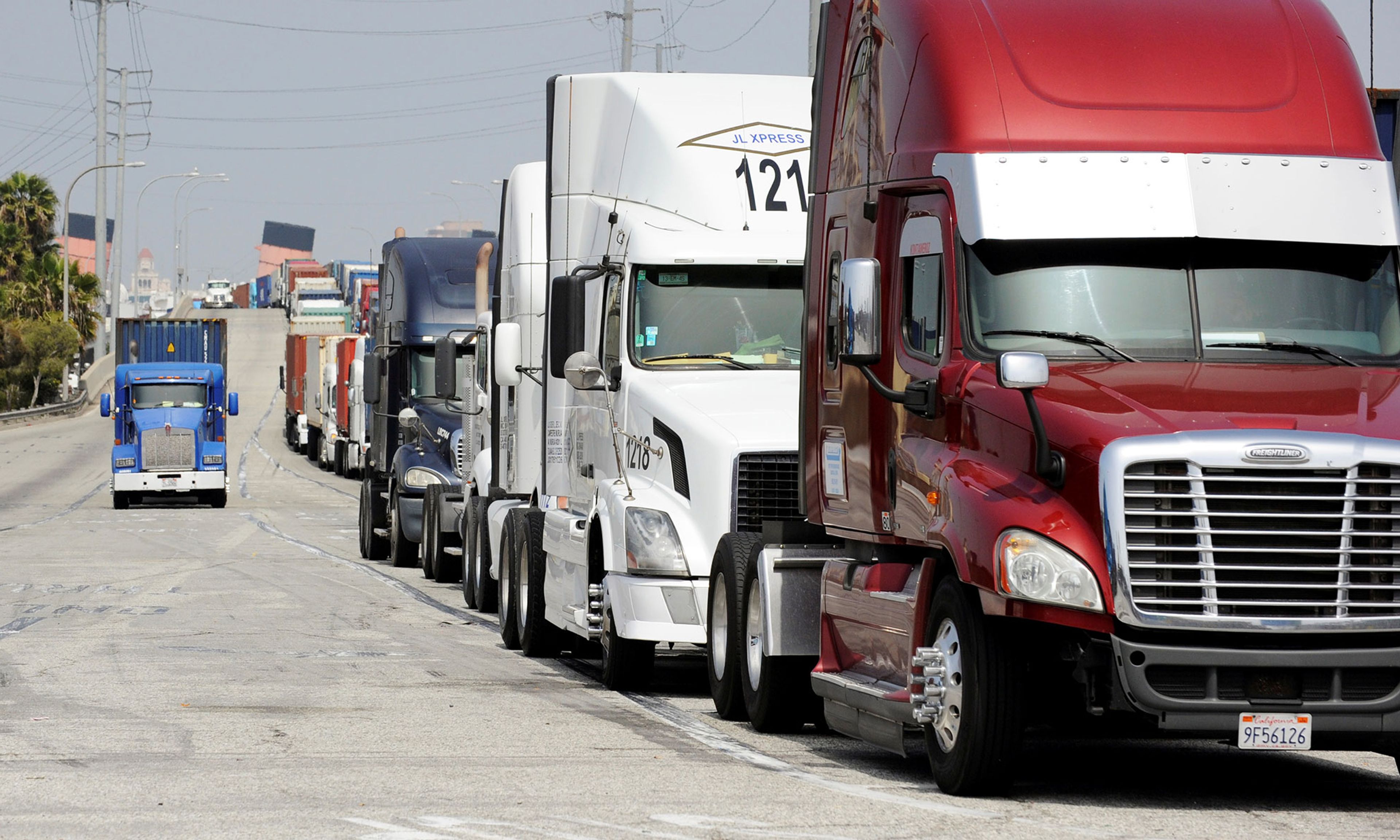
Semi-trucks line up at the Port of Long Beach, in Long Beach, Calif., in 2018.
It was only five months ago that Secretary of Energy Jennifer Granholm laughed at Bloomberg host Tom Keene’s question about increasing domestic oil production, calling it “hilarious.”
No one’s laughing now.
Since late November 2021, Americans have been dealing with record-breaking prices of gasoline, and the fuels that underpin crucial transportation sectors of the U.S. economy are even more expensive.
Last week, the average price of diesel hit a new record high at $5.55 per gallon after being priced at just $3.11 last May -- an increase of 78 percent in a single year. The cost of other middle distillates that power trucks, trains, tankers and agricultural equipment are on the rise as well. These high costs will be passed along to consumers in the form of higher prices.
That’s tough, given that consumers are enduring a 41-year-high bout of inflation and are still trying to navigate shortages of crucial supplies due to supply-chain bottlenecks that became clogged during the pandemic. Yet the Biden administration’s actions fail to address record-low distillate levels.
Now is not the time to force an energy transition. The Biden administration should be championing domestic production of oil and gas. Instead, the administration wishes to appeal to Venezuela and Saudi Arabia to produce more oil for export to the U.S., despite the fact that shipping generates large quantities of greenhouse-gas emissions. Burning more fuel to import foreign fuel is an interesting way to combat climate change, and it won’t solve the energy crunch. In time, domestic drilling will, but the administration isn’t doing nearly enough to encourage that.
Diesel fuel’s unique role in powering the machines that facilitate the transportation, manufacturing, and harvesting of products across the U.S. means that its price depends on several factors. When the economy is growing, demand for diesel rises due to the need to move products to market. Due to the Covid-19 pandemic, diesel prices fluctuated wildly as products piled up in bottlenecks that still have not been resolved.
Now that the economy has reopened, products are in even higher demand, and rail, shipping, and trucking companies must contend with a massive backlog of shipments. The federal excise tax on diesel is 24.3 cents per gallon (a rate fixed years ago), despite diesel engines' getting more miles to the gallon than gasoline engines. To be sure, the tax has never been tied to fuel efficiency, but if an administration that likes to claim that climate change runs through all its decision-making felt the need for an excuse acceptable to its climate activists to cut the rate on diesel, this might be it.
Yet, instead of suspending fuel taxes or encouraging domestic crude production, the Biden administration has chosen to tap the Strategic Petroleum Reserve (something of relevance only at the margins) and already handicapped domestic producers through permit suspensions and price hikes earlier this year. Raising costs, while also releasing the reserve supply of petroleum and pressing for a decrease in overall output, has thrown up more barriers to the industry as it tries to return to pre-pandemic production levels.
Additionally, the Biden administration has reduced the amount of available land for oil and gas development by 80 percent in nine states. While permit suspensions have been struck down in federal court, the large reduction in available land means any oil extracted would be a miniscule for the current energy crisis. The East Coast in particular is experiencing the consequences of these decisions, with distillate stockpiles the lowest since 1996 and diesel being traded at over $200 a barrel in New York harbor.
Another cause of the sustained diesel-fuel-price increase concerns refinery capacity. Several refineries are currently being reconfigured to produce biofuel, rather than diesel. The East Coast’s largest refining facility filed for bankruptcy in 2019, and Phillips 66 announced the closure of its 44,500-barrels-per-day Santa Monica, Calif., refinery in 2020. Phillips also announced the plans to transform its 120,200-barrels-per-day Rodeo, Calif., refinery into a renewable-biofuel facility, slashing its production capacity. Other refineries in Oklahoma, Louisiana, Texas, and Wyoming also are having a portion of their capacity diverted to biofuel production.
If the Biden administration’s energy policy and environmentalists’ pressure on industry continue to hamper domestic diesel production, high prices will be the new norm, even if supply-chain bottlenecks become resolved. It won’t matter that backlogs are cleared out -- high diesel prices will still mean high prices for consumers.
The Biden administration could help to lower prices for American consumers through better energy policy. Encouraging domestic fuel production would reduce the cost of diesel, which would lower the price of transported goods. Unfortunately for all of us, that doesn’t fit the administration’s agenda. They’d rather force through an energy transition, and that will increase costs to consumers indefinitely.
About the Author
Roy Mathews graduated from Bates College in Lewiston, Maine, and previously worked at Aii, an energy think tank in Washington, D.C. He has been published in Law & Liberty, The American Mind, and The National Interest.
Featured Tags
Advertisement
Advertisement

Comments