Renewables: A Greenout in Iberia?
Written by Andrew Stuttaford
The week of May 5, 2025: Iberia shuts down, tariffs, fiscal policy, papal economics, and more.
Share this story
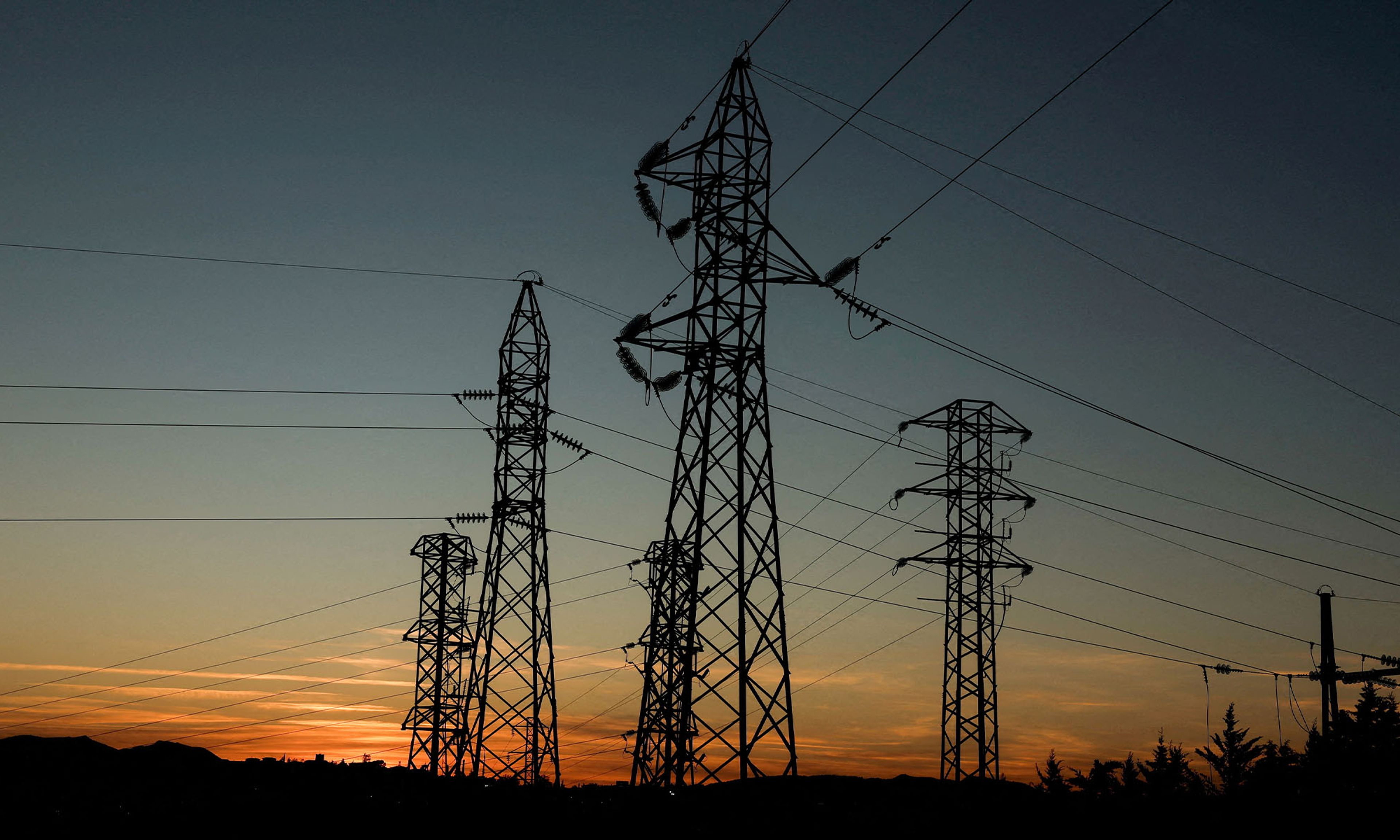
Power lines connecting pylons of high-tension electricity are seen during sunset at an electricity substation on the outskirts of Ronda, during a blackout in the city, Spain, April 28, 2025.
The exciting news (via PV) broke on April 16:
Spain’s grid ran entirely on renewable energy for the first time on April 16, with wind, solar, and hydro meeting all peninsular electricity demand during a weekday. Five days later, solar set a new record, generating 20,120 MW of instantaneous power – covering 78.6% of demand and 61.5% of the grid mix.
Crack open the Cava!
Less than two weeks later the grids in Spain, Portugal, and a small sliver of southwest France (all of which are connected) went down.
Crack out the flashlights!
Trains and metros ground to a halt…Traffic lights stopped working; hospitals cancelled all non-essential operations; mobile-phone networks and the internet went dark.
The chaos lasted for hours. Though Portugal recovered by the end of the day, most of Spain’s electricity was not restored until 7am the next day.
Jesus Diaz in Fast Company (who was in Spain):
As we were walking home, I noticed people searching for cell bars. Some of them were texting. I raised my phone trying to find a connection, like a diviner in search of water. My phone showed 5G and two bars. The internet worked for a few seconds and a torrent of messages poured in. Friends. Work. Family…The 5G turned to 4G, then 3G then E. Then nothing.
Spain’s electrical grid was running as normal until 12:33 p.m. when, suddenly, it suffered a disturbance.
Eduardo Prieto, the director of services for the grid operator Red Eléctrica, said the grid recovered after that first shock. [We now know there were three shocks]. But a second disconnection [which we now know was the third], one and a half seconds later, caused “a degradation of operating variables” of the system, leading to a “massive generation disconnection” and “disconnection of the connection lines with France.”
In the space of a few seconds, 15 gigawatts of energy suddenly dropped from Spain’s supply, Spanish government sources told CNN — equivalent to 60 percent of the electricity being consumed at the time — and the entire Spanish grid collapsed as a result.
The blackout cost lives too, perhaps as many as seven in Spain alone. The economic cost has been estimated at $1.5-$5 billion (translation: no one really knows).
Shortly before that “massive disconnection,” 66 percent of Spain’s electricity had been generated by solar (photovoltaic or thermal) power, with wind producing another 12 percent. The weather was normal (mid-50s to low-70s). Some suggested that wind speeds were the culprit. They had been fluctuating all day but fell sharply, just as there was a midday surge in demand. Another theory puts the blame on a sharp fall in solar generation in southwest Spain. Others suspected a cyber-attack, although that has since been ruled out.
Whatever the cause (and there may have been more than one), the disruption triggered a protective shutdown of the grid. In a piece posted on the American Enterprise Institute’s website, there’s a good explanation why:
[T]he frequency of the [Iberian] peninsular network (which should always be 50 Hz exact) began to drop quickly. The frequency is like the heartbeat of the network [Hz stands for Hertz, the standard unit of frequency, representing oscillations or cycles a second]: if it falls too much, the systems understand that the patient (the network) is collapsing and automatically disconnected so as not to self-destruct. Thus, in just five seconds, the solar and wind farms were turned off —very sensitive to frequency variations—, 15 GW of power was lost suddenly… and the network could not take it anymore…
Relatively few traditional (gas or nuclear) generators were running, meaning there was little inertia to keep things going.
Inertia? To keep things going? Sounds counter-intuitive, but Doomberg comes to the rescue:
Large spinning turbines endow electricity grids with the inertia to ride out minor fluctuations in frequency, reducing the risk of butterflies causing hurricanes. Solar and wind offer no such insurance, relying instead on inverters to deliver product to market.
As the Breakthrough Institute’s Seaver Wang and Alex Trembath relate, worrying about inertia has been portrayed by renewables advocates as old timey:
[W]e have personally heard more than one renewables developer criticize what they saw as an outdated “Westinghouse grid paradigm” built around spinning inertia. Yet this recent Spanish episode—alongside other major incidents such as Winter Storm Uri and the Odessa disturbance in Texas in 2021—have certainly emphasized the enduring value in the “Westinghouse” reliability standards and exhaustive contingency planning that engineers traditionally have enforced on grid operation.
Nuclear (followed by natural gas) furnishes the most inertia.
The Oxford Institute for Energy Studies:
[T]he heaviest rotating masses on any grid, which often provide the highest inertia both in relative and absolute terms, are the steam turbine sets of large nuclear power plants. For the largest individual nuclear units… the shaft string with its turbines and generator rotors can be up to 70 meters long and have a total rotating mass exceeding 1100 tons. Turbines this large operate at “half speed,” meaning this mass is rotating at half the frequency of the grid (1500 revolutions per minute for 50 Hz grids, 1800 for 60 Hz grids), to limit tensile stress. It takes a huge amount of energy to either speed up or slow down such a heavy component…[thus] the dampening effect such a turbine has on any disturbance in the grid.
No spinning turbines are involved with wind or solar. Rather, they connect to the grid electronically, through a device called an inverter.
In other words, beyond a certain point renewables render grids more “fragile.” The logic of that is more investment in gas-fired plants as backup, at least until enough nuclear power has come online. That will take time and money. Keeping gas-fired power plants on standby (or even in partial use) is expensive, but pursuing renewables without them is to risk greenouts, and they will end up proving much more expensive still.
But wait, there’s more (money that needs spending).
Countries like Spain may even have to consider hard limits on how much solar is allowed as a share of total generation at any given time — anathema among renewables supporters. That raises thorny questions about costs: renewables receive generous subsidies and governments may need to pay them not to use the solar panels — a suboptimal use of taxpayer money.
But sure, renewable electricity is “free” or “cheap” (choose your exaggeration), so long as we ignore the billions spent on installing “capacity” (which can be a deceptive word where renewables are concerned, given the nature of intermittency — the sun doesn’t always shine, and the wind doesn’t always blow), and the money spent on subsidies for when there is too much renewable energy and the money spent (or which should be spent) on back-up when there is too little of it.
Until nuclear can assume a greater share of the burden, scrapping existing gas-powered capacity (thus increasing renewables’ share) is madness, even more so as electricity demand is surging.
Blas:
Since 2010, global electricity demand has grown almost twice as fast as total energy use. The trend is likely to continue, in part because of electron-hungry new technologies, and in part simply because the world is getting richer. From 2025 to 2027, global electricity consumption is expected to rise every year by the equivalent of what Japan consumes today.
Blas quotes the International Energy Agency, no climate skeptics (my emphasis added):
On one hand, “systemic challenges will emerge from balancing increasingly renewable-dominated grids” whose output is weather-dependent; on the other, “premature retirement of dispatchable generation without adequate replacements” increases the risk for the grid’s stability.
Blas continues (again, my emphasis added, not that is really needed):
Those dangers were well known in the industry, but largely ignored by the government in Madrid as it pushed into renewable energy. In what today reads like a prescient warning, the parent of the Spanish grid operator wrote in February in its annual report that it faced challenges managing the system. “The high penetration of renewable generation without the necessary technical capabilities in place to keep them operating properly in the event of a disturbance [...] can cause power generation outages, which could be severe” it said. Yes, they knew.
Indeed they did, and the warning signs were accelerating.
In the week before the blackout, Spain saw several power surges and cuts.
A power cut disrupted railway signals and stranded at least 10 high-speed trains near Madrid on April 22. Transport Minister Oscar Puente said excessive voltage in the power network had triggered disconnections to protect substations.
On the same day, Repsol's (REP.MC), opens new tab Cartagena refinery saw its operations disrupted by power supply problems.
The grid suffered from significant instability in the days before the blackout, said Antonio Turiel, a senior researcher with the Spanish National Research Council.
These were warnings of immediate trouble ahead, to add to the general industrywide concern referred to by Blas, which has been discussed for years.
The base requirement for any national energy grid is that it should be resilient, but Madrid knew better. It prioritized its “race” to net zero — which will make no difference to the world’s climate — over resilience. Moreover, it will reduce what’s left of that resilience by abandoning nuclear energy. The lessons of Germany’s farcical Energiewende have yet to be learned in Spain, it seems.
Also not learned, central planning almost never works. The directives went out putting speed (“five years in four,” as the early Soviet planners urged) ahead of practicality. As so often with Soviet-style schemes, they were out of sync, just as they were with electric vehicles, built before problems with charging technology and availability had been sorted out. Wind and solar energy are essentially modular, fairly quick to put up (if local objections can be swept out of the way) and relatively cheap. By contrast, upgrading the grid is slow and expensive. The new generating equipment (wind turbines and solar panels) was being installed before the grid was ready to take it, and in Spain the mismatch was greater than elsewhere in Europe.
For now, Spain has seven nuclear power stations. On April 28, three out of the seven were down, two of them because the price of electricity had fallen too low to make it worthwhile (financially) to use them.
Isaac Orr and Mitch Rolling explain:
[W]holesale power prices were slightly negative from midnight on April 29th leading up to the blackout. These negative prices are well below the marginal operating costs of the conventional power plants, and as a result, the market essentially told them that their services were not needed.
A distorted market, of course, because of the way that the price of renewables does not (among other subsidies) reflect the cost of backing them up.
Adding to the risks to grid stability is the fact that Portugal and Spain are an “energy island,” in the sense that they don’t have many connectors to link them to the European grid as they should (according to Matthew Wielicki, 5 percent, rather than 15 percent).
A couple of days before the blackout, Julian Wettengall of Clean Energy Wire spoke to Joan Groizard, Spain’s secretary of state for energy.
To enhance our energy security, we need to reduce our dependence on fossil fuel imports and expand renewable energy. These are the resources we do have, and they are key to reindustrialization. In the wind turbine sector, we have the full supply chain in Spain, we have 60 percent of the solar supply chain as well, and we also have quite a few elements of the renewable hydrogen supply chain.
No mention about resilience. If the lights go out, Ms. Groizard, or are even at substantial risk of going out, that’s not energy security.
She continued (my emphasis added):
The transition towards renewable energy and boosting energy efficiency are integral parts of our energy security strategy. When we defined what we call our energy and climate strategic framework, it was meant to be more than just climate policy. It was energy security policy, industrial policy and social justice policy.
Opting for unreliable energy is an unusual way of boosting energy security and industrial production. but there we are. Mind you, having everyone sit in the dark, or in a motionless elevator or train is, I suppose, an excellent example of social justice at work, destructive, yet egalitarian.
Naturally, the Spanish authorities said that they were going to find out what had happened. A cyber-attack was quickly ruled out, but the investigation does not appear to be getting very far.
Via our Jim Geraghty, I noted this May 5 report in Bloomberg:
Spain’s high-voltage electricity grid suffered more power generation disruptions than previously known ahead of the country’s largest ever blackout, the government said.
“There is new information: there was a third loss of power generation” that occurred 19 seconds before the blackout and adds to two that were previously known, Environmental Transition Minister Sara Aagesen, the country’s top energy policymaker, said on Monday in an interview with broadcaster TVE. “We are seeking to identify the plants” where the generation collapsed and why this happened.
Until now, the government had said that the blackout on April 28 coincided with the loss of power generation in a plant in southwest Spain followed by a second loss of generation 1.5 seconds later in the same region.
We will find out (maybe) what factors(s) caused this disaster, but that will not change the uncomfortable truth about the fragility of renewables-based systems, which almost certainly contributed to what occurred.
As the Breakthrough Institute’s Seaver Wang and Alex Trembath observe:
It is a simple statement of fact to observe that most of Spain’s solar and wind capacity was wholly unequipped to weather grid fluctuations, possessing none of those shiny new supporting technologies.
They continue:
Now, this blackout is not the inevitable outcome of running an electricity system with substantial amounts of wind and solar power. But it is, frankly, exactly what one would expect from the type of energy transition attempted by the Spanish government: breakneck deployment of renewables, a failure to ensure enough spinning generator capacity to maintain stabilizing grid inertia despite widespread understandings of these risks and vocal warnings from grid operators, and underinvestment in grid capabilities that could compensate for renewable energy’s unique technical risks to reliability. It is a testament to the gravity of such risks that an outage has already occurred, two years prior to the start of Spain’s planned phaseout of nuclear energy…
Spain’s political leadership has ignored the many warning signs of integrating larger and larger capacities of wind and solar, even while resolving to gradually shift the nation’s electricity generation away from its nuclear power plants.
And let’s not forget Portugal. It has, Reuters reports, only two back-up plants — a gas and a hydro plant. Its prime minister now says more are needed.
Oh yes, there’s something else, as Andrew Follett pointed out at National Review:
To make matters worse… overreliance on solar and wind greatly delayed efforts to restart [Spain’s] power grid…as such systems must be slowly and gradually reenergized to prevent another catastrophic collapse. Green energy sources are technically difficult to use for a “black start,” or for restoring unpowered electrical systems. Conventional power systems, conversely, can be reenergized fairly quickly in the event of an accident.
Geraghty:
If government authorities wonder why publics are growing less trusting and more suspicious of those in power, moments like this one are a good example. The consequences for Spain and Portugal were severe, and the authorities are shrugging their shoulders and saying the public will have to wait months for an explanation.
Any suggestion that the Spanish government is attempting to cover up the extent to which its net zero policies were responsible is only likely to stir up the growing (if belated) opposition to this folly. The country’s socialist premier, Pedro Sánchez, has shown no interest in any change of direction. His government is not “going to deviate a single millimeter from the energy road map we have planned since 2018.” This is the language of central planners, the language of fanaticism.
Spain is set on achieving net zero GHG by 2045, negative net zero by 2050, and that’s that.
Contrast the comments of Alberto Núñez Feijóo, leader of the center-right People’s party:
If you have zero conclusive information — zero, zero — how do you know that your energy policy had nothing to do with it? And how can you be sure that it’s not going to happen again if you don’t know what happened?
But Sánchez knows — he just knows— the switch to renewables is the way to go:
Not only are renewables our country’s energy future, they are our only and best option. They are the only way to reindustrialize Spain.
No, they are not the only option. Deciding that they are is a political choice, unconnected to — on any realistic view — #science. And as for being the only way to reindustrialize Spain, well, expensive and unreliable energy is not an obvious way to go.
According to the Financial Times, Sánchez is claiming that the technology existed for solar power to play a stabilizing role akin to turbine-based generation (a reference to the focus on inertia) — and that half of Spain’s solar plants already had it. However:
[R]egulators and the grid operator, he said, must now work to integrate that technology into the system.
Spain has Europe’s lowest ratio of grid spending to clean power investment, according to BloombergNEF, a data provider. In the past five years it has invested an average of 30 cents in the grid for every $1 it spent on renewables, compared with an average of 70 cents in most European markets.
Put less politely, it was grotesquely irresponsible for the Spanish to have proceeded in the way they did, and just about anyone involved either knew it or should have.
That should already be a scandal, regardless of what the inquiry finds.
But surely all this can be fixed?
While global investment in renewables has nearly doubled since 2010, investment in grids has barely changed at around $300 billion a year. The amount needs to double by 2030 to over $600 billion a year to cover the necessary overhauls, according to the International Energy Agency….
The European Commission has estimated Europe needs to invest $2.0-2.3 trillion in grids by 2050. Last year, European firms invested 80 billion euros ($90.5 billion) in grids, up from 50-70 billion in previous years, analysts at Bruegel said while adding investments may need to rise to 100 billion…
Europe has 10.8 gigawatts of battery storage and it will grow to 50 GW by 2030 - much less than the required 200 GW, according to the European Association for Storage of Energy.
Renewables are cheap, they say.
Plugging on with renewables in the way dictated by the race to net zero is nuts, but those running the green “transition” insist on sticking to their plan.
Yet, again, the words of Blackadder’s General Melchett (a caricature of a British First World War general) come to mind: "If nothing else works, a total pig-headed unwillingness to look facts in the face will see us through."
The Forgotten Book
Capital Matters has a (more or less) fortnightly feature, The Forgotten Book, which is written by National Review Institute fellow, the writer and historian, Amity Shlaes. We live in an age of short attention spans, and one of Amity’s objectives is to introduce readers to books or other primary sources that warrant a second look.
In this column, Amity dedicates herself to sharing with Capital Matters readers older, forgotten books, along with new books that aren’t getting the attention they perhaps warrant.
Her latest column can be found here. In this case, Amity draws on an old (1912) issue of the Literary Digest as part of a wider discussion on how some comments by President Taft about Canada backfired.
Sound familiar?
Shlaes:
What is the lesson beyond the obvious, which is that a whisper in the U.S. rings like a roar to Canada, and a roar, an avalanche? It is that making a pitch you don’t even half mean for domestic political reasons can be fatal. Only 14 months after the noble Laurier was booted, Taft, too, was out of office.
The Capital Record
We released the latest of our series of podcasts, the Capital Record. Follow the link to see how to subscribe (it’s free!). The Capital Record, which is hosted by financier David L. Bahnsen makes use of another medium to deliver Capital Matters’ defense of free markets.
The issue of shareholder engagement is one we have covered a lot here on Capital Record. Our partner in this endeavor, Bowyer Research, has gotten the attention of Bloomberg, which unsurprisingly wanted to paint them as “conservative activists.” But what if the reason this matter is not to counter left-wing politics or impose right-wing politics, but rather to drive shareholder value? Is it really that hard to understand why these issues matter in the improvement of company performance?
David takes on the idea that protectionism and globalization are chief rivals and instead suggests that the chief rival of protectionism is free enterprise itself. He critiques Joe Nocera’s recent Free Press article suggesting that the protectionists have been vindicated and instead suggests that the entire protectionist agenda is essentially the plight of the central planner. A careful critique of the tariff dogma, combined with a non-revisionist view of what has transpired in trade and culture over the last few decades.
The Capital Matters week that was . . .
Fiscal
During the 2024 campaign and since, President Trump has mused about replacing the income tax with tariffs. Trump believes that tariffs will put the burden of financing the U.S. government on the backs of foreigners.
Nice idea. Who wouldn’t want somebody else paying our government’s bills? To support his case, Trump correctly points out that until the modern income tax was adopted by the 16th Amendment in 1913, the United States collected the bulk of its revenue through tariffs and excise taxes.
So why can’t the U.S. do that again? If foreign producers of products imported into the U.S. in fact pay tariffs, it might be a good idea. The problem is that’s just not how it works…
Energy
It’s now been a week since that widespread power outage in Spain and Portugal left 50 million people without electricity.
Authorities in both countries say they still don’t know why the power failed, which is A) not reassuring and B) going to spur suspicious minds to conclude that authorities secretly do know why the power failed but don’t want to tell them. Those immediate insistent arguments that the blackout had nothing to do with reliance on renewable energy certainly seem to be driven more by political and reputation concerns than a thorough examination of the evidence.
Tariffs
One of Donald Trump’s more humorous qualities is his ability to undercut his defenders who rationalize grand plans behind his actions. There is no shortage of sophisticated explanations about Trump’s supposedly real goals of promoting U.S. exports or negotiating more free trade deals. But speaking today in the Oval Office during Canadian Prime Minister Mark Carney’s visit to the U.S., Trump said it isn’t primarily about any of that…
One of Trump’s favorite talking points on tariffs is that the U.S. is some kind of free-trade paradise while the rest of the world is staunchly protectionist. It isn’t true, as is apparent if you are even slightly familiar with the federal government’s tangled web of subsidies and trade restrictions affecting large swaths of the economy…
I repeatedly hear a dangerous idea in some corners of the right: the notion that extending the 2017 Tax Cuts and Jobs Act (TCJA) will somehow offset the economic damage of President Trump’s protectionist tariffs. As the theory goes, “as long as Republicans hurry to pass the president’s one big, beautiful bill, all will be okay.”
This is economic fantasy, and it’s time we confront it…
The Tax Foundation’s Erica York has written a piece that examines the effects of Trump’s current tariffs combined with the potential extension of his individual tax cuts…
Joe Nocera has written for the Free Press what feels like the thousandth think piece about how the cold, heartless “neoliberals” took over all of American economic policy in the 1990s and have been proven wrong thanks to Donald Trump. Nocera writes from the perspective of someone who, as a journalist in the ’90s, “covered free trade . . . as if we had been handed Holy Scripture.” Given that journalists’ coverage of religion is reliably awful, it should come as no surprise that their coverage of the economics of trade has been, too…
Transportation
Thirty years ago, California progressives came up with the idea of an 800-mile high-speed rail service that would connect San Francisco, Los Angeles, San Diego, and Sacramento. Their goal was to burnish the state’s cutting-edge image while fighting climate change…
Fiscal Policy
Scott Bessent, Treasury secretary in the second Trump administration, just published a piece in the Wall Street Journal that reads more like campaign spin than sound economic analysis or strategy. In it, he insists that tariffs, tax cuts, and deregulation form a “coherent” growth agenda. But no matter how much lipstick he slathers onto this pig, it remains a barnyard animal: Tariffs remain economically destructive, Trump’s tax plans are fiscally reckless without a serious agenda to cut spending, and deregulation — while essential — will be hard to implement and might not be able to compensate for all the Trump chaos…
Papal Economics
The new pope is taking the regnal name Leo XIV. The last Pope Leo was in office from 1878 to 1903. Perhaps his most famous written work is Rerum novarum, an 1891 encyclical “on capital and labor” that is often described as charting a third way between capitalism and socialism for Catholic teaching. This description is incomplete, if not entirely wrong, as Rerum novarum is very clear that socialism is evil, and markets and private property are essential to human flourishing. And Leo XIII composed some of the strongest denunciations of socialism ever written. It was a major theme of his papacy from beginning to end…
Trade
The easiest way to be wrong in economics is to reason from an accounting identity. That’s because an accounting identity tells you how things add up, not why they change. Treating it like a cause-and-effect explanation mistakes the scoreboard for the game.
Many reporters and commentators have made this mistake since the Bureau of Economic Analysis released its latest GDP report. Analysts point to the first-quarter surge in imports as the source of reduced economic activity. Beyond mere arithmetic, there’s nothing to this. It’s totally wrong as an explanation of how the economy works…
To sign up for The Capital Letter, please follow this link.

About the Author
Andrew Stuttaford is the editor of National Review's Capital Matters.
Featured Tags
Advertisement
Advertisement



Comments