RFK Jr. Gets One Right
Written by Pradheep J. Shanker
He’s correct in questioning the Covid-19 vaccine’s inclusion on the schedule for children.
Share this story
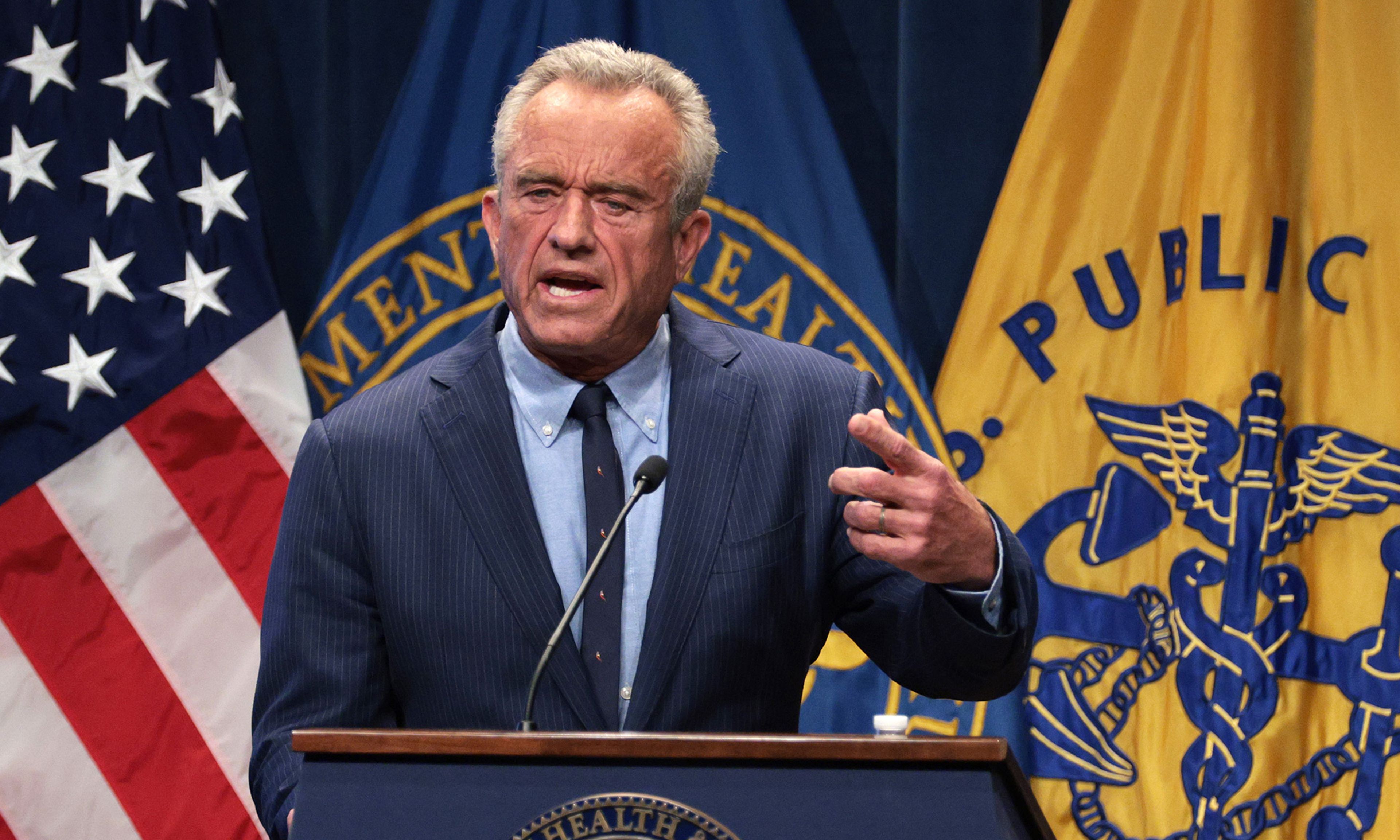
Secretary of Health and Human Services Robert F. Kennedy Jr. speaks during a news conference at the Department of Health and Human Services in Washington, D.C., April 16, 2025.
My criticism of Robert F. Kennedy Jr., secretary of health and human services, has been public for many years and is no secret. Kennedy has not been a science-based policymaker, before or after his confirmation to the Trump cabinet. His proposed policies since becoming the head of HHS have been no better, as he continues to follow his own personal agendas instead of following the science and data.
But Kennedy did get one right: He is suggesting that the Covid-19 vaccine be removed from the federal government’s vaccine schedule for children, the list of vaccines recommended by the top scientists in America that should be universally provided to all children.
Kennedy is correct on this policy.
I’ve been talking about this issue since the vaccine came out in 2021. In fact, in October 2022 when the ACIP (the Advisory Committee on Immunization Practices, the board that decides recommendations on vaccine schedules) decided to place the Covid vaccine on the list, I was highly critical. In a piece at National Review, I criticized the decision:
The recommendation to place Covid-19 on the childhood vaccine schedule was a decision that lacked extensive public debate and should not have been made in haste. It is not based on published evidence and data. We still have not been able to publicly assess and debate the Omicron bivalent clinical-trial data that the CDC has obtained. Many CDC officials have said that the data from that trial is convincing but have not been willing to share it with the rest of us. So, as this matter moves to its conclusion at the CDC, we are left simply to wonder how the agency can justify its decision. . . .
As for the Covid risk to children, it has been clearly established that morbidity and mortality from Covid among those under the age of eleven are very rare. Furthermore, CDC studies have shown that 73 percent of American children already have antibodies to the virus, showing that they were sufficiently exposed to the virus for their bodies to produce a sufficient antibody response. Moreover, studies have shown that, during last year’s Delta wave, natural immunity was 2.8 times more effective in preventing hospitalization and 3.3 to 4.7 times more effective in preventing Covid infection compared with vaccination. Given this data, what exactly is the scientific basis to state that the experts should recommend all children receive the vaccine — even those who have immunity from prior exposure?
The data and evidence are the key to this debate. The evidence for providing the Covid vaccine to older patients, and the immunologically vulnerable, has always been very strong. The first Trump administration’s Warp Speed program was an enormous success. Worldwide, it is estimated that at least 2 million people were saved, largely because of the efforts of the Trump team.
However, these numbers completely change when we are talking about children and young adults. Covid-19 clearly had an asymmetric effect on the populace, with the elderly facing the brunt of the threat. In 2020, before initiation of the vaccine, the death rate among adults aged 85 and over (1,645.0 per 100,000 population) was 2.8 times higher than the rate for ages 75–84 (589.8), and seven times higher than that for ages 65–74 (234.3). On the other hand, childhood mortality was almost nonexistent, other than in complicated cases where patients had weakened immune systems. A 2023 study reviewing deaths during the pandemic showed that, even when studying excess mortality (an analysis that considers all deaths that have occurred in a specific time and place, and thus includes both direct Covid-19 deaths and any indirect deaths), there was no evidence of widespread, significant excess mortality among those under age 25 or excess stillbirths for 2020 or 2021.
Compounding this problem is the fact that the ACIP didn’t completely follow its normal procedures in its approval of the Covid-19 vaccines for children. It was reported that there was a unanimous vote to add the Covid vaccines to the childhood schedule, but there was not. There was no discussion of age or timing or anything else that would be involved in putting a vaccine on the schedule.
The CDC has repeatedly made these mistakes. In June 2022, when discussing Covid boosters, Dr. Marty Makary, at the time a Johns Hopkins professor but now the Food and Drug Administration commissioner, stated his dismay at the procedure involved:
I listened to the meeting, and couldn’t believe what I heard. At times, the committee members sounded like a group of marketing executives. Dr. Beth Bell of the University of Washington said “what we really need to do is to be as consistent and clear and simple as possible,” pointing out that the committee needed “a consistent recommendation which is simple.” . . .
Exhibiting classic medical paternalism, committee member Dr. Oliver Brooks of the Watts Healthcare Corporation said “I think may is confusing and may sow doubt,” adding “if we say should more people will get boosted versus may, then we may have more data that helps us really define where we’re going.” Dr. Brooks was essentially suggesting that boosting in this age group would be a clinical trial conducted without informed consent.
That doesn’t sound like following the science to me.
Ultimately, that has been the problem with the public health infrastructure throughout this pandemic. When thought leaders faced a critical question about the pandemic, they often reverted to a position based on fear rather than on evidence and data.
To put it bluntly, the elderly were at a very high risk of morbidity and mortality during the pandemic, and children and young adults were at almost no risk of such severe complications. Furthermore, although the CDC vaccine schedule is not a mandate (they have no legal power to force anyone to accept it), many school districts have used it to enforce their own mandates. The physicians that make up the ACIP committee, for the most part, do not view their recommendations as mandates, but simply “best science” recommendations. But many states have laws that specifically cite the “ACIP immunization schedule” for determining school requirements. This results in the schedule becoming a de facto mandate across most of the country.
It is important to note that the worldwide standard was not to require that children universally get the Covid-19 vaccine. The United States was out of step with the majority of Western nations. The World Health Organization (WHO), for example, repeatedly rejected vaccine mandates for children because the benefits are middling at best: “Although benefit-risk assessments clearly underpin the benefit of vaccinating all age groups, including children and adolescents to reduce the number of infections, hospitalizations, deaths and long-Covid, the direct health benefit of vaccinating healthy children and adolescents is lower compared with vaccinating older adults due to the lower incidence of severe Covid-19 and deaths in younger persons. As children and adolescents tend to have milder disease compared to adults, unless they are in a group at higher risk of severe Covid-19, it is less urgent to vaccinate them than older people, and those with chronic health conditions and health workers.”
The CDC has traditionally been circumspect in adding new vaccines to the pediatric vaccine schedule. Only those vaccines that have been thoroughly studied, with extensive data and evidence and with a safety profile second to none, have been allowed to be listed. That has not been the case with the Covid-19 vaccine, however. The study panels so far have been very small; the data set that the CDC used to add the vaccine to the recommended list this past summer included only 140 children. As of now, the safety profile of these vaccines has been quite excellent, but we also must admit that they haven’t studied the aftereffects of these vaccines in full detail.
Secretary Kennedy himself has not been steadfast in following the evidence and data in making decisions. Many of us have repeatedly criticized his actions for that. But to be scientifically and logically consistent, we must accept that he isn’t unique in this regard. Our public health leaders largely failed the American people during the pandemic. They repeatedly appeared to make decisions based on politics, disease theater, fear, and a certain disconnectedness from the real world, rather than on data, evidence, and science. Health care experts now find themselves as distrusted as the media and politicians, and the costly consequences are upon us. However, Secretary Kennedy correcting this mistake would be the right decision. The Covid-19 vaccine should have never been added to the schedule in the way it was, and removing it is simply acknowledging that the scientific basis never existed for that policy change. We should welcome that and, most important, require exactly the same level of scientific accuracy and thoroughness in all recommendations we make for vaccines and other policies going forward.
About the Author
Pradheep J. Shanker is a radiologist who focuses on health policy.
Featured Tags
Advertisement
Advertisement




Comments