Share this story
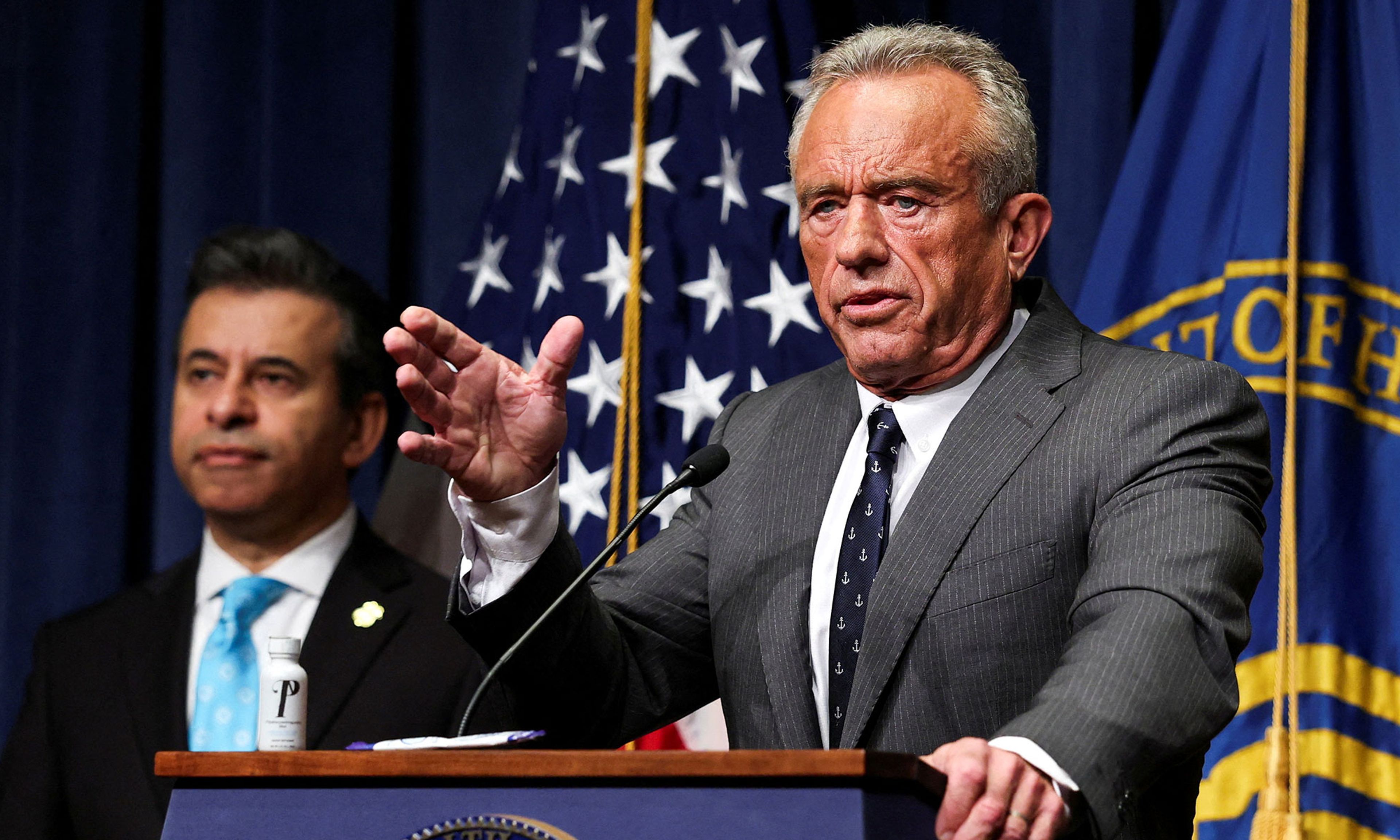
Health and Human Services Secretary Robert F. Kennedy, Jr., speaks during a press conference at the Department of Health and Human Services in Washington, D.C., July 29, 2025.
Health and Human Services Secretary Robert F. Kennedy Jr., who has a long history of raising unwarranted skepticism about vaccines, took a dangerous step last week when he ordered the Centers for Disease Control and Prevention to revise its message that vaccines do not cause autism.
Under RFK Jr.’s guidance, the CDC website, which previously debunked the unfounded theories about the link, now has an asterisk next to the heading “Vaccines do not cause Autism.” The description below says the statement “is not an evidence-based claim. Scientific studies have not ruled out the possibility that infant vaccines contribute to the development of autism. However, this statement has historically been disseminated by the CDC and other federal health agencies within HHS to prevent vaccine hesitancy.”
In an interview with the New York Times about the change, RFK Jr. said that while large studies have found no link between the measles, mumps, and rubella vaccine and autism, there had not been large studies of the links with other vaccines to completely rule out any relationship. Yet it wouldn’t make sense for a health agency to set the bar at proving a negative and requiring a massive-scale study to debunk every cockamamie theory for which there is no scientific support. As one doctor quoted in the Times article quipped, “You can’t prove that Coca-Cola doesn’t cause autism either.”
Proponents of the vaccines-cause-autism theory have either relied on discredited research, such as Andrew Wakefield’s retracted 1998 study, or made the classic mistake of mixing up correlation and causation. Conspiracy theorists, for instance, will point to cases of young children getting diagnosed with autism after receiving shots as evidence of something rather than the simple fact that autism signs manifest themselves in the early years, which is around the same time that children get vaccinated. Much of the statistical rise in autism that has been observed over the past several decades, and that skeptics blame on vaccines, can be attributed to an increasing awareness of autism, a change in the diagnosis criteria, and more-advanced screening tools. While there may be other causes that researchers are investigating, there is no evidence to focus on vaccines, which have incredible health benefits.
Senator Bill Cassidy was critical of the CDC website decision, citing his experience as a doctor and noting deaths of children who had died of vaccine-preventable diseases. But Cassidy, who chairs the Senate Health, Education, Labor, and Pensions Committee, provided a crucial vote to confirm RFK Jr. Explaining his support in a February floor speech, Cassidy said that the nominee had committed to him that the “CDC will not remove statements on their website pointing out that vaccines do not cause autism.” Given RFK Jr.'s decades of “just asking questions” about the link between vaccines and autism, it’s hard to believe that an intelligent lawmaker like Cassidy was so easily deceived. More likely, Cassidy was concerned about drawing Trump’s ire ahead of his daunting 2026 reelection bid.
Unfortunately, RFK Jr. was confirmed, and now that he is in a position of authority, reckless actions could have real-world consequences as the efficacy of vaccines ultimately relies on having a critical mass of the population vaccinated, denying viruses enough hosts to spread sufficiently. Already, in 2025, the U.S. has seen the most measles cases since 1992 — with the number spiking sixfold since 2024. Whatever caveats RFK Jr. may try to give in interviews to claim that he isn’t totally anti-vaccine, the clear signal being sent by the nation’s top health official is that those on the fence about vaccinating their children should take a pause.

About the Author
The Editors comprise the senior editorial staff of the National Review magazine and website.
Featured Tags
Advertisement
Advertisement


Comments