San Francisco’s Justice System Is Breaking Down
Written by Steve Smith
Despite more money and more staff, fewer cases are being resolved, leaving more people in legal limbo.
Share this story
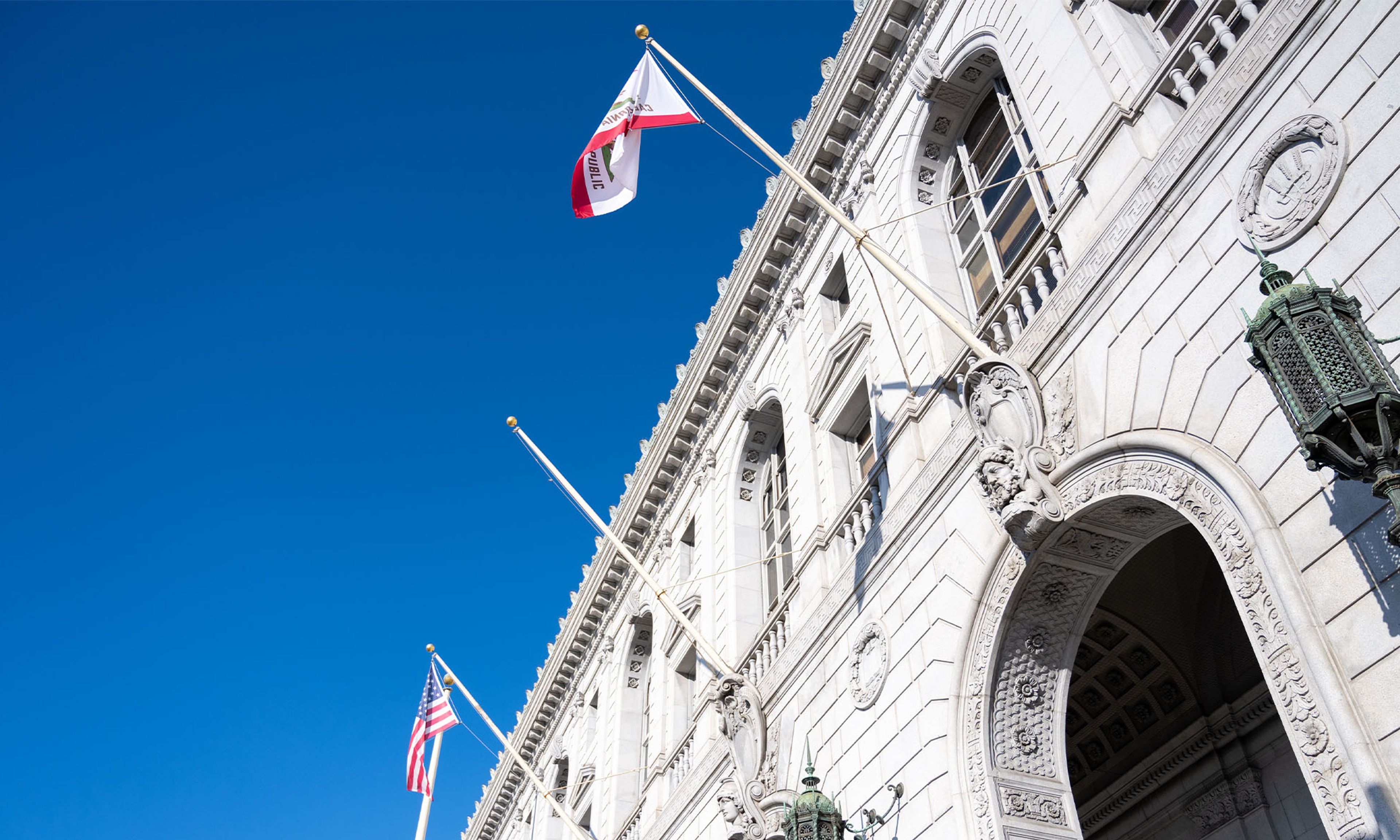
Supreme Court of California Civic Center, in San Francisco, January 22, 2026.
San Francisco’s criminal justice system may be reaching a breaking point. A San Francisco Superior Court judge recently found Public Defender Mano Raju in contempt and imposed fines after the office continued declining court-assigned cases in defiance of a prior order to stop doing so. District Attorney Brooke Jenkins says the refusals are disrupting court operations. The public defender says caseloads are too high to handle additional assignments ethically.
Both sides have valid points, but the reality is that only one set of rules can keep the courts running and ensure defendants are not left without representation — and victims without justice.
California’s indigent defense system consists of 58 county-based systems with uneven funding and staffing, a messy patchwork that creates strain when caseloads rise or enforcement priorities shift. The Public Defender’s Office relies in part on workload standards issued by the American Bar Association and RAND, which show that many defense attorneys nationally carry caseloads exceeding recommended limits. These standards reflect real changes in criminal litigation, including expanded digital discovery, longer timelines, and heavier evidentiary burdens. However, they are not law. California courts are not bound by ABA or RAND benchmarks, and those standards do not override statutory obligations requiring courts to appoint counsel for indigent defendants.
This difference is even more stark when you look at San Francisco’s own record on staffing and caseloads.
Over the past decade, San Francisco’s Public Defender’s Office has expanded significantly, with staffing rising from 156 employees in 2011–2012 to roughly 244 in 2024. Over that same period, the office’s budget more than doubled, from approximately $27 million to $56.7 million.
Despite that growth, from 2011 to 2023, case resolutions have declined dramatically:
- Felony dispositions: 4,436 → 3,483
- Non-traffic misdemeanor dispositions: 2,183 → 1,694
- Traffic misdemeanor dispositions: 2,432 → 724
The trend is clear: despite more money and more staff, fewer cases are being resolved, leaving more people in legal limbo. Much of the current strain reflects the scale of misdemeanor enforcement rather than case complexity alone.
District Attorney Brooke Jenkins has indeed filed more cases than her predecessor, now-recalled DA Chesa Boudin. In 2024, Jenkins filed 4,262 misdemeanor cases, while in 2021, Boudin filed just 2,050 — increasing the volume of prosecutions moving through an already congested court system. Yet the total number of cases filed by Jenkins in 2024 stands at 8,069, well below a 2018 peak of 9,588.
While misdemeanors are generally less complex than felonies on a per-case basis, modern prosecutions still require review of body-worn camera footage and other digital evidence, along with repeated court appearances. At scale, these obligations compound into a significant administrative burden. The issue is therefore not merely complexity, but whether the system can absorb sustained misdemeanor volume without creating bottlenecks across defense, prosecution, and the courts.
At the same time, staffing growth across the broader California criminal justice system has been far more modest:
- Public defenders: 3,914 → 4,930 (+26 percent)
- District attorneys: 9,479 → 10,571 (+11 percent)
- Police personnel: 116,794 → 116,983 (essentially flat)
This imbalance is at the heart of the problem. The Public Defender’s Office in San Francisco has grown much faster than the statewide average — as well as the DA’s office or the police — yet it now claims it cannot take on more cases. Meanwhile, defendants are left waiting.
This raises a basic question: when do internal workload complaints become an excuse for not providing constitutionally required defense, and how many defendants are left without representation or victims denied justice as a result?
Courts cannot simply stop assigning cases because of resource disputes. Their job is to make sure every defendant gets a lawyer and that cases do not stall.
If the workload is truly unmanageable, the answer is to fix it through funding, legislation, or statewide standards — not by refusing to represent people who need a defense.
Analysis of California’s broader indigent defense system underscores the structural reality that delivery is fragmented across counties, with uneven funding and capacity constraints.
But county-by-county structural differences do not authorize unilateral non-participation in court operations. It requires reform through governance, not disruption through refusal.
San Francisco’s crisis is not just about money or a staff headcount. It is about whether the institutions responsible for justice are willing to do their part so that the system does not fail those who depend on it.
District Attorney Jenkins is correct on the central point: when a constitutionally required institution is found in contempt for declining court-assigned cases despite significant increases in staffing and funding — while enforcement-side growth remains comparatively flat and case resolutions have declined — the result is not reform. It is operational pressure displaced onto the courts.
Courts are not built to handle one side simply refusing to participate. If one side can simply opt out, the system stops working.
That is not how constitutional justice is designed to operate.
The public defender may be correct that workloads are heavy. Legislators may be correct that funding is inadequate. Courts may even agree that workload standards require revision.
But none of that alters the controlling principle: court orders are not optional, and participation in the justice system is not conditional on institutional preference.
If selective refusal becomes the norm, the system does not improve. It breaks apart, leaving defendants and victims without justice.
And a fragmented justice system is not justice at all.
About the Author
Steve Smith is a former peace officer and college instructor and is a senior fellow with the Pacific Research Institute.
Featured Tags
Advertisement
Advertisement





Comments