Space Captures the Imagination
Written by James Lileks
How can you not be moved by what’s happening on the Final Frontier?
Share this story
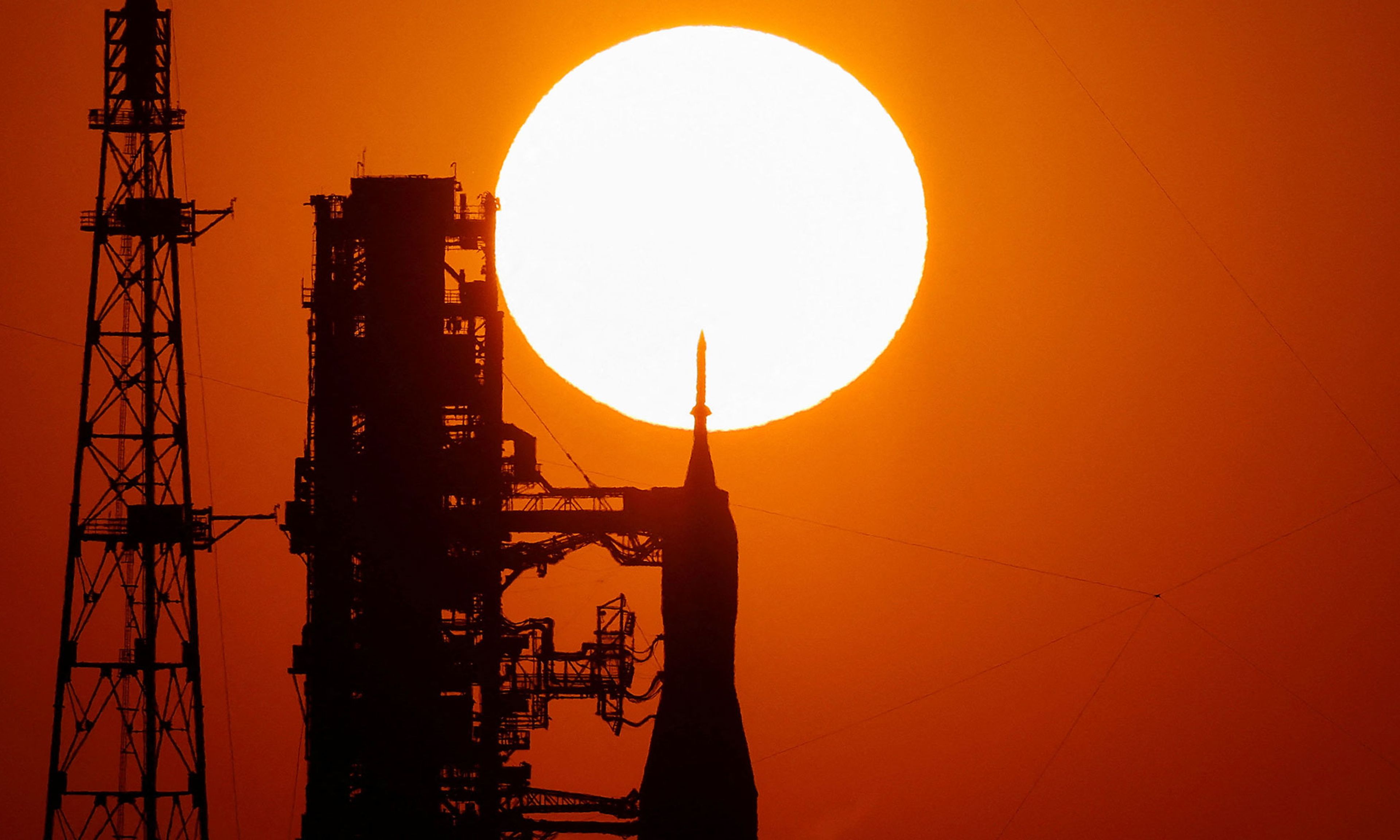
NASA's Space Launch System rocket with the Orion crew capsule on launch pad 39B at the Kennedy Space Center in Cape Canaveral, Fla., March 24, 2026.
I was a space enthusiast as a young boy. I drew pictures of rockets and Gemini capsules; I fired Estes model rockets into the North Dakota sky. Once I launched a payload of ants I shanghaied from the backyard and watched the rocket streak up and pop the chute. The ants were returned to their colony. No one believed them, I’m sure. You went up in the air on a spaceship, and you saw glimpses of a vast world beyond our imagining. Sure. You’re late for your shift. Get downstairs and start milking the aphids.
Those of us who grew up with the thrills and victories of the American space program never understood the people who were unmoved by the effort. This is what mankind is supposed to do. Earth is just the start. Once we invent the Hyperdrive or the Cosmic Overthruster, we’ll get way out there and meet other species and form an organization and drive around learning things and having cool battles. What — we’re just supposed to sit here on this wet rock until the sun gutters out?
The indifferent attitude exists today, if you look at the reaction to Artemis II. You tell some people that the ship flew farther from Earth than any other crewed vessel, and they nod and shrug, as if you said someone just broke the hot-dog eating record. Hardly anyone knows the astronauts’ names, let along the fact that one, Jeremy Hansen, is from the Canadian Space Agency, the logo for which ought to be a fellow standing by the side of the road with his thumb out. Hardly anyone knows the purpose of the mission, which was to . . . well . . . do it again, I guess, to show that we can. That’s enough for me.
But will it lead to a moonbase? That’s the plan, yes. NASA wants one. Elon Musk wants one. Who’s your money on?
NASA has a timetable. The next step is Artemis III, which will land at the moon’s South Pole in 2028. After that, they will land annually to build out the base. They should’ve done this a long time ago. I’m sure there’s a good reason besides institutional drift and ennui.
SpaceX, Musk’s company, has shifted from Mars colonization to moonbase construction. You suspect Musk was one of those kids who drew elaborate diagrams of cool underground bases, each room and function properly labeled. He probably kept them. He’s probably using them for blueprints. I wouldn’t put it past him to start next year and have Tesla convertibles racing through subterranean tunnels by 2036.
Two bases would be great. China will get in on the act, of course. Russia might send a pup tent and an inflatable dummy. As much as I grew up loving NASA, I’m pulling for Musk, because he seems most likely to understand that everything should not only be safe, efficient, and durable, it should look cool. You just know that when SpaceX lands on the moon and the first payload deploys a surveying robot rover, it will be cherry red, and it will have tail fins.
Fuzzy dice hanging from the camera arm? Eh, probably not mission-critical.
[slideshow slideshow="1938249" /]

About the Author
James Lileks blogs at www.lileks.com.
Featured Tags
Advertisement
Advertisement




Comments