Stanley Fischer: The New Monetarist
Written by Garett Jones
The late macroeconomist played Milton Friedman’s tune in a new key and made monetary policy better.
Share this story
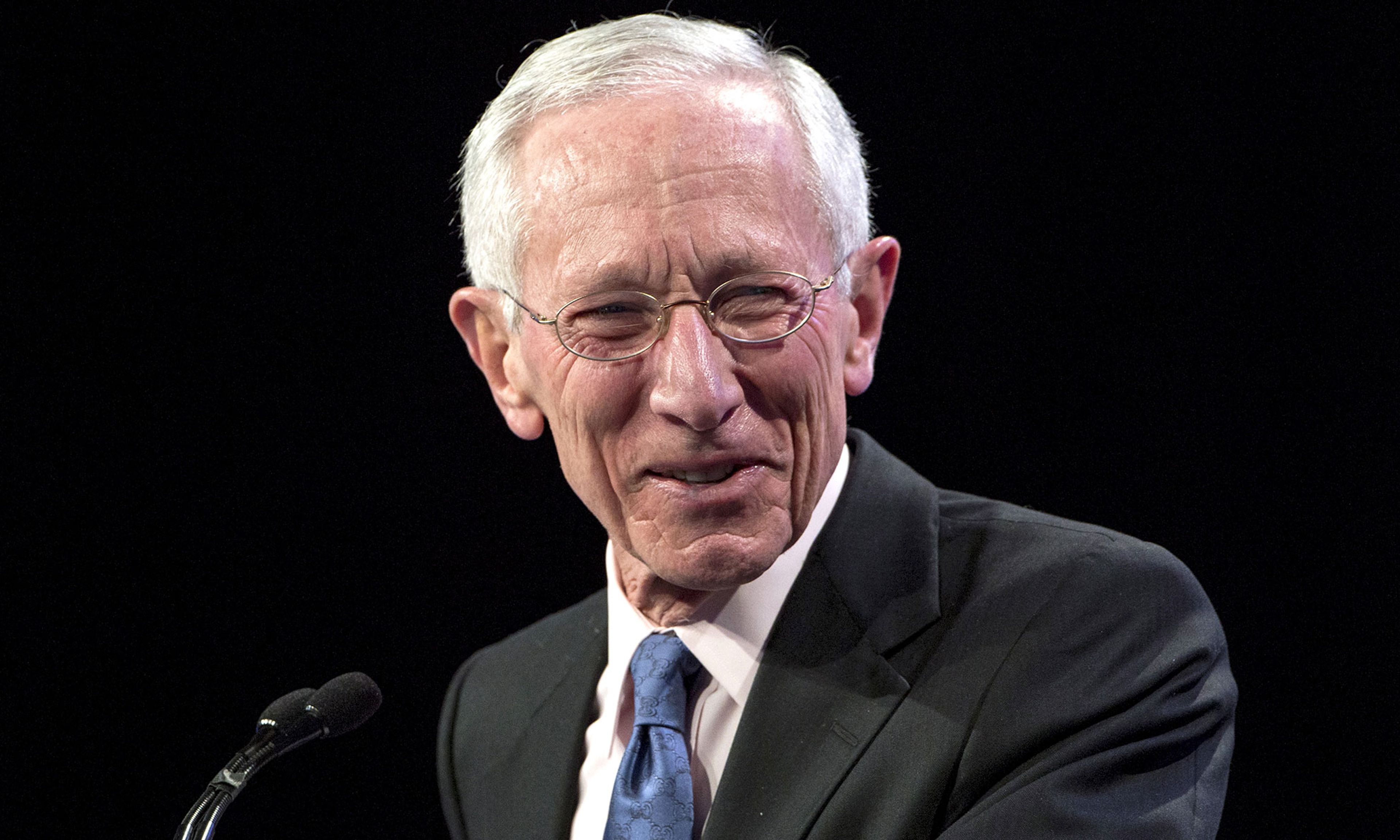
Then-Federal Reserve Vice Chair Stanley Fischer addresses The Economic Club of New York in New York City in 2015.
I never met Stanley Fischer, the legendary MIT economist and central banker for the U.S. and Israel who died last week at 81. So if you really want to learn about what he was like, you should read the short essay written two years ago by his friend, economist Olivier Blanchard. It’s lovely and wise.
But what I can do is tell you how Fischer made the world of ideas better, richer, fuller. In the late ’70s and ’80s, Fischer built out a research agenda -- in papers as well as in an influential textbook, Lectures on Macroeconomics, co-authored with Blanchard -- that played Milton Friedman’s monetarist tune in a new key. He showed how bad monetary policy could create volatile boom-bust, stop-go business cycles even though in the long run, money growth only influenced inflation.
Other economists -- and even philosopher David Hume in the 1700s -- had thought about this issue, but what Fischer had going for him was the work he did to resolve the tension between two big ideas in 1970s economics:
- People can’t be fooled all the time by loose money.
- People can be fooled for a while by loose money.
The big question in the 1970s was, “How long is ‘for a while’?” Fischer found his answer by looking at real-world labor markets, where people’s wages get changed maybe once a year. That meant that if the Fed tried to bring down inflation with tight money, then for the first year or so people would lose their jobs because with less money in the economy, wages would be too high to hire everyone.
But after that rough transition, wages would fall, people would go back to work, and inflation would in fact come down. The pain would last as long as the wage contract terms were sticky, but once the contracts all had time to adjust, we’d be living in Milton Friedman’s long run, where tight money causes low inflation but no job loss.
The cruel trade-off between job growth and inflation would be temporary -- a year? two years? -- and hard, to be sure. But not years and years, never a “lost decade.” Central banks like the Fed can create chaos if they create uncertainty and vagueness about their true goals, but the battle to bring down inflation is a battle that, when fought with firmness, can usually be won before the next election.
This was a good practical lesson built from economics that assumed people aren’t perfect fools and aren’t perfect robots. Fischer, along with many others who became known as New Keynesians, straddled that no-man’s-land between the homo economicus of perfect rationality and the homo behavioralis where people are just bundles of cognitive errors. By my reading, Fischer was more on the economicus side of the New Keynesians, but only slightly so. Perhaps what Fischer really did was find the golden mean, perhaps not quite where we humans truly are, but where we hope to be, what we deserve to be.
How does all of this fit with my claim that Fischer was an heir to Milton Friedman, the great monetarist who taught us that “inflation is always and everywhere a monetary phenomenon” and who argued for much of his career that banks should strictly follow a 3 percent growth rate for the nation’s money supply?
For one thing, Fischer’s influential early paper from 1977 really did treat the money supply -- not the more Keynesian interest rate -- as the tool that the central bank used to control inflation. Second, in the spirit of Friedman, he argued that offering credible, stable central bank policy -- not swaying with political winds -- was the best policy for any central bank.
And finally, I’ll quote Harvard’s Greg Mankiw, who served as chairman of the Council of Economic Advisers in the George W. Bush administration, and who coauthored a paper where he had this to say about the New Keynesians, a group of which Fischer was a founding father:
Although [this group of economists] are often called "new Keynesians," this label is also a misnomer. They could just as easily be called "new monetarists."
Greg Mankiw wrote that in the 1990s, and though the ideological teams in macroeconomics have shifted a bit since then, Fischer certainly deserved the label of new monetarist. There are almost always short-run trade-offs between job growth and inflation, and policymakers should keep their eyes overwhelmingly on the long run, making it clear to everyone in society that it’s worth fighting the battle to get to low, stable inflation. That’s a lesson, when preached over the decades both in the classroom and through real policy choices, which makes one a new monetarist.
I said that I’d never met Stanley Fischer, but at my first economics conference 25 years ago, I did ride in an elevator with him. I recognized him as soon as he walked on -- wearing the same kind of perfectly fitting suit and tasteful tie that was his trademark. He was talking in his lively and crisp manner with a couple of young economists.
I felt, I knew, that I was in the presence of a legend. May he rest in peace, and may his memory be a blessing.
About the Author
Garett Jones is a professor of economics and BB&T Professor for the Study of Capitalism at the Mercatus Center, George Mason University.
Featured Tags
Advertisement
Advertisement



Comments