Share this story
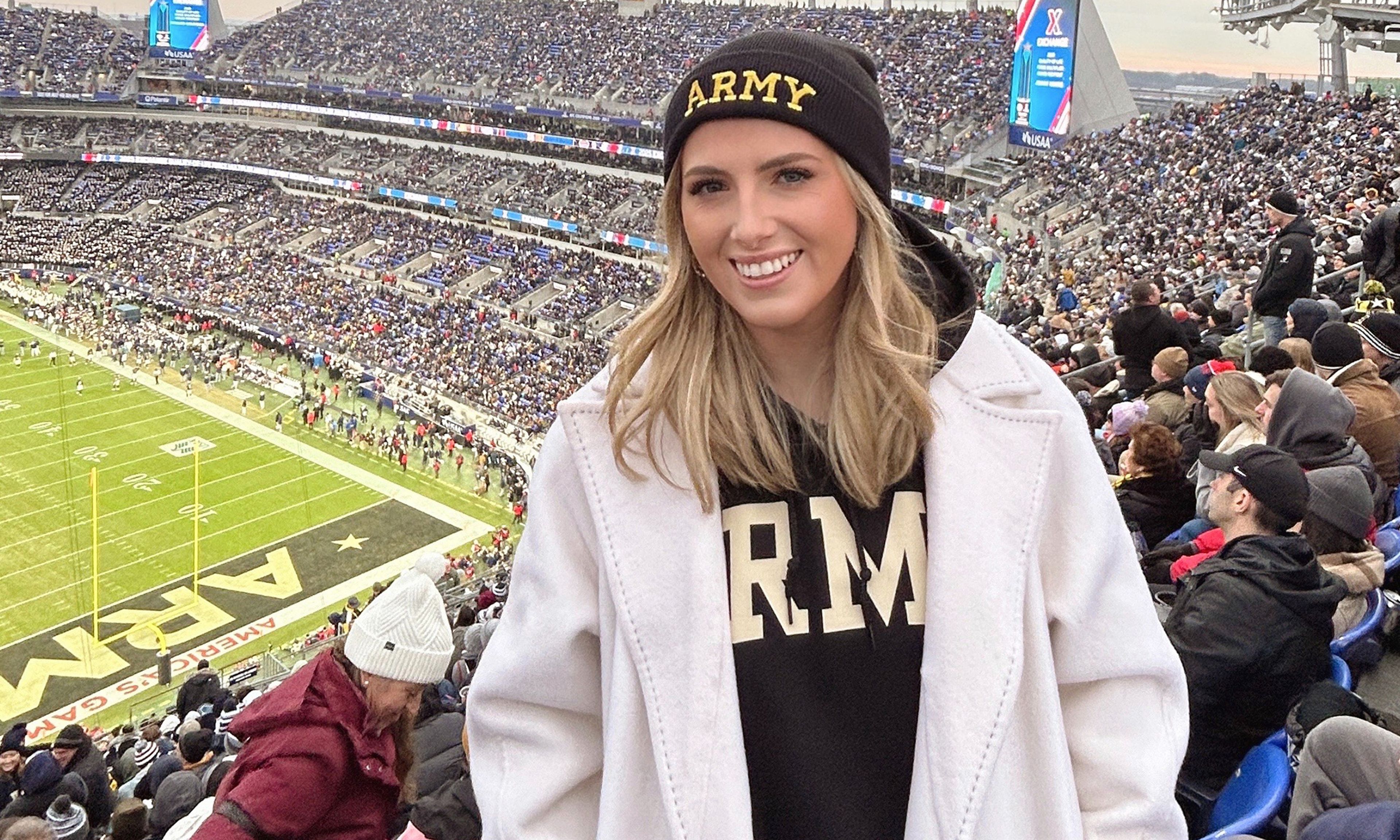
Caroline at the Army-Navy game, December 13, 2025
West Point, N.Y. — During a history class last semester, a United States Military Academy cadet and his peers stopped by West Point’s cemetery, where many revered officers are buried.
As they peered at the names etched into the weathered stones, the cadet exclaimed to his classmates, “That’s my grandpa!”
The grandfather in question -- my dad -- was laid to rest at West Point a few years ago after a long battle with cancer. The funeral involved a procession to the campus Catholic church, where I sang the “Alma Mater” and my brother sang the “Battle Hymn of the Republic,” followed by a gun salute at the cemetery. Though we knew we likely wouldn’t ever join him there, because space is extremely limited and mainly reserved for graduate combat veterans, we knew this was where he belonged.
That is because his heart never left that fortress on the Hudson River. After he graduated, he served two tours in the Signal Corps in the Vietnam War, earning the Bronze Star and the rank of captain, before being honorably discharged. Upon returning to civilian life, he took his engineering chops to a phone company, where he worked until retirement. But despite not making the military his career, West Point was central to his life until the very end. It was a brotherhood he regularly kept up with over email and at reunions.
And when he was met in his late 50s with the herculean task of being a father to triplets (of which I am one), my dad brought the Army ethos into our household. To be sure, he was a bit of a drill sergeant in his parenting (although we often deserved the kick in the pants). But aside from the loudness (which he blamed on the shell explosions in Vietnam), his teachings paid dividends as I grew up.
“If you think you can, or you think you can’t, you’re right,” was one of his mantras.
An excerpt from the “West Point Cadet Prayer” served as the moral code not just for my childhood but for my journalism career: “Make us to choose the harder right instead of the easier wrong, and never to be content with a half-truth when the whole can be won.”
West Point is where my dad developed the virtue of fortitude. As ever, the school today instills in its students a victor’s attitude and the denial of self for the service of the whole. Whenever West Point watered down those standards or dabbled in progressive politics -- such as by infusing critical race theory into curricula -- he took personal offense. My dad’s identity was intimately tied to the school that had made him a soldier and a man. For him, attending was the pride and ultimate achievement of his life, alongside his nearly 40-year marriage and his children. This past December, I honored his memory and our nation’s military by attending the 126th annual Army–Navy Game.
The Army’s Black Knight refers to West Point’s castle structure and land warriors. The Navy’s anchor symbolizes maritime supremacy, and its goat mascot recognizes the animal that historically provided food and drink on Navy ships.
Before kickoff, the Navy flew four F/A-18E Super Hornets over the arena, while the Army flew several helicopters, including a CH-47F Chinook, two AH-64E Apaches, and a UH-60M Blackhawk. I experienced the comically fierce rivalry between Army and Navy, as I was heckled by several midshipmen on the way into the stadium. The gates were swarming with eager fans, but the Secret Service had to do diligent security checks, causing bottlenecks. I clearly looked lost amid the chaos.
“I guess we can help her to the right gate, even though she’s wearing the wrong colors,” some midshipmen joked.
Both schools ruthlessly mock the specialties of the other as weaknesses (“Sink Navy,” “Army swims in the shallow end”). West Point cadets are cast as boneheads who tremble at the sight of water. Annapolis midshipmen are made out to be effeminate Popeye cosplayers who float around on boats twiddling their thumbs. But as goofy as it is, the impish cross-branch bonhomie reflects the real devotion that graduates and branch service members have for their vocation.
Besides, they’ll all serve together one day. There have been many episodes of the two collaborating throughout U.S. military history. Mobile Riverine Force was a joint operation during Vietnam in which Navy shallow-water vessels provided fire support and aid for Army infantry troops during ground operations. This was essential for fighting the enemy Viet Cong in areas inaccessible to larger naval ships. And in modern military conflicts, joint operations are the standard, with all branches working together seamlessly.
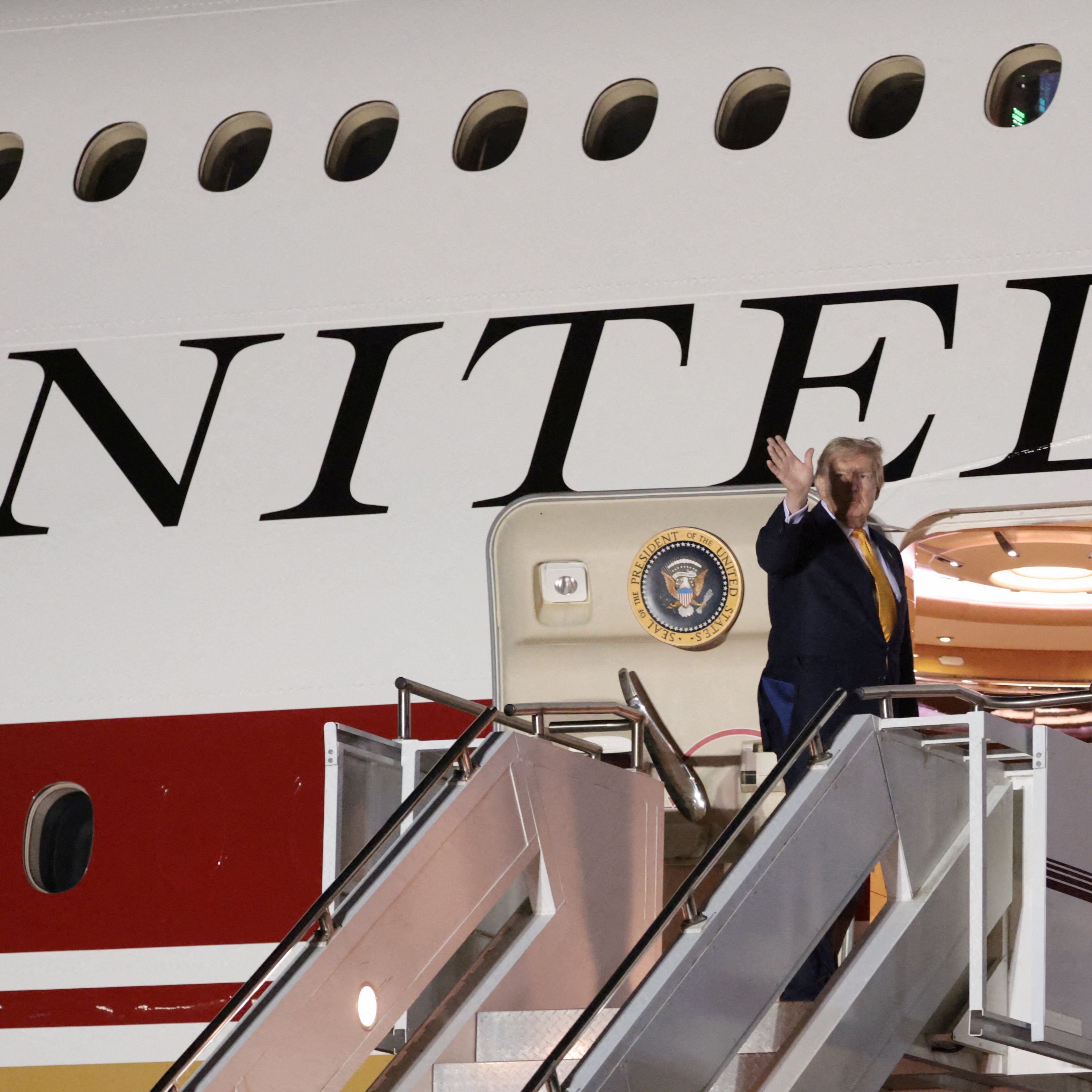
President Trump, in attendance at the Army–Navy game with an entourage of lawmakers, switched sides halfway through the game, as is tradition. Established by former President Theodore Roosevelt, the ritual is a reminder of the commander in chief’s neutrality toward the branches and of their common cause.
During the “prisoner exchange” before the game, students from West Point and Annapolis who had spent a semester at the rival institution were “returned from enemy territory” midfield.
To be selected as a “hostage” student is a great honor, but also one that comes with its share of pranks and hijinks, especially the week of the Army–Navy game. It’s not unusual for a cadet to have his West Point garb stolen from his barracks by midshipmen, or vice versa.
On game day, the prisoners come out to the field, exchange salutes, rotate sides, and march behind their brigade commander. At that point, a secret message is revealed via letters taped onto their backs. At the 2024 game, Army’s cadets spelled “AAC CHAMPS,” while Navy’s midshipmen spelled “GOT JETS?” -- a tongue-in-cheek jab at the Army’s circumscribed air assets compared with the Navy’s carrier-based air power.
But this year, there was a hiatus in the teasing. The phrases on the students’ backs combined to read: “ONE TEAM. ONE FIGHT.” The stands erupted in cheers before the students ran back to be reunited with their schools.
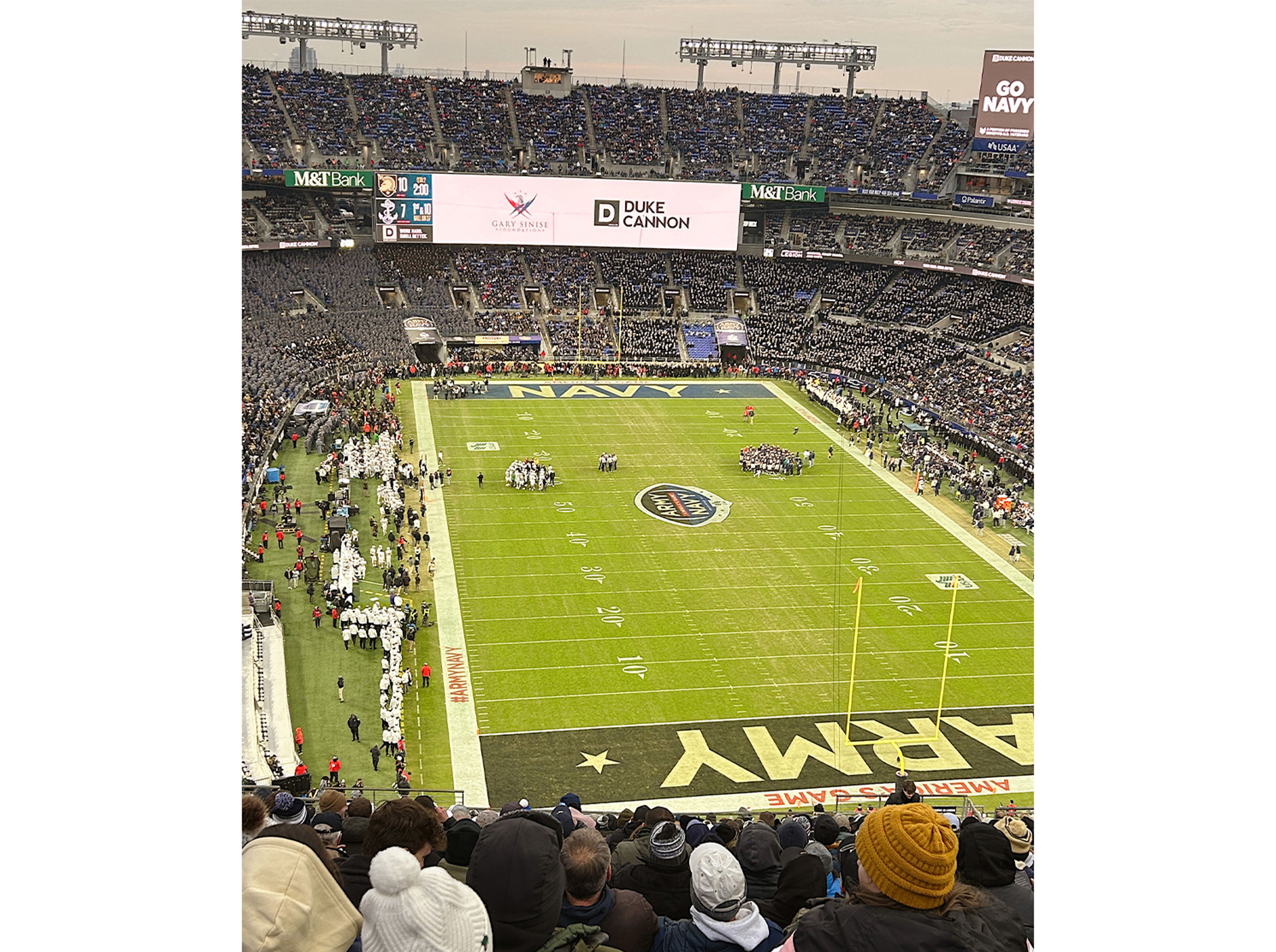
During halftime, my cadet nephew came up to the nosebleeds where we were sitting. He wore nearly the exact same gray wool overcoat that my dad had worn for Army–Navy games many decades before. Looking down, I saw that the student section was a ribbon of gray, as it had always been in footage of games past. It was a physical demonstration of the “Long Gray Line.”
At West Point, once you’re a cadet, you’re always a cadet. My dad expressed this sentiment throughout his life, but it became tangible for me only after his death. Last year, my mom donated Dad’s class ring for a program whereby alumni rings are melted down to become future cadets’ rings. Last year’s melt became the rings for the class of 2026, a class that includes his grandson.
At halftime, the Navy band performed a rousing rendition of Kenny Loggins’s “Danger Zone,” from Top Gun, while the musicians marched into the formation of an anchor. The dance teams from both schools did a joint performance. The Navy’s theatrics were top-tier, I admit. But the Army took the cake for best football uniform.
A tribute to America’s upcoming 250th anniversary, the uniform, named “1775” for the year the Army was founded, was created by West Point’s Department of History and War Studies in collaboration with Nike. On the back of the jerseys were the players’ numbers stitched in purple, representing the Military Badge for Merit that was issued by George Washington during the American Revolution, as well as the present-day sacrifices of soldiers, Gold Star families, and Purple Heart veterans wounded in service.
I recognized the typography right away as evoking the handwritten script of the Constitution. When they graduate and become commissioned officers, the players will swear to uphold that founding creed that, as the West Point website says, has “guided our nation throughout its vaunted history.”
My favorite feature of the uniform, however, was the chain that surrounded the West Point seal on the front of the jersey. An homage to the “Great Chain,” it represents the 65-ton iron barrier that stretched across the Hudson River at West Point, securing the entire river valley for the patriots during the American Revolution. It was designed to block British ships and prevent them from sailing upriver to attack the colonies, and it was a fundamental part of the early American defense system, famously never breached by the British.
The Army–Navy game is about far more than tackles and touchdowns. It occupies its own week on the college football calendar. Between the patriotic fanfare, sacred traditions, and huge swell of support from veterans, cadets, and alumni of both academies, the event is a celebration of our nation’s military might. While the game doesn’t typically feature elite players, there were four-star generals and admirals in attendance. It’s the game that celebrates why all other games can happen. Because of a strong national defense -- brave soldiers and sailors, including the ones on the field -- we can punt, kick, and score in peace.
I had grown skeptical of West Point over the years, fearing that wokeness would inevitably corrupt it as it has most great American institutions. But the game showed me that the academies are still formidable in what they do -- cultivating top military officers of tremendous character -- and are extremely dedicated to making their branches ferocious in preparation for war. Beyond that, it was actually a riveting game, especially for someone who isn’t a sports enthusiast, with lots of close calls and surprises.
Losing by only one point, West Point failed to break Navy’s two-year winning streak; the game nonetheless reminded me of why my dad’s love for his school was much more broadly a love for the military and what it defends.
The last verse of the West Point “Alma Mater” captures the eternal kinship and gratitude for the academy experience that many graduates feel: “And when our work is done, our course on earth is run, may it be said, ‘Well done. Be thou at peace.’ E’er may that line of gray, increase from day to day. Live, serve, and die, we pray, West Point, for thee.”
About six months before my dad passed away, my brothers and I put on Top Gun: Maverick for him in the hope that it would bring him some joy, something in short supply those days, when treatment had become futile. He spent most of the day sleeping. When he was awake, he was restless and irritable, his focus fried by the chemotherapy. It was a triumph if he managed to eat anything resembling a meal. He had lost interest in reading or any other entertainment.
But when that sequel to the iconic original blockbuster came on the screen, suddenly the Army man was back. He was engrossed, locked into the high-stakes plot, technical jargon, international intrigue, and camaraderie.
The movie, centered on the Navy’s elite strike-fighter program, seemed to transport my dad back to the old Army–Navy rivalry. He laughed at how his classmates used to make fun of Navy pilots by calling them “fly boys,” and joked about what he claimed was occasionally annoying flamboyance in the branch.
But by the end of the film, when the main characters Maverick and Rooster are rescued by rival Hangman from a perilous mission to destroy an enemy facility, my dad was stoic. He was struck by Hollywood’s choice to air an unapologetic display of heroism and military power. No doubt it brought back poignant memories and emotions.
“That’s why America is the best,” he whispered as the credits started to roll, tears streaming down his face.
Then he asked us to put on YouTube highlight reels of the A-10 “Warthog.”

About the Author
Caroline Downey is a staff writer for National Review.
Featured Tags
Advertisement
Advertisement


Comments