Share this story
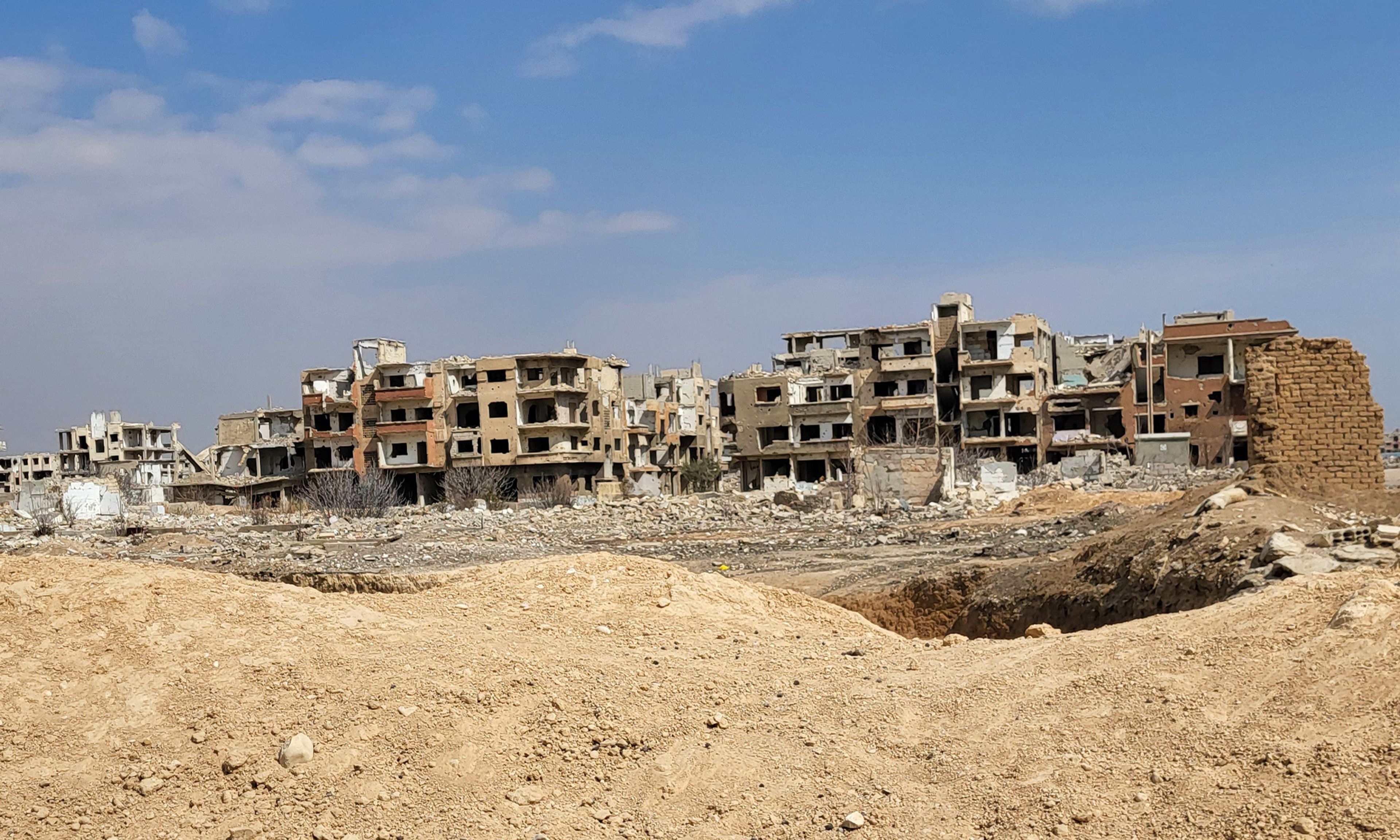
Jobar, Syria: more or less the same sight, in every direction, as far as the eye can see
On December 7, 2024, Bashar al-Assad’s regime collapsed like a wobbly Jenga tower, and the Syrian dictator fled his war-weary country with his freakishly long neck intact. That was also the night of the Geraghty family Christmas party, where my guests included my long-distance traveling buddies, Caleb Johnson, a transnational-threat analyst at CSIS (the Center for Strategic and International Studies), and James Spiller, a globe-trotting lawyer and longtime friend of National Review. When the news about Assad’s downfall popped up on our phones, James reacted with the exuberant glee that most associate with once-in-a-lifetime events, like the fall of the Berlin Wall or a New York Jets Super Bowl victory.
A short while later, planning our third trip to Ukraine, Caleb and James said we ought to visit Syria to see what Syrians and the new government were making of their opportunity for something better.
This was crazy and ill-advised, of course. The U.S. State Department’s travel advisory for the country warns, point-blank: “Do not travel to Syria due to the risk of terrorism, civil unrest, kidnapping, hostage taking, armed conflict, and unjust detention. . . . No part of Syria is safe from violence. Hostage taking by armed groups, unjust detentions, the use of chemical warfare, shelling, mine fields, and aerial bombardment of civilian centers pose significant risk of death or serious injury.”
That warning casually mentions that the “United States continues to designate Hay’at Tahrir al-Sham (HTS) as a terrorist group,” without specifying that the current acting president of Syria, Ahmed al-Sharaa, under the nom de guerre Abu Mohammed al-Jolani, used to run HTS. Up until late December, the U.S. government was willing to pay $10 million for information about his location, because he was on the “specially designated global terrorist” list. Jolani traveled to Iraq in 2003 and joined al-Qaeda; he was later captured and held at Camp Bucca. In 2011, at the start of the Syrian civil war, he formed the Nusra Front as an affiliate of the Islamic State. But Sharaa had a falling-out with Abu Bakr al-Baghdadi in 2013, and the Nusra Front split off.
Sure, I said. After we gallivant across Ukraine, let’s all meet up and tack on a jaunt across another war-torn country, this one run by a guy who’s done stints with both al-Qaeda and ISIS, before founding his own Islamist expansion franchise. I figured my guys were never going to get a visa to enter Syria anyway.
Well, it turns out that, to enter Syria, all you need now are an American passport and $200 to purchase a tourist visa. And that’s how I found myself there, three months into a new interim government and after what is probably the worst 13-year stretch that any country on earth has endured in recent memory: the rise and fall of ISIS, hundreds of chemical weapons attacks, atrocities of every kind, and a death toll from the civil war so high that most international organizations stopped counting and now just say “around half a million.” The Syrian Observatory for Human Rights is more specific: as of March 2024, it has documented the names of 507,567 people who have died in Syria since the outbreak of the conflict in March 2011. For perspective, consider that the U.S. suffered 407,316 military casualties in the Second World War.
The moment you step off the plane at the Damascus airport, the dust hits you. Syria has an arid climate, and much of the city has the classic Arab-world confusion of disrepair, exposed wiring, and half-completed construction. The narrow streets and alleys of the old city are full of stray kittens that were both adorable and potentially menacing. There are intermittent power outages, and our hotel didn’t have water for the first few hours after our arrival. A civil war of 13 years doesn’t leave much time or money for infrastructure investments.
But that doesn’t mean the city wasn’t welcoming. Frequently during our visit, locals overheard my traveling companions, as pallid as I am, speaking English, and Syrians -- usually under 30 -- would smile and eagerly cheer, “Welcome to Syria.” As one man put it to me in English, “We are a hospitable culture, and for the past 13 years, we haven’t been able to have guests.”
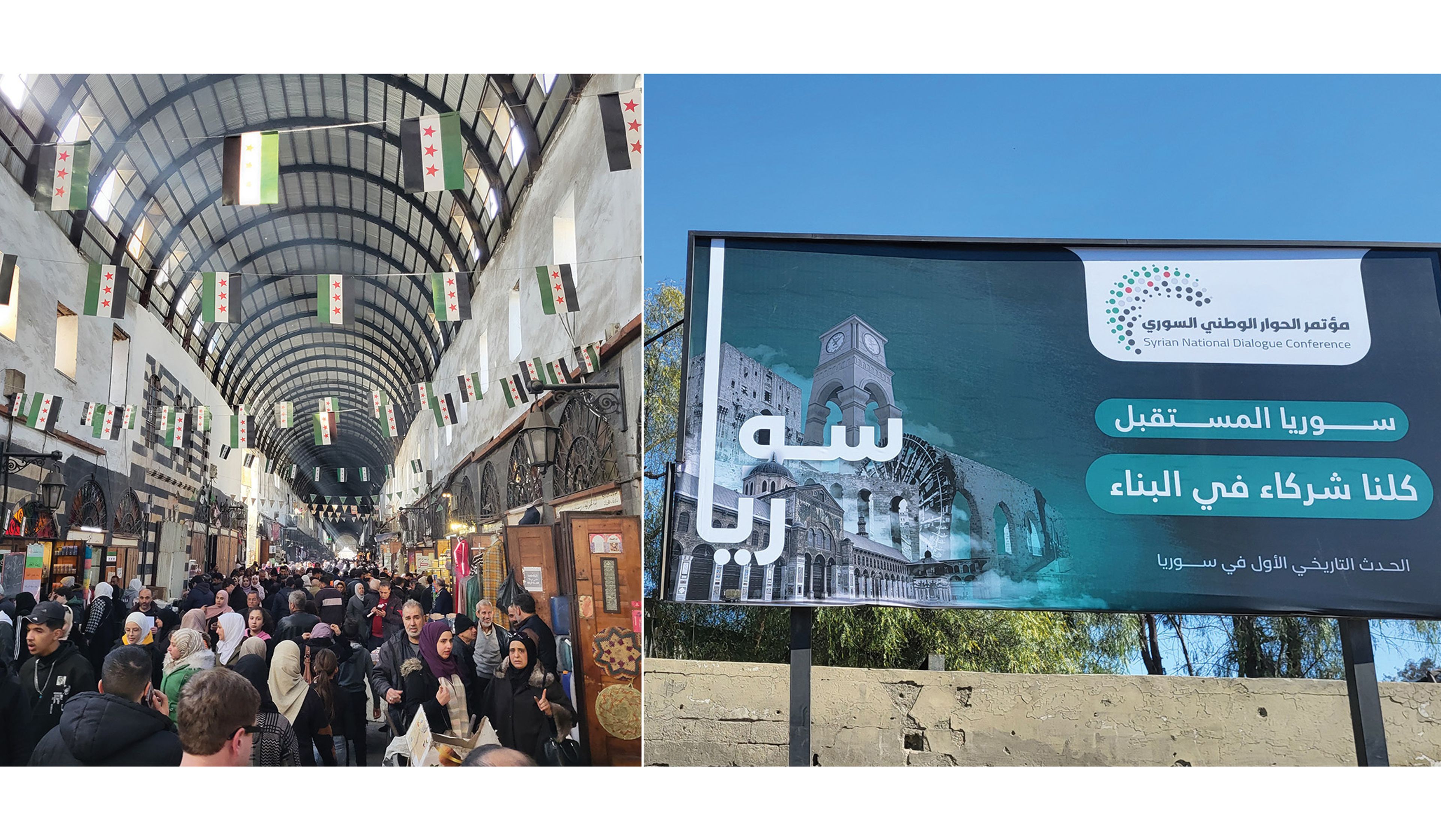
We arrived two days before Ramadan -- apparently the Black Friday of the Muslim calendar -- and the bazaar in Old Damascus was packed shoulder to shoulder, with the occasional motorcycle slowly weaving its way through the crowd. We intermittently encountered sad, black-abaya-wearing old women, offering to sell us a box of tissues, and when we declined, they just turned to begging.
Above us in the bazaar, and seemingly in almost every store window, was the new Syrian flag, similar to the pre-Baathist independence flag used from the 1930s to the 1960s -- black, green, and white, with three red stars. In the streets, you could still find a couple of displays of the old flag that hadn’t yet been painted over.
As we arrived, a variety of Syrian leaders were wrapping up a two-day “national dialogue summit.” The hastily called conference wasn’t overflowing with specific suggestions to guide the formation of a new government. But it did resolve that a draft constitution should feature “a balance between authorities, establishing justice, freedom, and equality, and laying the foundation for a state of law and institutions.”
Our first interview was with Patriarch Ignatius Aphrem II of the Syriac Orthodox Church in Damascus, who said his bishops had attended the conference. “They were part of the dialogue, and their report was quite positive,” he told me.
Asked if he knew anything about the vague reports that a second conference would be held soon, Aphrem shrugged. “We don’t know. That’s the problem, we don’t know what the plan is. We don’t see any road map for our country. Obviously, the national dialogue should not be a one-time event. It must be a process, and that has not been announced yet.” As of this writing, in mid-March, the second meeting still hasn’t been announced or scheduled.
Born Sa’id Karim in Qamishli in northeastern Syria, Aphrem took a long, far-flung road in his religious studies, including stints in Cairo, in Bikfaya, Lebanon, and in Maynooth, Ireland. Before coming to Damascus as the patriarch of the Syriac Orthodox Church in 2014, Aphrem had a stretch in Teaneck, N.J. From there he presided as the archbishop of the Eastern United States.
“When the war started in 2011, I was overseas,” Aphrem said. “I was watching from the United States and, like every Syrian, I saw beams of hope that things are going to change for the better. Although as Christians we had full freedom here in the time of the former regime, we had everything we wanted in terms of practicing our religion. But of course, there were other issues.”
Aphrem quickly figured out that his home country had turned into a battlefield, with Assad, Iran, and Russia on one side, a whole bunch of jihadists on the other, and a lot of innocent civilians caught in between. “Soon I learned that there were foreigners involved, terrorists coming from all over the world, to fight jihad here in Syria. It was clear to me this was not merely a Syrian process to have a better life. That was one of the reasons I came back here and tried to do the best for our people here, including the relationship with the former government.”
Aphrem described himself as cautiously optimistic about the new regime.
“Our responsibility is to be a pastor, to be a servant of the people and their needs. For that we have to deal with whoever is in authority. Even now, we are ready to work with the new people. But we don’t know their agenda yet. . . . We don’t have that much influence, but we have to do something. We cannot just sit down and not do anything.”
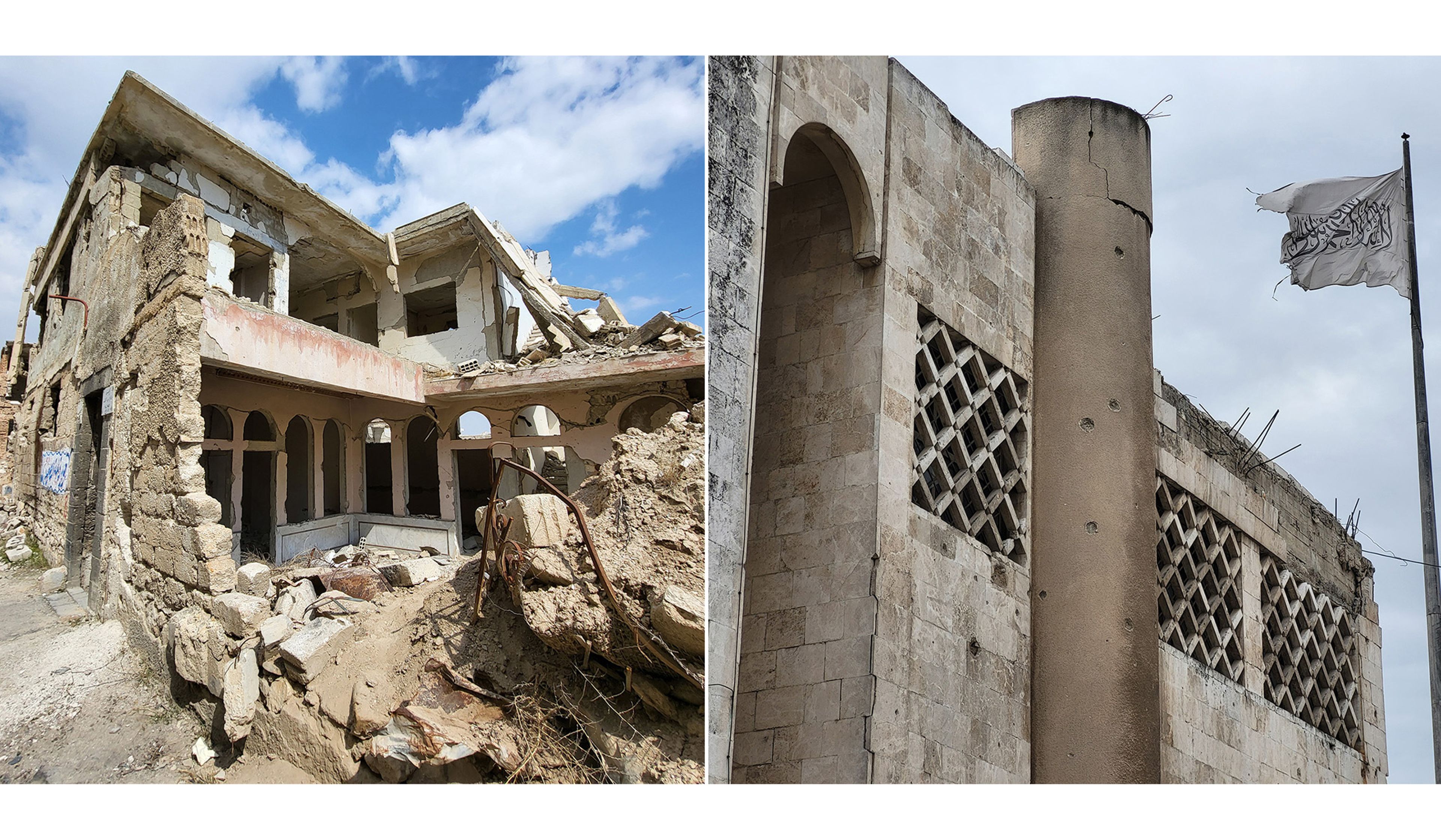
Aphrem still walks the neighborhood around his church almost every day. Of the jihadist foreign fighters, he said: “We haven’t seen them recently on the streets, but we hear some of them still walk the streets. At the beginning, there were some incidents where they would come and raise the so-called flag of al-shahada in the middle of the Christian areas.” (The shahada is an Islamic oath and creed. The Islamic State used a flag featuring white lettering on a black background; other Islamist groups use one of black lettering on a white background. I would get much more familiar with the shahada later in the trip.)
The next morning, I interviewed “Harun,” a Chechen-born Belgian citizen and jihadist who is just about the nicest guy you’ll ever meet who’s on a terror watch list. Then again, Harun’s got a good reason to be in bright spirits. If you were a young man who ran away from home to join the fight in Syria in 2013, convinced that Assad was committing zulm (Arabic for “intolerable injustice”), and eleven years later you finally beat the bastard and sent him running to Moscow, you’d feel like you’d just hit the jackpot. Harun described a long stretch of fighting -- and of often being forced to retreat -- in Kessab and Idlib. In 2015, Russia joined the fight in assisting Assad. “The Russians don’t bomb like the Americans bomb,” Harun observed, meaning that Russia bombs more heavily, and with less regard for civilian casualties.
Polite and soft-spoken, Harun is convinced he and his comrades are kinder and gentler Islamists; he said he knew that Damascus residents expected that he and his fellow jihadists would act like “savages.” With pride, he described HTS officials waiting in line for coffee in stores, like everyone else; he said the shopkeepers said that, under the old regime, officials would just cut in line, take their coffees, and not pay.
Harun was convinced that sharia law would be a great deal for everyone in Syria, even the Christians and Alawites. He contended that the jizya, a sort of “infidel tax” charged on non-Muslims in Muslim lands, is assessed at a lower rate than is the zakat, religiously mandated alms in Islam, and that therefore the jizya is effectively a tax cut for the infidels. As thoroughly unpersuaded as I was, it was illuminating to hear Harun explain his genuine belief that he was fighting for a better and more just world. Lest you fear that Harun is planning to bring his fight to the Western world, he said he’s waiting for orders but that his dream is to liberate his homeland of Chechnya, currently run by Putin ally Ramzan Kadyrov. Harun and his buddies are gonna be your problem soon, Vlad.
If you could bottle up optimism, hope, and confidence in Syria’s future, the bubbling essence would be Farah al-Atassi, a Syrian-American woman who is president of the American Arab Center and serving on the Syrian national dialogue committee. The day I met her, she was wearing a black “Make Syria Great Again” cap. Readers, I swear I did not hallucinate this.
We met Atassi through Mazen Derawan, a libertarian-minded Syrian-American businessman who is helping to draw up the new government’s economic policies and wants to push things in the most free-market direction possible. At lunch, Caleb asked if he could get a beer, and Derawan cheerfully answered, “Of course you can, it’s a free country.” (How good it must feel to say that after two generations of absolutely ruthless dictators.)
Over Afamia -- touted as “the beer of Syria” -- Atassi and Derawan described a near-future Syria that was stable, at peace with its neighbors, pluralist in its respect of religious and ethnic minorities, and thriving economically and culturally. From Atassi’s perspective, HTS is the past, with its foot soldiers in the process of being integrated into a modern Syrian army that will respect citizens’ rights. If you thought the past decade and a half would have crushed every last ounce of optimism out of Syrians, you would be wrong. It is very easy to root for the likes of Atassi and Derawan.
Before we left Damascus, we met with Bakhour Chamntoub, one of seven Jews -- three short of a minyan -- remaining in Syria.
Chamntoub, a tailor, related that if someone used his services in the 1980s, under Hafez al-Assad’s rule, they would be harassed by the regime’s intelligence services, demanding to know why they had chosen “the Jew tailor.” Chamntoub boasted that his customers would often answer, “Because he’s the best tailor.” These days, Chamntoub is something of a Damascus celebrity, greeted warmly by his neighbors as he walks the streets. (If majorities are more tolerant of minorities whom they deem no threat, it must be very easy to be nice to the local Jews when they don’t even have enough to field a baseball team.)
With that said, there are some optimistic signs for the handful of Jews in Syria and the nation of Jews over the border. At the beginning of the year, a representative of Syrian President Sharaa met with Chamntoub, telling him that the Jewish community would be protected and that exiled Syrian Jews are welcome to return. While Sharaa is hardly a friend of Israel, in December he ruled out any hostilities toward Israel for the foreseeable future, declaring that “the general exhaustion in Syria after years of war and conflict does not allow us to enter new conflicts” and that “the priority at this stage is reconstruction and stability.” And a group of American Jews -- some Syrian émigrés, some not -- did visit Damascus in February and hold services in the Faranj synagogue, which had been closed since the 1990s.
On the way out of Damascus, we drove through and explored what’s left -- which is to say, almost nothing -- of the suburb of Jobar. It’s just block after block, mile after mile of husks, a ghost of a community that once featured a synagogue founded in the eighth century. (We visited the site of that synagogue, but there’s nothing left to indicate that’s what it was.)
Compared with the masses of destroyed buildings I saw in Syria -- not just in Jobar, but in many stretches along the highways from Damascus to points north -- the neighborhoods in Ukraine look like HGTV fixer-uppers.
Our first stop on the way north was the gates of the naval base at Tartus, where the departure of the remaining Russian naval forces is still being negotiated. As expected, we were not allowed to enter the facility and look around, but we did get a good look at a large white pilotless blimp, probably a Peresvet monitoring craft, floating high in the sky over the Mediterranean Sea, presumably conducting electronic surveillance over the naval base. Simultaneously, the Russians probably got a good look at us.
We then drove a little farther north up the coast, to the entrance to the Khmeimim Air Base in Latakia, home of what remains of the Russian air force in Syria. The Syrian guards outside were surprisingly chatty, telling us that about 2,000 to 3,000 Russian troops were still at the base and that they were confined to their part of it, allowed to go only to the Russian naval base and back, escorted by Syrian forces. Remember that shahada Islamist flag I mentioned earlier? These guys stood under one. We moved on to an uneventful night in Latakia, a place that would look dramatically different within a few days.
Driving through Syria, you encounter checkpoints manned by security forces who are often masked and always wearing camouflage uniforms, with ammunition pouches or other military gear, and carrying AK rifles. As menacing as they looked, they almost always just asked our driver where we were going and nonchalantly waved us through.
Natalie, a chain-smoking young speed demon who worked as a dentist at her day job, was the driver for our translator, Ali. I asked about how the local authorities would react, and Natalie and Ali explained that Islamist men almost always want to minimize their interactions with women and are hesitant to touch a woman who isn’t their wife. This pair was sharp, I concluded.
In Idlib, the shahada flag appeared again, flying high above a busy traffic circle in the heart of the city, next to the temporarily closed-for-rebuilding Idlib Museum. No one in Idlib confronted us, but we certainly got a lot of stares. More than a few onlookers pointed at Natalie as she drove; she said that some of the young people in that city may have never seen a woman driving.
One of my buddies wanted to see if there were guns for sale in Idlib -- not for us to purchase, just to ascertain whether rumors of easy gun sales were true. We didn’t find any for sale, but we were referred to a store that is named -- I kid you not -- The Jihadi’s Backpack. I know, you’re expecting sales to be booming and the prices to be dynamite; I did get an Afghan-style Pakol hat for three bucks. No, I did not blend in.
When Assad fled to Moscow, Trump declared on Truth Social that “this is not our fight.” And he’s right enough about that, but the fight is over. The question now is how much the U.S. wants to work with the new regime. We’re already sharing intelligence with the regime to prevent ISIS attacks. We’ve negotiated a deal to integrate Kurdish forces in the north into the new Syrian army, and reportedly the Trump administration is contemplating moving displaced Gaza residents to Syria.
The Syrians are desperate to get out from under sanctions that were originally established to punish the Assad regime. No matter who’s doing the measuring, the Syrian economy ranks near the absolute bottom of national economies worldwide. The Syrians are also enduring a currency crisis; the largest denomination is 5,000 lira, which comes out to about . . . 38 cents. (Even more infuriating is that, because the Syrian government has never printed its own currency, it has to pay Russia to keep printing new banknotes, and the 2,000 lira banknote, worth about 15 cents, still features the face of Bashar al-Assad.)
At the time of our departure, it looked like maybe the governments of Syria and the U.S. could slowly inch toward something resembling normal relations.
But less than a week after we had arrived home, long-simmering tensions between the coastal Alawites and the forces of the new regime exploded in shocking violence in Latakia. (Assad was an Alawite, and more than a few members of that ethno-religious group fear the worst under the new regime.) Eyewitnesses accused government supporters of carrying out execution-style killings, and video footage of mass graves emerged on social media. Quite a few Western media reports described the violence as “clashes,” but unarmed civilians don’t really clash much. The U.K.-based Syrian Network for Human Rights told CNN that “non-state armed groups” loyal to Assad were responsible for the deaths of 315 individuals, 148 civilians and 167 members of state security forces. In the Alawite village of Sanobar, about eight miles southeast of Latakia, a masked fighter filmed himself walking among corpses and singing, “With the taste of death, we have come to you.”
This place just can’t catch a break.
Westerners may look at the recent history of the disaster area that is Syria and conclude that its primary export was trouble. It’s hard to begrudge people the instinct to recoil and avoid interacting with Syria at all. But a large portion of the 25 million people still living there have endured just about the worst that modern (and not so modern) warfare can throw at a population. Somehow, they keep getting up every morning and going about their business, determined that tomorrow will be better. If they can still find hope in this place, and keep looking for opportunities to build something decent and stable out of a country that’s lived through hell, why shouldn’t we cooperate in that work when it aligns with our interests?

About the Author
Jim Geraghty is the senior political correspondent of National Review.
Featured Tags
Advertisement
Advertisement

Comments