The Alliance of Qatar and China Is Dangerous to the U.S.
Written by Natalie Ecanow & Jack Burnham
Beijing and Doha are reinforcing one another. Washington must ensure that they don’t do so by weakening America.
Share this story
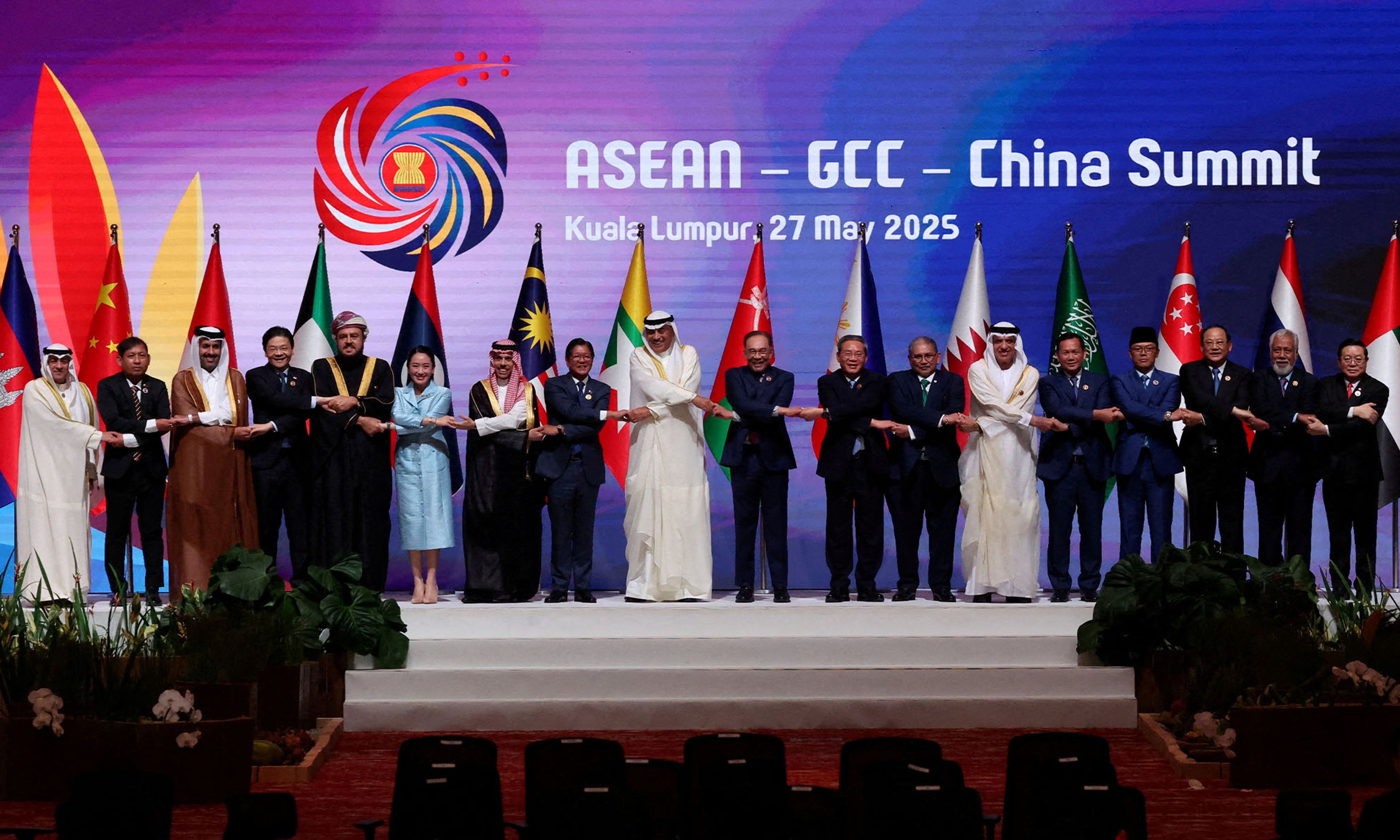
The ASEAN-GCC-China Summit at the Kuala Lumpur Convention Centre in Kuala Lumpur, Malaysia, May 27, 2025.
Just weeks ago, Qatari officials welcomed President Donald Trump to Doha with pomp, circumstance, and a $400 million jet. Now, Qatar is extending the same hand of friendship to China.
Last week, Qatari officials gathered in Kuala Lumpur with members of the Gulf Cooperation Council (GCC), the Association of Southeast Asian Nations (ASEAN), and delegates from China. The trilateral GCC-ASEAN-China summit underscored the burgeoning relationship between Qatar and China, which is part of Doha’s effort to expand its global influence and China’s interest in strengthening its regional ties amid deteriorating relations with Washington.
If Qatar’s sympathy for Hamas, collaboration with the Kremlin, or record of bribery hasn’t sounded alarm bells in Washington, Doha’s relationship with Beijing certainly should. Qatar’s open embrace of the United States’ primary adversary demonstrates the folly of entrusting Doha with American friendship.
Relations between Qatar and China have blossomed over the last decade. In 2014, Qatar established a $10 billion fund to invest in Chinese health care, infrastructure, and real estate. The funding hasn’t dried up. Last week, China gave approval for Qatar to acquire 10 percent of top Chinese asset manager China Asset Management Co. The acquisition is the first in China’s financial sector by a Gulf investor and a sign of Beijing’s willingness to open its opaque internal financial markets amid economic desperation.
The money goes both ways. China has sunk more than $4 billion into Qatar through investment and construction funds, including $764 million to construct Qatar’s Lusail Stadium for the 2022 FIFA World Cup.
Energy cooperation is a pillar of Qatar-China relations. Qatar has been China’s primary supplier of liquefied natural gas (LNG) since 2017, accounting for approximately 35 percent of China's LNG imports. In 2022, China Petroleum & Chemical Corporation (Sinopec) and QatarEnergy signed a $60 billion, 27-year LNG agreement — the “longest LNG supply agreement in the history of the industry,” according to QatarEnergy. Sinopec and QatarEnergy signed a similar agreement in 2023 that will see Qatar deliver 3 million tons of LNG per year to China well into the 2050s. Sinopec also acquired a stake in Qatar’s North Field East expansion project, positioning Beijing as a shareholder in the world’s largest natural gas field.
Chinese energy cooperation with Qatar may have strategic implications, given that Taiwan also relies heavily on Qatari energy imports. In the event of a Chinese attack on Taiwan, Beijing could lean on Qatar to enact a de facto blockade far from the island’s shores, bringing Taiwan to a grinding halt to achieve "reunification" while leaving Taipei intact. Washington’s friendship with Doha must not blind American policymakers to the risk that Qatar could assist China in a war over Taiwan. If the October 7 war is any indication, Doha has no problem siding with America's adversaries.
Beijing’s push to enter the Gulf intends not only to siphon energy, but also to push its silicon. Over the past decade, Chinese technology firms have become ubiquitous in the region, looking to open new markets to expand their economic influence and access export-restricted components to fuel the country’s military modernization efforts.
While not nearly as extensive as its ties to the United Arab Emirates or Saudi Arabia, China’s tech ecosystem has slowly come to encompass Qatar. Major Chinese national champions such as Huawei have taken a leading role in building Doha’s 5G network, while government data is stored in a “sovereign” cloud powered by Chinese firms. This outreach is only poised to expand in the coming years, both as China becomes more adept at offering full-stack AI solutions — using Huawei’s improved hardware to power DeepSeek and other firms’ software — and Qatar doubles down on its Vision 2030 to spur its post-carbon economic future.
Amid Trump’s recent slate of AI dealmaking across the Gulf, the administration was right to bypass Qatar, despite Doha’s self-stated neutrality and its presumed willingness to pay for American AI components. Going forward, Washington should refuse to sign or endorse any deal that would allow Doha to gain access to export-controlled technology — unless Qatar removes itself from China’s tech ecosystem, including stripping out Huawei components from the country’s critical infrastructure.
As China looks to solidify its place in the Gulf and Qatar seeks to befriend East and West, Beijing and Doha are reinforcing one another. Washington must make sure they don’t do so by weakening the U.S.
Natalie Ecanow is a senior research analyst at the Foundation for Defense of Democracies. Jack Burnham is a research analyst in the China Program at FDD.

About the Author
Natalie Ecanow is a research analyst for the Foundation for the Defense of Democracies. Her work focuses on the Middle East.
About the Author
Jack Burnham is a research analyst in the China Program at FDD.
Featured Tags
Advertisement
Advertisement

Comments