Share this story
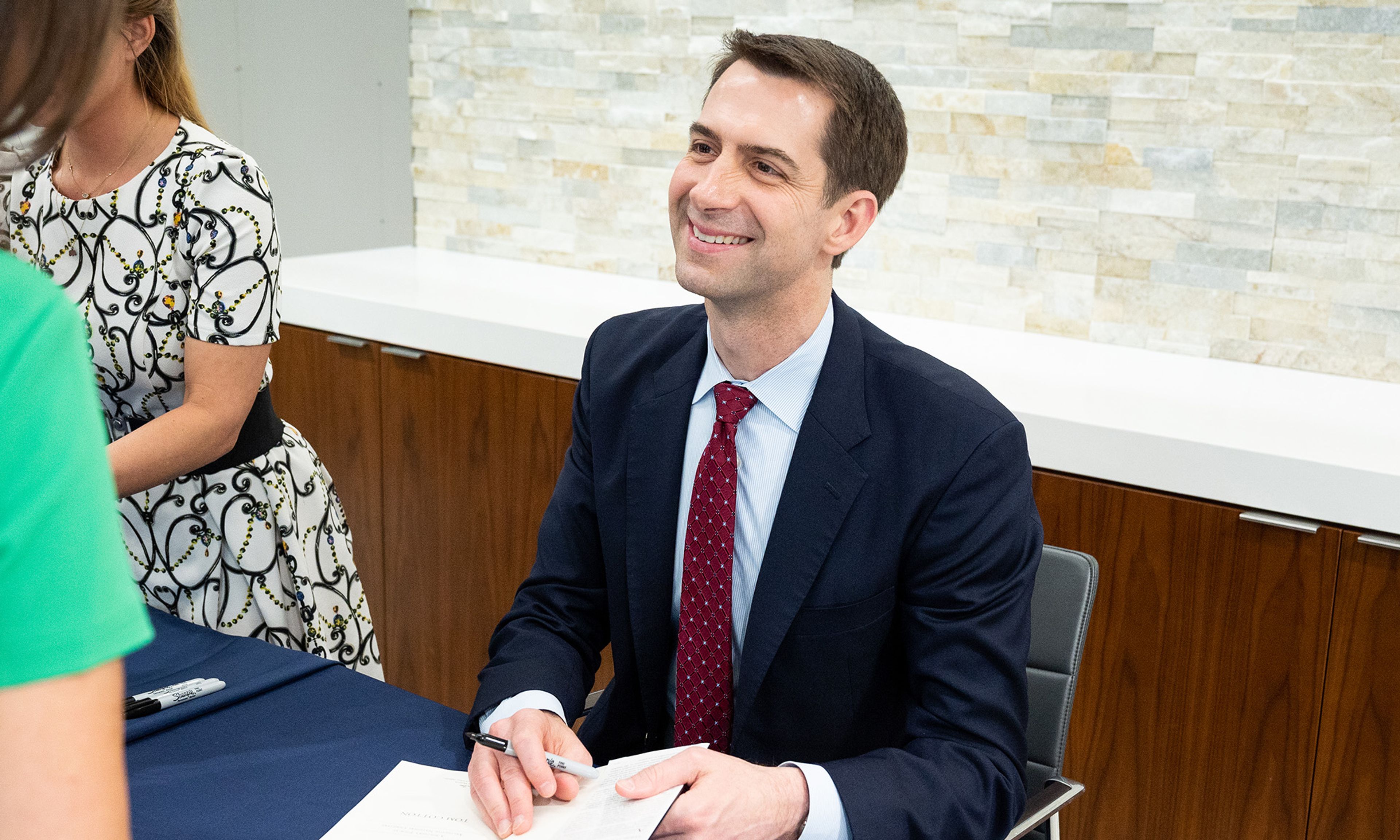
Senator Tom Cotton (R., Ark.) signing a copy of his book <i>Sacred Duty: A Soldiers Tour at Arlington Cemetery</i> in Washington, D.C., May 20, 2019.
In Seven Things You Can’t Say About China (Broadside Books, 208 pp., $27.99), Tom Cotton, the Senate’s foremost China hawk, pulls no punches. The things the Arkansas Republican wants people to hear about the Chinese Communist Party are directly stated and well supported, beginning with “China is an evil empire” and ending with “China could win.” Though many of his propositions will seem uncontroversial, if no less alarming, to readers who have been paying attention, he reminds them that powerful interests -- in Hollywood, media, professional sports, the corporate world, higher education, Washington, and on Wall Street -- still have strong incentives to whitewash the nature of the CCP or downplay the danger it presents. This often willful blindness has cost us greatly and left us “unprepared for the coming storm.” Cotton paints a sobering picture of the chain of events that would follow a Chinese invasion of Taiwan, beginning with economic disaster and culminating with China atop a new world order. Such an outcome would match the “long-standing ambitions and plans of the Chinese Communists.” Now that we’ve at last perceived the threat, it remains to us to counter it.
We Have Ceased to See the Purpose: Essential Speeches of Aleksandr Solzhenitsyn (University of Notre Dame Press, 228 pp., $28) is a new volume collecting ten speeches given by the great Russian writer and dissident, edited by his son Ignat Solzhenitsyn. The speeches, composed between 1971 and 1997, include Solzhenitsyn’s most significant orations -- his famous Nobel lecture and Harvard address among them -- on art, culture, the spiritual crisis of East and West, freedom, and history. Together they form a powerful distillation of his major themes. After the sensational publication of The Gulag Archipelago in France in 1973, Solzhenitsyn was stripped of his Soviet citizenship and hurled into exile in the West, eventually settling for a couple of decades in Cavendish, Vt. While his international celebrity was immense in a way no longer imaginable for a man of letters, from the first he began to surprise and puzzle many of his admirers. As Ignat Solzhenitsyn writes in his introduction, there was “a chasm between what Western opinion-makers expected the newly banished writer to say and what he himself felt compelled to offer.” He spoke not only to condemn “bestial Communism” but also to explain what he perceived as the weaknesses and flaws of the modern West. He thought that it too had made the fatal mistake of embracing “anthropocentrism -- the idea of man as the center of existence.” His diagnosis has lost none of its resonance today.
“A person does not have to be a medical professional to have noticed that certain diagnoses have become suddenly common,” writes Suzanne O’Sullivan, a practicing neurologist, in her provocative new book, The Age of Diagnosis: How Our Obsession with Medical Labels Is Making Us Sicker (Thesis/Penguin, 320 pp., $32). It is not only ADHD, autism, and mental-health conditions that are significantly on the rise but physical diseases such as diabetes, cancer, hypertension, and many more. O’Sullivan argues, persuasively, that this explosion of diagnoses indicates not that we are becoming considerably sicker, or that we are becoming better at identifying and treating sickness, but that “borderline medical problems are becoming ironclad diagnoses and that normal differences are being pathologized.” Expanding definitions for health conditions, earlier screening, and increased testing, as well as a social push to reframe normal human suffering and life stages as medical problems to be solved, are all driving this trend. O’Sullivan worries about the actual and potential harms of overdiagnosis and overmedicalization, especially for the people with the most severe forms of a given condition, who must now compete for limited resources. She also notes the ethical risks inherent in increasingly routine predictive genetic testing, both for unborn children and for adults. As she reminds readers, “The history of medicine is dotted with assumptions long held and trusted that later proved to be wrong.”
About the Author
Katherine Howell is the literary editor of National Review.
Featured Tags
Advertisement
Advertisement
Comments