Share this story
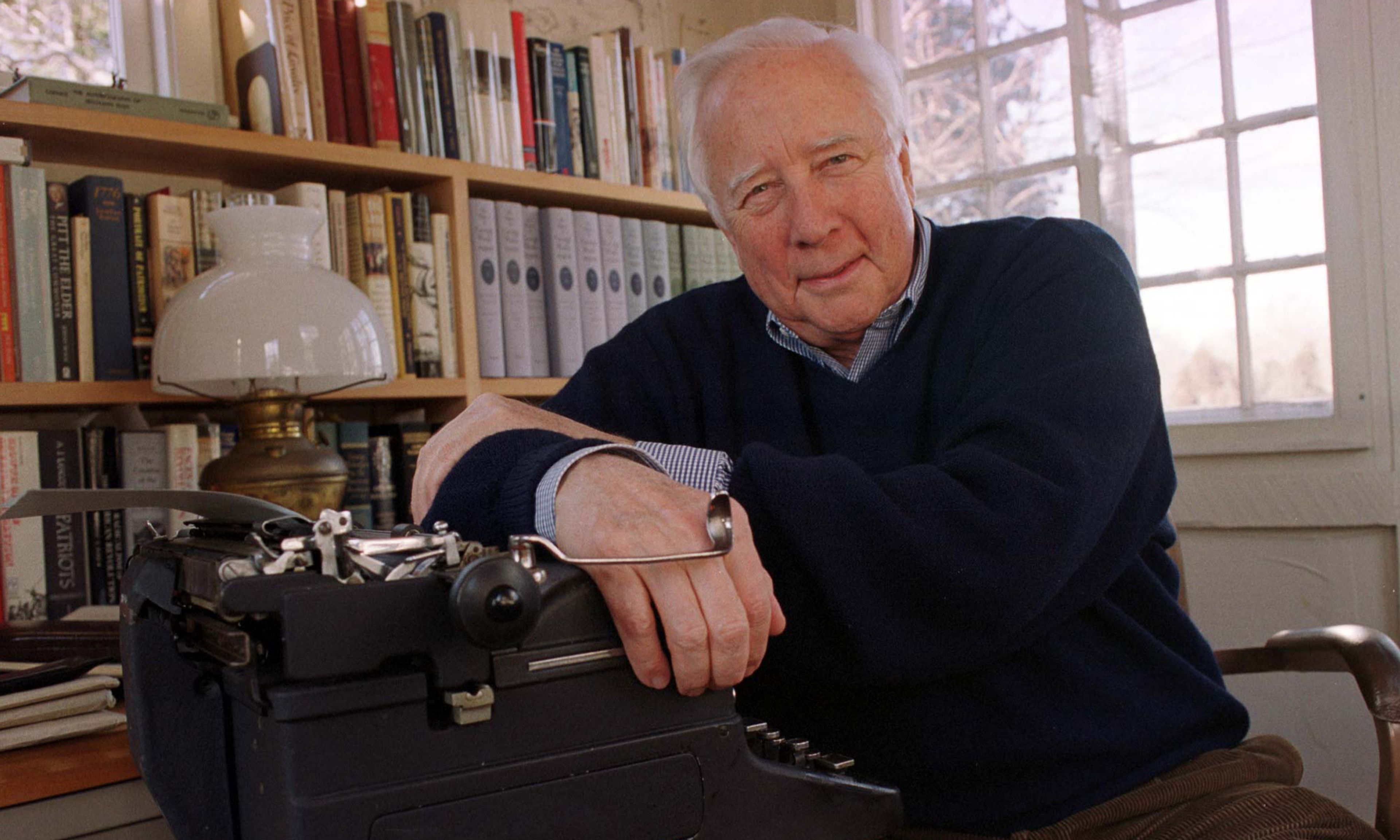
American author and historian David McCullough in his writing shed where he used a 1941 Royal typewriter, at his home in West Tisbury, Mass., February 4, 2002.
In his excellent Paradise Lost: A Biography (224 pp., $24.95), an entry in Princeton University Press’s Lives of Great Religious Books series, Alan Jacobs writes that his subject is, “surely, the greatest poem in English, but it is not lovable.” Down through the generations, Milton’s epic has drawn intense responses and sharp debate from readers and critics: Was Satan the poem’s true hero? Was Milton a misogynist with, in Samuel Johnson’s words, a “Turkish contempt of females”? (Jacobs presents a convincing case for a more nuanced reading of Milton’s treatment of Eve.) Joseph Addison judged that the poem compelled universal interest because “no less than our utmost happiness is concerned” in the story. Virginia Woolf, for her part, wondered, “Has any great poem ever let in so little light upon one’s own joys and sorrows?” The poem loomed especially large for the Romantics, calling forth William Blake’s Milton and providing imaginative grist for Mary Shelley’s Frankenstein. In the 20th century, C. S. Lewis in his treatment of Paradise Lost boldly combined scholarly analysis with Christian apologetics. The reader comes away from Jacobs’s short, stimulating volume with a sense of how thoroughly Milton realized his ambition that he “might perhaps leave something so written to after times, as they should not willingly let it die.” Whether it will continue to meaningfully live on in a post-biblically-literate society is less certain.
Barry Strauss, a classicist and senior fellow at the Hoover Institution, takes as his latest subject a historical contest that he hopes “will offer context for the clash of civilizations we are witnessing today.” Jews vs. Rome: Two Centuries of Rebellion Against the World’s Mightiest Empire (Simon & Schuster, 384 pp., $29.99) begins in 63 b.c., with Rome conquering Judea, setting the stage for periodic uprisings by the Jewish people, from the catastrophic Great Revolt of a.d. 66 -- resulting in the destruction of the Temple -- to the Bar Kokhba Revolt, ruthlessly suppressed by Rome in the next century. Hemming in Judea to the east, and complicating its geopolitical situation, was a Roman enemy, the Iranian empire of Parthia. Strauss writes brisk, vivid prose handled with scholarly care. He is clear about when he is speculating and how he evaluates the often spotty written sources and archaeological evidence that undergird his narrative. Jewish survival -- against the odds, despite infighting, and in the face of cataclysmic events -- is one of his themes. Another is strategy and statesmanship: how they are essential for peace, and how their absence leads to war. And he writes, as he says, following Herodotus, to give due glory to the “great and marvelous deeds” of the past.
The late David McCullough believed that “history should not ever be dull.” History Matters (Simon & Schuster, 192 pp., $27), a new collection of his essays edited by his daughter Dorie McCullough Lawson and his longtime researcher Michael Hill, opens a window into his mind and his writing process. McCullough, the author of many widely acclaimed books of popular American history, insisted that he was not a historian but “an English major.” What was his method? An amateur painter, he liked to quote Delacroix: “What I demand is accuracy for the sake of imagination.” He thought that to write well -- to tell a compelling story -- one had to see well, to really look at things. And he understood the men and women of the past as living through their own contingent present, making choices with no certainty about how events would turn out. McCullough thought knowledge of history was foundational for citizenship and patriotism: without it there can be no gratitude for the achievements of our forebears or standards to live up to. Fittingly, the collection includes many expressions of McCullough’s own gratitude -- for the teachers, historians, and books he learned from and for the figures of the past whose stories he told, never dully.

About the Author
Katherine Howell is the literary editor of National Review.
Featured Tags
Advertisement
Advertisement





Comments