Share this story
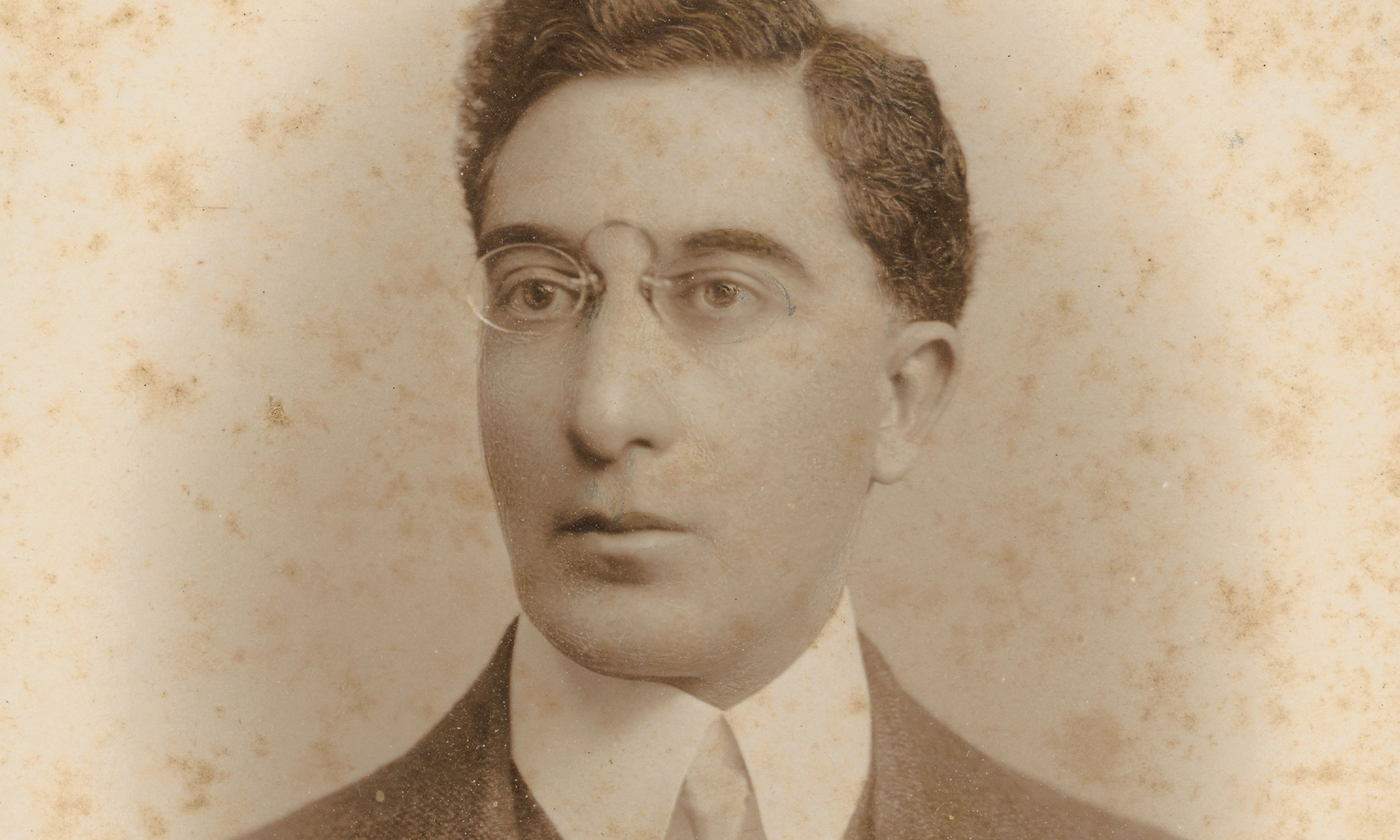
A portrait of Constantine Cavafy, 1910s
Constantine Cavafy was the whisperer of dignified loss. Fitting for a nouveau pauvre Constantinopolitan Greek–British poet in Ottoman Egypt in the late 19th century. He left his hometown, Alexandria, twice in his teens before a permanent return. Even Odysseus had only one homecoming. In Constantine Cavafy: A New Biography (Farrar, Straus and Giroux, 560 pp., $40), Gregory Jusdanis and Peter Jeffreys ask, “How did a man who, until middle age, showed little promise or capacity for greatness, living in a provincial city and writing in a minor language, manage to create poetry that has captured the world?” He had an early modernist view of the self, they want to argue, but they make a much stronger case for his vernacular and commercial skill. Cavafy wrote in demotic Greek, and he frictionlessly fused Romanticism and history with the mundane and the erotic. (“Nero sleeps sensual, calm and blissful, / In the bloom of his body’s strength / And the lovely vigor of his youth” -- as the Furies come for him.) He also ignored Virginia and Leonard Woolf when they first expressed interest in publishing translations of his work. Why? He was carefully designing his reputation by hosting salons in his dim, relic apartment (no electricity), personally recruiting ardent readers. There are no recordings of his voice. Still it rings distinctly through his verse, even -- especially -- in English.
Nicholas Wade was for 30 years a science writer at the New York Times. Much later he would argue, persuasively, that Covid-19 might have sprung from a lab. That was in May 2021: not exactly a warm season for heterodoxy. His new book, The Origin of Politics: How Evolution and Ideology Shape the Fate of Nations (Harper, 256 pp., $32), is a broadside against the idea that human behavior is the result wholly and exclusively of culture. Against the idea that human society is independent of our primate biology and natural selection. This is a lot more defensible than some of the conjectures made in his 2014 book, A Troublesome Inheritance. The best parts of his argument affirm Thomas Sowell’s constrained vision of human nature, avoid genetic determinism (and Freudian discontents), and suggest that cultural practices that channel our biological instincts better than others do are preferable. The worst parts are facile (“The structure of human societies is implicit in human genetics”; “Human nature can be thought of as having two components, one self-interested and one social”) and polemical (treatises on DEI and on the Western fertility rate seem out of place). The hypothesis that ideological discord in a population has a genetic basis and is useful for long-term survival is intriguing enough.
Patrick Ryan’s novel Buckeye (Random House, 464 pp., $30) is a portrait of the many faces of loneliness. Here’s the story of two Midwestern families, the Jenkinses and the Salts, whose lives converge over the better (or worst) part of the 20th century. Forgive a few regrettable lines and plotlines. Think of the punctures through the insularity of small-town America in Sinclair Lewis’s Main Street, with less caricature and more charm. Except for the moments when Ryan departs from historical fiction to insert historical intermissions in his fiction (“A polio vaccine had finally been approved. A place called Disneyland had opened in California”), he’s subtle and dexterous: The political upheavals of the century “pluck at a filament” that runs through everyone in Bonhomie, Ohio. Keep an eye out in particular for the oscillations of Everett Jenkins, a World War I vet who enjoys writing letters to presidents and cabinet secretaries -- “Blas your coral a oll o hell” (his typewriter is missing a key) -- and shoots a .22 at census takers.
About the Author
Vahaken Mouradian is the literary editor of National Review.
Featured Tags
Advertisement
Advertisement



Comments