Share this story
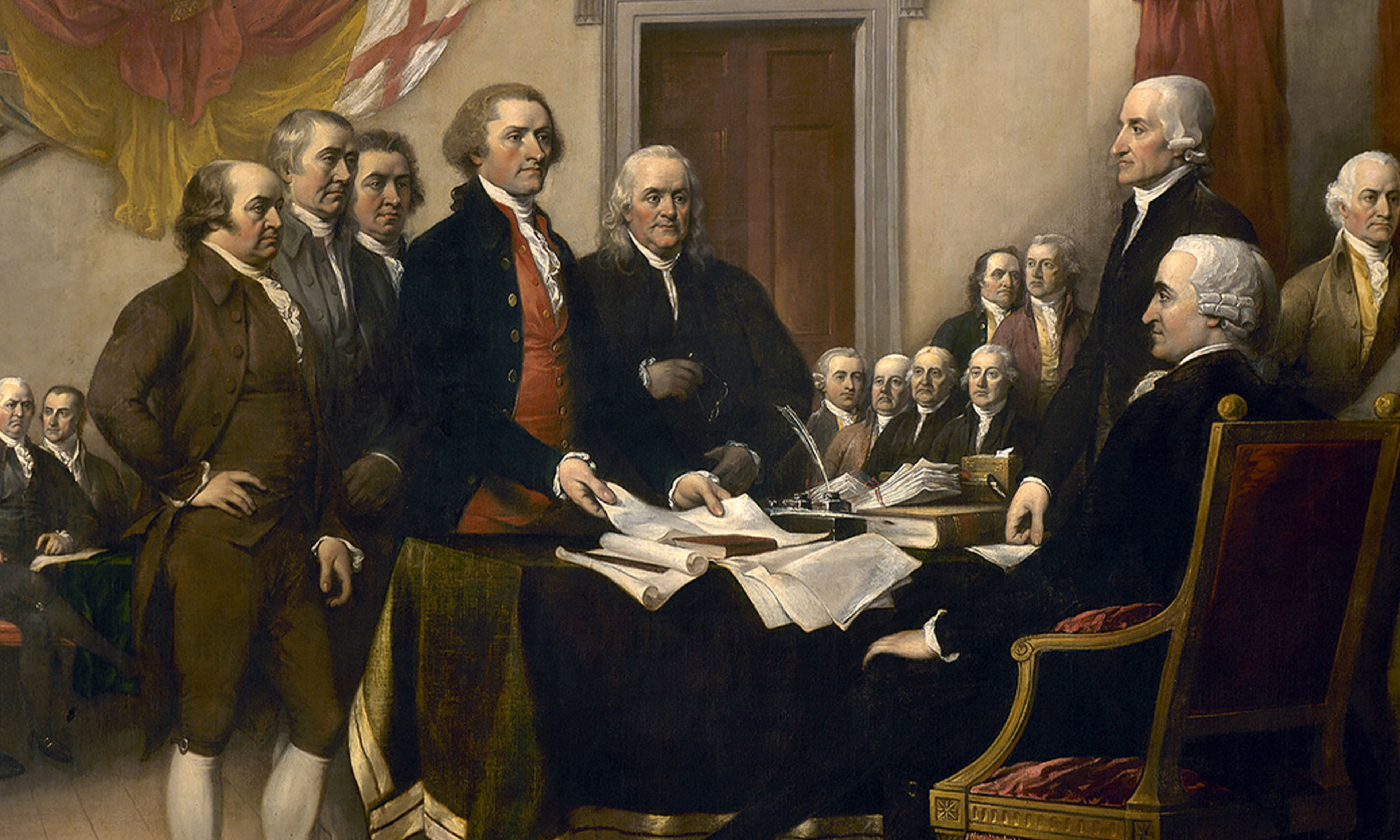
<i>Declaration of Independence</i> by John Trumbull, 1819
Mark Skousen is Benjamin Franklin’s great-great-great-great-great-great-grandson. Comes with great expectations. Familial standards for most of us are more manageable. His 2001 book, The Making of Modern Economics, was reviewed favorably in these pages by William F. Buckley Jr. himself. It led Skousen to a guest lecture and then to a regular lecturing gig at Columbia Business School. Now, deans of colleges of history should take note: Skousen’s newest book, The Greatest American: Benjamin Franklin, the World’s Most Versatile Genius (Republic, 320 pp., $28), is an anthology of 80 short, highly readable, carefully researched, candid, dutifully reverent but not oily or obsequious, thematically organized essays on the old sage. Franklin the investor and inventor, Franklin the philanthropist and philanderer, Franklin the patriot and cosmopolitan, Franklin the swimmer and lifter of weights. From a chapter on misquotation, I learned that the seasoned epicure never said that “beer is proof that God loves us and wants us to be happy.” He preferred Madeira port.
Follow great Americans and you’re led to great writing. Walter Isaacson, who happens to be a celebrated biographer of Benjamin Franklin, identifies The Greatest Sentence Ever Written (Simon & Schuster, 80 pp., $20) as this one: “We hold these truths to be self-evident, that all men are created equal, that they are endowed by their Creator with certain unalienable Rights, that among these are Life, Liberty, and the pursuit of Happiness.” That line is also a rare instance in which heavy-handed intervention by more than one editor resulted in overall improvement. Granted, the editors were Franklin and John Adams. Isaacson traces their pen strokes on Jefferson’s draft; the certainties of conviction and the tensions in reasoning between the words. But he strains -- doubtless egged on by less creative editors -- to imbue each of his short chapters with present-day “relevance.” No need. The moral currency of the Declaration of Independence is to every thinking American self-evident. Isaacson’s suggestion that we might look in our Founding document for sufficient answers to, say, housing or immigration policy questions is self-evidently simplistic.
Alongside Vladimir Nabokov (whose lectures at Cornell he probably attended), Thomas Pynchon is one of those very few worthy Americans to have been inexplicably denied the Nobel Prize in Literature. His latest -- maybe last -- novel, Shadow Ticket (Penguin Press, 304 pp., $30), confirms it. It’s an acid trip inside a sensory-augmentation chamber inside a time machine behind a Milwaukee speakeasy. It’s neon noir. “When trouble comes to town it usually takes the North Shore Line”: the best opening line I’ve read this decade. Hicks McTaggart, a hatchet man turned private eye at the Unamalgamated Ops detective agency, is tasked with recovering the daughter of Bruno Airmont (the “Al Capone of Cheese”), a twentysomething vamp who has run away with a jazz clarinetist. Some critics moan that Pynchon doesn’t say something about our politics: a point in his favor, really. The novel is plenty political without being politicized. Dilettante spies. Hungarian antisemites. Fascist bikers. The International Cheese Syndicate. A Czech golem with a light machine gun for a left arm (manufactured in Prague and regulated by BAGEL, the Bureau Administering Golems Employed Locally). Real and fraudulent practitioners of telekinesis. Renegade submariners. Trainee terrorists. Suave pickpockets. Try to discern their moves and motives in the ideological stewpot of Central Europe in the 1930s. Or don’t. The sightseeing alone is worth the trip.

About the Author
Vahaken Mouradian is the literary editor of National Review.
Featured Tags
Advertisement
Advertisement

Comments