Share this story
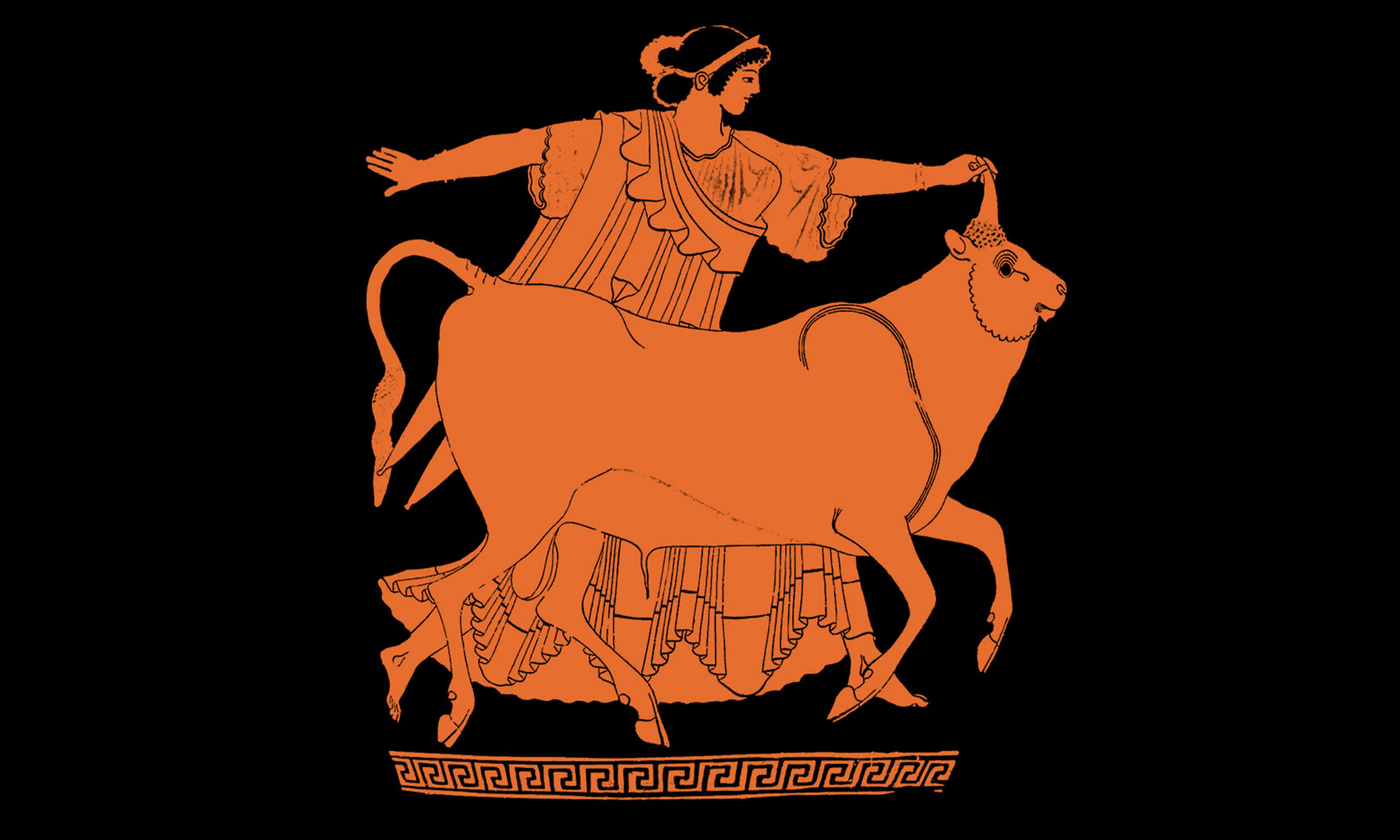
Unknown Artist, <i>Europa and the Bull of Zeus</i>, 5th century B.C., red-figure pottery.
The Mighty Continent: A Candid History of Modern Europe (Creed & Culture, 466 pp., $38) begins in the Mediterranean. Without Mycenae and Moses and Rome, argues Walter A. McDougall, there would be no Catholic Church and no medieval Europe. Without medieval Europe, there’d be no Renaissance and no scientific revolution. Without the Renaissance, no Age of Discovery, no Protestant Reformation, and no modernity. “Europeans invented the modern world,” as we know it, by variously synthesizing what the Greeks called techne and themis: science and culture.
Obviously, the aperture of the lens that McDougall uses is enormous; its depth of field must be commensurately shallow. The reader is catapulted over the ages and can take only snapshots of the rapidly changing scenery below. It’s the price of covering such a great distance. But McDougall is an expert guide. What you might miss in detail you’ll gain in understanding of Europe’s almost dialectical evolution. The might of the continent had begun to diminish by the start of the First World War; it was depleted by the end of the Second. Just as her birth was in the Eastern Mediterranean, Europe’s afterlife, too, is likely beyond her shores.
Were history taught as a story, Rudyard Kipling guessed, it wouldn’t be forgotten. McDougall proves him right.
When Martin Shaw says he’s a storyteller, he means only that he’s human. Naturally we all see and seek narrative order in our lives. A beginning, a (hopefully dense) middle -- here’s blessing, adversity, friction, loss, epiphany, triumph -- a fitting (and hopefully distant) end. But, Shaw warns, the farther we depart from tradition and ritual and nature, the more the threads of our lives slacken. Plot holes can fray a good story.
Shaw’s Liturgies of the Wild: Myths That Make Us (Sentinel, 256 pp., $30) is a collection of closely related essays intended to re-mystify human existence. The author is a Christian eccentric who dislikes the indoors, hangs out with Sioux shamans, and once counseled a retired hit man who wanted to pray but couldn’t motivate himself to do so. Each chapter features some fairy tale, an anecdote, a memory, a dream. Shaw has had extraordinary dreams. The matter of whether he has gifts beyond that of fine prose I’ll leave to another reader. We might all be storytellers, but he’s a good one: Aren’t you curious how he once ended up at a Rhode Island airport with a bagful of torn-up banknotes?
Shaw would agree with Emma Sharp that “the trail brings up what you’ve buried.” Emma, the protagonist of How to Survive in the Woods (Harper, 320 pp., $30), encounters guilt and ghosts, bears and men, and other dangerous creatures during her hike through Maine’s Hundred-Mile Wilderness, arguably the most hazardous section of the Appalachian Trail.
Kat Rosenfield, a onetime contributor to these pages, has been publishing thrillers since 2012. This is her sixth and best. Once Emma, her lunatic husband Logan, and their inscrutable friend Taylor have left the trailhead, they’re in a Hobbesian state of nature. Lies, guile, cruelty, camouflage. Murder is their invisible companion. Everybody wants to survive; not everybody will.
The author and her characters sometimes lose their footing. All would’ve benefited from fewer instances of “rummaging” in backpacks, for example. (That verb in this context is a fearsome cliché.) In a later chapter, there are three rummagings in as many pages before Rosenfield regains her balance and agility: “Nature is indifferent to whether you live or die -- but once you are dead, it certainly takes an interest.” This is very fine. If the rights to a miniseries haven’t been sold yet, HBO should certainly take an interest.

About the Author
Vahaken Mouradian is the literary editor of National Review.
Featured Tags
Advertisement
Advertisement

Comments