The Border Tax Is Back, and It’s Still a Terrible Idea
Written by Jack Salmon
The BAT is a gamble with America’s economic future, and it’s not a gamble worth taking.
Share this story
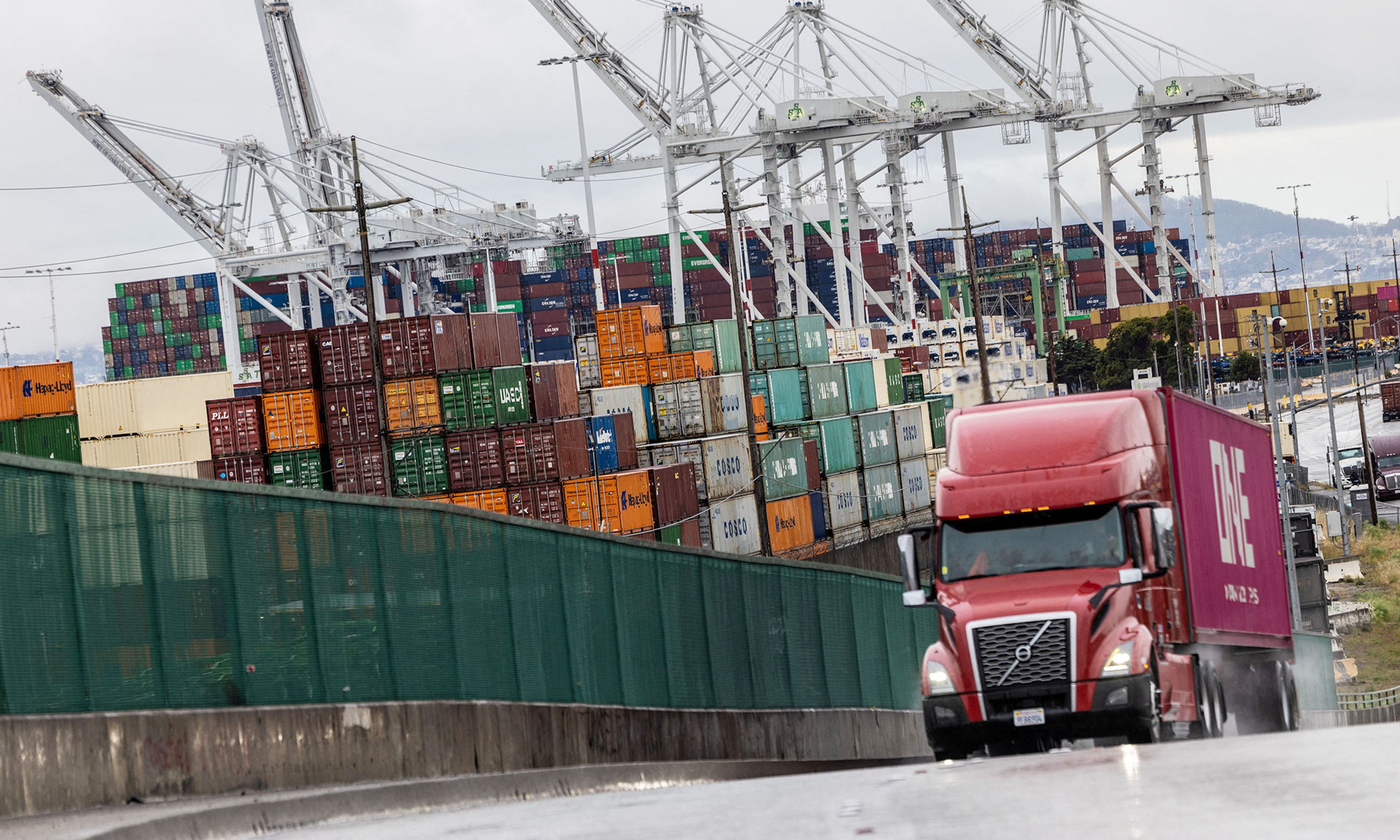
Shipping containers at the port of Oakland, Calif., May 12, 2025.
This morning, the Joint Economic Committee is holding a hearing on the advantages of something called a “destination-based cash flow tax” or DBCFT. This isn’t a new policy idea; it’s a recycled version of the border adjustment tax (BAT), a policy so flawed that it divided Republicans and nearly derailed the 2017 tax reform effort.
The idea has resurfaced in the wake of the Supreme Court’s recent ruling striking down President Trump’s International Emergency Economic Powers Act (IEEPA) tariffs as unconstitutional. With the administration’s unilateral trade powers somewhat curtailed, some lawmakers now appear eager to revive border-adjustment-style policies through the tax code instead, repackaging trade protection as tax reform.
A BAT, which taxes imports while exempting exports, rests on the questionable assumption that the U.S. dollar will quickly appreciate by roughly 25–30 percent to offset the import tax and export subsidy. In theory, this adjustment would shield American consumers from higher prices while giving exporters a boost. But the theory doesn’t hold water.
International currency markets are unpredictable at best, chaotic at worst. Models that predict a clean currency adjustment often fail to account for real-world complexities like monetary policy, capital flows, global risk sentiment, relative growth expectations, and geopolitical shocks. History shows that exchange rates rarely adjust fully or quickly to policy changes. Instead, they shift partially and gradually, leaving importers, and ultimately consumers, to foot the bill.
This effect disproportionately harms lower-income households, who spend a higher percentage of their income on imported goods like food, clothing, and electronics. If imports become more expensive, the tax burden will fall hardest on those least able to afford it, making the BAT a regressive policy disguised as a corporate tax reform.
Adding to the folly, BAT advocates underestimate the political reality of tax exemptions. Value-added tax (VAT) systems in other countries typically exempt close to half of all goods, particularly politically sensitive essentials like food and energy. A BAT riddled with exemptions would fail to raise the revenue needed, further undermining its economic logic.
Even without exemptions, a BAT creates clear winners and losers, sowing economic inefficiencies and political rent-seeking. Exporters like Boeing would lobby furiously to preserve their lucrative subsidies, while import-heavy businesses, such as retail chains, would face staggering tax bills that could exceed their profits. Those costs would not simply vanish; they would be passed on to consumers in the form of higher prices. Rather than simplifying the tax code, a BAT would entrench special interests and incentivize corporate lobbying on an unprecedented scale.
This system would also encourage tax-motivated mergers and distortions. Since export revenue would be excluded from the tax base, but domestic expenses would still be deductible, a firm that exports heavily could deduct more than it reports in taxable revenue. The resulting tax losses could be monetized through refunds or used to offset another firm’s tax liability, encouraging tax-driven mergers rather than economically efficient ones. Companies might feel compelled to merge with profitable firms — not for strategic growth, but to game the tax system. This distorts the economy, reducing efficiency and competition.
Beyond its domestic challenges, the proposed BAT’s legality under international trade law is highly questionable and would almost certainly face legal challenges. If deemed illegal, the U.S. could face retaliatory sanctions or be forced to replace the BAT with a European-style VAT, precisely the kind of consumption tax that Republicans have long opposed.
Moreover, BATs undermine global competition. By taxing based on where goods are consumed rather than where they are produced, it insulates the U.S. tax base from international pressures. At first glance, this might seem like a win. But in the long run, it removes the incentive for countries to lower corporate tax rates to attract businesses, leading to higher tax rates globally and stifling innovation.
The ripple effects would not stop at America’s borders. Emerging markets, which often carry dollar-denominated debts, could face severe economic instability as their currencies depreciate. Central banks in these countries would likely intervene to stabilize their currencies, further destabilizing global financial markets.
Domestically, a BAT’s impact on the U.S. balance sheet would be another ticking time bomb. While a stronger dollar would make imports more expensive and exports cheaper, it would also increase the value of U.S. foreign-held debt, most of which is denominated in dollars. Based on the latest international investment data, U.S. investors held $41.3 trillion in foreign assets as of the third quarter of 2025, while most U.S. liabilities are dollar-denominated. Applying a 25 percent appreciation to the net foreign-currency exposure implies valuation losses on the order of $4–$5 trillion. Under a 30 percent appreciation, the losses approach $6 trillion.
Approval of a new BAT would be gambling with America’s economic future, and it’s not a bet worth taking. By shifting the tax burden onto consumers, distorting market incentives, and destabilizing international markets, it could do far more harm than good. By promoting the DBCFT as a “smarter” alternative to tariffs and a revenue fix for the nation's worsening fiscal condition, its advocates are repeating old mistakes: overlooking the immense economic risks and the serious questions it raises under international trade law.
The better path forward is clear: Stop looking for desperate fiscal Band-Aids and return to principles of sound economic policy. Competitive tax rates, broader bases, leaner government, and fewer market distortions are what drive prosperity, not convoluted schemes that gamble with America’s economic stability.
Traditionally, Republicans built their brand on fiscal responsibility and free markets. Embracing the BAT would not only betray these principles, but also saddle Americans with higher costs, fewer choices, and diminished economic freedom. Conservatives should remember that once government begins managing trade through the tax code, markets adjust — and not always in ways policymakers expect.
About the Author
Jack Salmon is a Gibbs Scholar and research fellow at the Mercatus Center at George Mason University and a visiting fellow at Philanthropy Roundtable. His research and commentary have been featured in a variety of outlets, including The Hill, Business Insider, RealClearPolicy, National Review, the American Institute for Economic Research, and Reason magazine.
Featured Tags
Advertisement
Advertisement
Comments