The Coming Political-Process Armageddon
Written by Dan McLaughlin
Democrats could find themselves briefly in power with their prospects slipping away. Beware what they may do.
Share this story
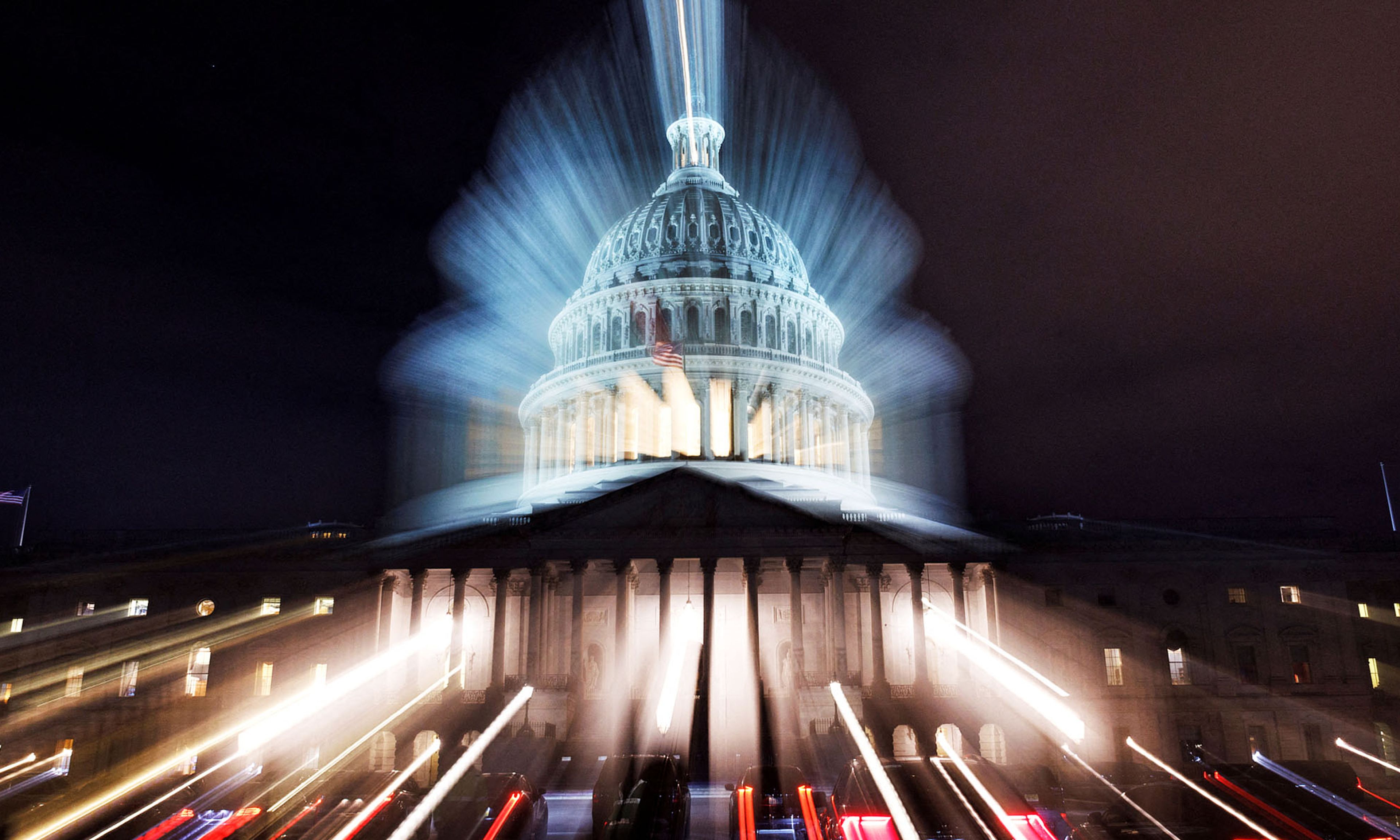
The U.S. Capitol building in Washington, D.C.
If you think American politics is acrimonious now, wait for 2029. It’s not hard to envision a situation in which an Armageddon-level fight arrives in 2029–30 over changes to the ground rules of the American political process.
Picture the following scenario, all of which is entirely plausible:
- Trump fatigue helps Democrats between 2026 and 2028 recapture the House, the Senate, and the White House, all without moderating the party, and perhaps even while elevating its angrier, more radical voices.
- Democrats win a narrow popular-vote margin in the 2028 presidential election, mostly by running up the score in blue states, but claim only a narrow majority in the Electoral College by recapturing Pennsylvania, Michigan, and Wisconsin -- a 270–268 map that would be a losing hand in 2032 (the same is true if you add Nevada).
- Democrats’ slim Senate majority rests on many more Democratic senators in Trump 2024 states than Republicans have in Biden 2020 states. Currently, there are ten Democratic senators in Trump 2024 states to just three Republican senators in Biden 2020 states; that needs to become even more lopsided in order to give Democrats a majority.
- Republican appointees continue to hold a 6–3 majority on the Supreme Court in 2029, with no end soon in sight, possibly after Republicans replace one or more of their oldest justices between now and the end of 2028.
- With three more years of hard border enforcement and a high level of deportations combining with preexisting dynamics of internal migration from blue states to red states, the U.S. population continues to shift out of blue states and into red ones -- perhaps even more dramatically than the current projection of an eleven-seat loss for blue states in the House and the Electoral College beginning in 2032.
- By the fall of 2029, the usual midterm dynamics appear poised to give Republicans the governorships in Virginia and New Jersey in 2029 and a major leg up in winning state legislatures and governorships across the Midwest and the purple parts of the Sun Belt in 2030. This is what happened in 2009–10 and set Republicans up to dominate redistricting for the first time in the 2010s.
All of these are extremely plausible assumptions; indeed, each of them individually may be the likeliest outcome over the next three years. The net result would be that Democrats would be riding high in power in Washington and in many key states, while knowing that power was likely to be a very short-lived window of opportunity. How do we think Democrats would react in this situation? Is there any chance that they would not react by trying in every way possible to change the rules? If so, how can they best be stopped from doing so? Let’s consider the history and the potential battlespace.
Fighting the Process
Many issues affect the lives of the American people. But battles over the political process itself affect the jobs of politicians, so those fights generate an entirely different level of ire and bile and are uniquely hard to resolve by compromise. Partisan power, after all, is a zero-sum game. And restraint in seeking it has been crumbling.
While our constitutional system is built to assume that politicians will seek to maximize their power, American politics is constrained in part by rules and in part by norms of behavior. While some rule violations can be policed by the courts, many of our rules and norms are enforced only by a combination of personal honor and decency, fear of voter backlash at overreach, and fear that the gains from breaking taboos will be outweighed by the costs of partisan retaliation in kind. All three of those checks have been systematically eroding, as politicians and voters alike convince themselves not only that the other side started it but, increasingly, that one may as well go first because the other side is about to start it. This is essentially the mindset of the median European general staff circa June 1914.
In early 2026, there are two major fronts. At the state level, both parties are pushing increasingly aggressive House district gerrymanders, justified as retributions and heedless of every potential downside. At the federal level, many Republicans are pushing the SAVE Act, which would interject additional federal rules into state administration of voter identification. Some Republicans, heedless of the obvious downsides, have demanded changing or abolishing the Senate filibuster to pass the bill. The Supreme Court is also hearing cases on racial gerrymandering, mail-in ballot deadlines, political party campaign-spending limits, the removal of Federal Trade Commission commissioners and Federal Reserve governors, and birthright citizenship -- all of which can reshape the process in different ways.
In the previous five years, we had major changes to state voting laws during and after the pandemic; Democrats trying and narrowly failing to abolish the filibuster and enact a sweeping federalization of elections and redistricting; Democrats proposing Court-packing; and Republicans trying to limit the counting of illegal aliens in the Census by executive action. That’s even aside from battles at the state level over state processes.
There’s a long history of American political parties monkeying with the rules to gain advantage. Outside of the Jim Crow South, where one-sided process rules were driven by race and persisted long after Democrats had stamped out partisan competition, these efforts have typically come in waves, but they have usually been constrained by a desire to avoid the appearance of naked power grabs. A very incomplete history:
- The admission of states has long been a football for partisan and sectional hijinks, with fights over free/slave state admission in 1820 and 1850 and in “Bleeding Kansas,” six Western states added by Republicans under Benjamin Harrison to shore up a crumbling GOP coalition, and a bipartisan deal to let in Alaska with Hawaii in 1959 on the assumption that each would support a different party.
- Winner-take-all states in the Electoral College were undermined by Michigan Democrats scheming to beat Harrison in 1892; Maine and Nebraska still have these mischievous systems, but Nebraska Republicans beat back a Trump effort to undo theirs in 2024 (both states awarded one elector to the statewide loser in 2024).
- Control of the House hinged in 1839 on which of two rival New Jersey delegations should be seated, a dispute that was decided largely on partisan lines and considerations. The same was true at a more disturbing level of the presidency with dueling electors in 1876, ending in a deal to end Reconstruction.
- In 1920, the Census for the first time in history showed more Americans living in urban than rural areas. A bipartisan coalition of rural representatives blocked any reapportionment, with the result that the whole map of the 1920s was distorted. Only in 1929 did Congress provide for reapportionment, taking place in 1932.
- The size of the Supreme Court was contracted by the Federalists under John Adams, restored by the Democrats under Thomas Jefferson and expanded by them under Andrew Jackson, expanded again by Lincoln’s Republicans during the Civil War, contracted by them when Andrew Johnson took over, restored by them under Grant, and threatened with expansion by FDR.
- A Supreme Court nominee was filibustered for the first time, by a bipartisan coalition, in 1968; the first partisan filibuster of federal appellate-court nominees was conducted by Democrats in 2003; Senate Democrats abolished the filibuster for appellate judges in 2013, and Republicans did the same to the filibuster for Supreme Court nominees in 2017 after a Republican majority in the Senate held a seat open during the 2016 election.
The Partisan Mood
Each of these past periods has reflected partisan anxiety about losing power. Some of those maneuvers were justified with more plausible arguments than were others. But where things get really nuts is when parties start talking themselves into worrying about extinction at the hands of an opponent -- especially an opponent that they believe (or claim to believe) is plotting to kill them, end democracy, etc.
That’s where the South, and by extension the Democrats, went in 1859–61. It led to the Civil War. It also led, in reaction, to a number of the things Republicans did to rework the process in their favor between 1863 and 1870, including amending the Constitution.
Every war raises three questions: Why is there a conflict? Why did the conflict lead to war? Why did it lead to war at this time? Slavery, of course, was at the core of the conflict, and the extremity of the conflict over slavery goes far toward explaining why it led to war. The various other sources of cultural, economic, and political North-South conflict were not solely driven by slavery, but they would likely not have produced war in its absence. But why now? John Brown’s raid, a spectacular act of political violence in late 1859, fanned the flames, which had been burning for some years in the form of violence in the territories, violence around fugitive slave-catching, and violence in the halls of Congress itself.
But the trigger was that the political process passed the tipping point. Territorial expansion tilted the balance of the Senate against the slave states beginning in 1850, irrevocably so with the admission of Minnesota in 1858 and Kansas in January 1861. Mass immigration, concentrated in the North, contributed to the 1850 Census showing the free states pulling away in the House and the Electoral College, a trend that everyone (correctly) expected to see accelerate in the 1860 Census. The South still controlled the Supreme Court, the presidency, and the foreign and military policy organs between 1853 and 1860, but the 1860 election for the first time unified the free states to elect a president without the votes of a single slave state. That meant that he could use the appointment powers of the presidency in ways that Southern slaveholders saw as a plot to have them murdered in their beds, as well as appointing new justices and ending pro-slavery foreign policy. (The Senate held a Supreme Court seat open in 1860–61 that ended up getting filled by Abraham Lincoln.) The simultaneous rise of a free-state majority in the Electoral College, Senate, and House led Southern leaders to conclude that the democratic process could no longer work for them, and that things would only get worse if they waited any longer for drastic action. That empowered radicals within the Democratic Party and ended up marginalizing pro-Union figures such as Stephen Douglas, Andrew Johnson, and Sam Houston.
Now, consider where the Democrats may stand in 2029–30. Start with their current mood. The street conflict with ICE has Democratic governors and mayors talking like the men who fired on Fort Sumter and deploying state resources to stalk federal agents. There are already candidates talking about “Reconstruction” or something like a South African–style or post-Nazi Truth and Reconciliation Commission. This is not how you talk or act when you think you are retaking power within a democratic system; it’s how you talk and act when you are overthrowing a tyrannical regime whose participants must not be allowed to take power again -- including its voters. Some European parties of the left have been talking and acting similarly, in Poland (where they retook power from a right-populist party) and in Hungary (where they hope to soon).
Eric Levitz at Vox is warning darkly that Trump will have the military seize the voting boxes this fall. This kind of talk abounds among Democrats and their pundit, academic, and Hollywood classes. You hear it from rank-and-file Democrats on Facebook and Instagram. They tried jailing opponents last time, and it failed. What will they do this time?
Look back at the scenario I’ve sketched out. A popular-vote win with a narrower Electoral College win will be enough to convince Democrats yet again that they are the rightful majority, but not enough of one to fix their problem: It won’t realign the Sun Belt away from the GOP or deny the obvious writing on the wall from the 2030 Census that the House and the Electoral College will get dramatically redder in 2032, and that one more bad cycle could put Democrats in a very bad long-term hole in the Senate, which also means no hope of recapturing the Supreme Court.
At that point, what might Democrats consider in that brief window of power in 2029–30 to remake the system and the electorate in order to avoid getting annihilated under the existing rules in 2030–32? We’ve seen many of these proposals floated before:
- End the Senate filibuster.
- Pass national voting and election laws to abolish state voter ID laws and other election-integrity laws.
- Pass national legislation removing House redistricting from the control of state legislatures, possibly even to the extent of having maps drawn at the federal level and/or by unelected bodies.
- Expand the Supreme Court to pack it with an anti-constitutionalist majority.
- Admit new states such as D.C. and Puerto Rico and/or subdivide existing states.
- Abolish or fundamentally remake the Senate and the Electoral College.
- Use government power to remove Elon Musk from owning X and use his absence to bend the channels of social media in the direction of censoring more right-leaning content.
- Reopen the floodgates not only of immigration but of legalization and the vote for people illegally in the country.
The list can go on; there are many creative ways to use power to produce more power and redirect public funds toward allies while stifling the channels of fundraising and political speech for opponents. True, several of these things would be hard to do constitutionally, but that’s where control of the courts by people who don’t believe in a fixed, written constitution comes in.
Who will stand against this, on the Democrats’ side? Joe Biden was a modest restraining factor, given that he was temperamentally an institutionalist who had previously criticized many of the progressives’ ideas, but the elderly Biden had never known how to say no to his own party, so he only slowed things down rather than speaking out against them. Nobody of Biden’s generation of Democrats is returning to national power. Joe Manchin and Kyrsten Sinema took the public heat for saving the filibuster, but both have since been drummed out of the party. Even Chuck Schumer is probably not long for the Senate on grounds of insufficient procedural radicalism. It’s hard to see a Democrat winning the 2028 primaries without making all manner of radical promises to smash the system.
There are lessons that Republicans can learn about not breaking tools they will need to resist all of this, and about not needlessly antagonizing the voters they will need to fight back against naked power grabs. There are also lessons that anti-Trump moderates should learn about the danger of permanent harm from giving temporary power to Democrats. But the most important thing we can do is start thinking now, before the next crisis, about what it will take to resist it and preserve the system of government we inherited.

About the Author
Dan McLaughlin is a senior writer at National Review Online and a fellow at National Review Institute.
Featured Tags
Advertisement
Advertisement


Comments