The Countdown to Conflict with Venezuela Looks Nothing Like the Run-Up to the Iran Strikes
Written by Noah Rothman
The Trump administration hasn’t been straight with the public in this case, and voters have noticed.
Share this story
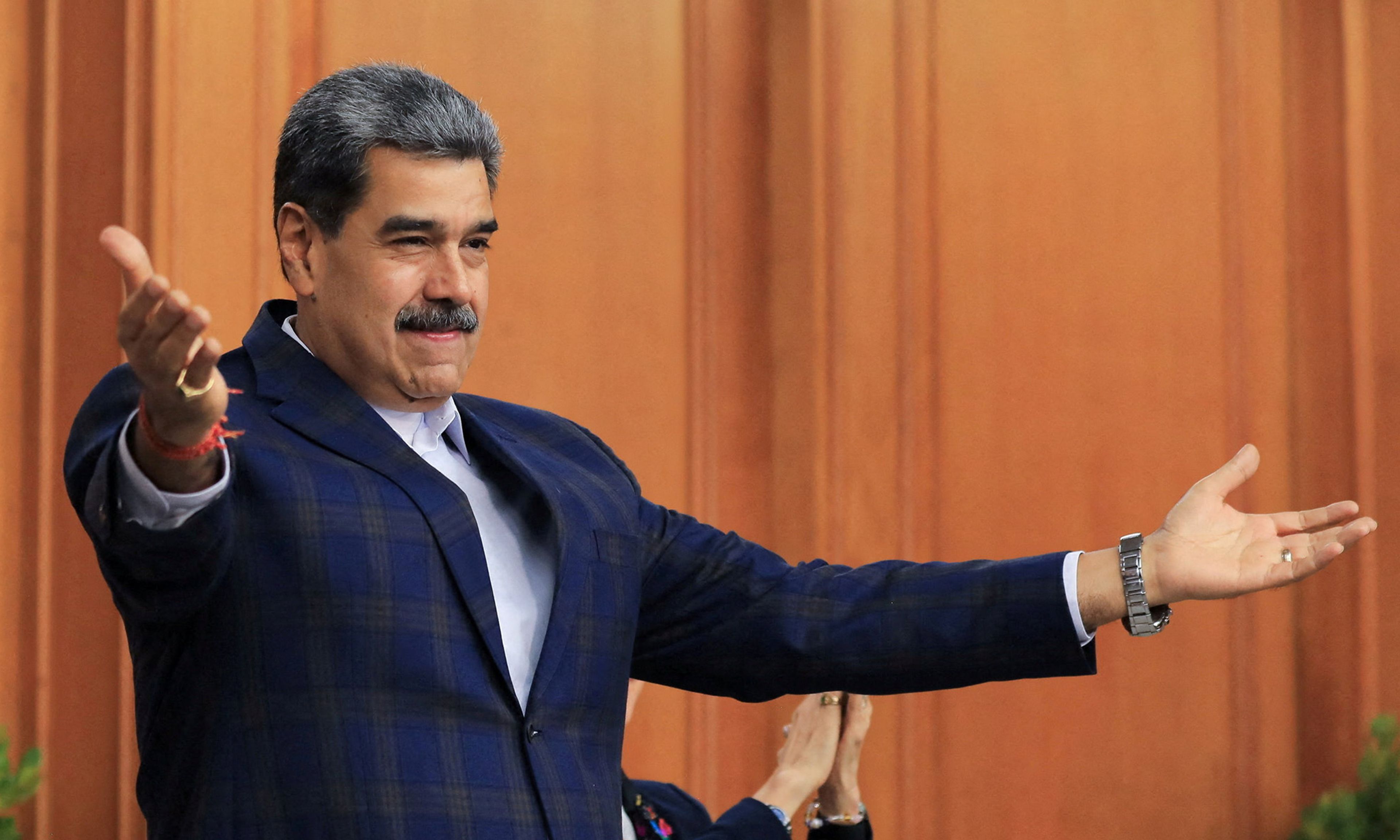
Venezuela's President Nicolás Maduro participates in an event with evangelical groups at Miraflores Palace, in Caracas, Venezuela, November 18, 2025.
The United States has officially designated Venezuela's Cartel de los Soles a foreign terrorist organization. And because the United States believes that Venezuelan caudillo Nicolás Maduro sits at the head of that drug-trafficking outfit, Washington now recognizes his regime as a narco-terrorist organization.
The president has made no secret of his desire to see Maduro removed from power. His administration has reportedly authorized covert U.S. intelligence operations aimed at destabilizing Maduro’s authority in Caracas. Many observers believe that military action against the Venezuelan government is imminent. But the Trump administration may be surprised by the public’s equally shocked response to such a campaign. Most Americans don’t seem to be following the administration’s logic.
Only 24 percent of respondents to a CBS News/YouGov poll this weekend said the administration had “clearly explained” its “position on military action in Venezuela.” The vast majority of respondents, including nearly two-thirds of self-identified Republicans, say Trump needs to make his case for strikes on regime targets to the American people. And they may not buy it even if he did. Just 13 percent said Venezuela’s government represents a “major threat” to U.S. security. Nearly 40 percent say the regime is “not a threat” at all. And although 66 percent of those who identify as MAGA would back Trump’s strikes, a slight majority of “non-MAGA” voters join the overall 70 percent who are presently skeptical of an attack on the Venezuelan regime.
Those numbers are not, however, static. The president can shape and remake the opinion landscape when he’s willing to expend political capital in the process. But neither Trump nor his administration’s officials have done much to persuade Americans that a military campaign against Venezuela is necessary, nor have they dwelled much on the strategic objectives such a campaign is designed to secure. That contrasts markedly with the administration’s months-long run-up to strikes on the Iranian nuclear program.
Upon entering office, the president mounted a diplomatic offensive against Iran aimed at cajoling the regime to reenter a modified nuclear disarmament agreement with the U.S. and its Western allies. Either there will be a new nuclear deal or “there will be bombs,” Trump warned in March. The mullahs balked at first but then appeared to play ball. But it was only a gambit to stall for time.
By June, the Trump administration had settled its internal deliberations over whether Iran should be allowed to enrich uranium on its soil, sidelining elements within Trump’s inner circle who are inclined toward appeasement. All the while, the president warned Iran in no uncertain terms that the nuclear standoff would be resolved by force if necessary. By the time the U.N.’s International Atomic Energy Agency formally found Iran in noncompliance with its nuclear non-proliferation obligations, the American public was convinced of the Iranian threat. Even if voters remained split on the virtue of strikes on Iran’s atomic weapons program, more than seven in ten Americans regarded the Iranian regime and its nuclear program as direct threats to U.S. security.
When Trump’s strikes gave way only to a face-saving response from the Iranians, American observers were probably quite relieved that their modest qualms about the operation proved unduly apprehensive. Battlefield success coupled with a long public-information campaign defanged Trump’s critics, who had spent weeks forecasting the cataclysms that would follow an attack on the Iranian regime. There was, of course, no great global conflagration, as the isolationist right maintained there would be, and there was no great crackup of the MAGA coalition. The Democrats who claimed Iran was not an “imminent threat” to the U.S. found no audience, and left-of-center agitators who claimed that Iran’s nuclear capabilities were as illusory as Iraq’s WMD program were humiliated.
Indeed, even Biden administration officials attempted to claim partial credit for the successful military operation. The incentives to which they were responding were clear. Domestic opinion was retroactively warming to the strikes and the utility of an extroverted American presence on the world stage. Abroad, negotiations over Arab normalization agreements with the Israeli government, which stalled after the 10/7 massacre, resumed with pent-up alacrity. The doomsayers were repudiated. Events had proven them wrong.
Compare this timeline with the one that brought us to this point, the brink of hostilities in Latin America.
The first signals that a military conflict was imminent could be gleaned only from the administration’s maneuverings before the courts. In April, the administration attempted to circumvent due process protections for its Venezuelan deportation targets by claiming that the Tren de Aragua gang was functionally an arm of the Venezuelan regime. Thus, pursuant to the terms of the 1798 Alien Enemies Act, Venezuelan nationals could be treated like enemy combatants. The courts did not look favorably on the administration’s argument, but the predicate was set.
You would, however, have to be a court-watcher to have encountered the administration’s case. The general public’s introduction to the crisis in the Caribbean probably followed the first U.S. strikes on what the administration claims are “drug boats” emanating from Venezuelan ports. But Trump’s (literal) war on drugs amounted to strikes on couriers, some of whom could not even be held in military custody, perhaps because of the lack of evidence against them.
The campaign was destined to expand to include regime targets, and the administration appeared to know that. What else explains the presence of the USS Gerald Ford Carrier Strike Group, the Iwo Jima Amphibious Ready Group, and more than a half dozen guided-missile destroyers, fast-attack submarines, and littoral-combat ships in the region? It has, however, been left to outside observers to explain the threat posed by the Maduro regime and the strategic benefits the U.S. would derive from his ouster -- or, at least, his diminution as an asset for the anti-American axis of great powers and rogue states vying to overturn the U.S.-led geopolitical order.
Even today, the president is only quietly conveying his desire to see Maduro consent to exile, albeit in somewhat contradictory ways. “Nobody is planning to go in and shoot him or snatch him,” one administration official told Axios. “I wouldn't say never, but that's not the plan right now.” And yet, according to the officials who spoke with that outlet, the U.S. believes that Maduro’s “Cuban handlers might execute him if he yields to American pressure and quits.” It sure sounds like you’re getting shot either way. But at least the White House is at last conveying its strategic objectives, if only for the benefit of the audience in Caracas.
If armed conflict is in the offing, the American public will need to be consulted first. Matters as weighty as war and peace in democratic republics require public support. Those projects collapse in the absence of, if not consensus in their favor, at least a dedicated constituency that supports them. But unlike the buildup to the Iran strikes, the Trump administration hasn’t been straight with the public, and voters have noticed.
Perhaps the administration believes that Americans cannot be trusted to comprehend the true rationale for an attack on Venezuela; interdicting narcotics exports, yes, but also putting economic pressure on Cuba, wresting those two satraps away from Russia’s influence, and depriving China of footholds in the Western Hemisphere. Maybe the administration thinks that logic is too close to the one that yielded the Iraq War for their comfort. Maybe they think voters would be as scared of their conclusions as they are.
Either way, the Trump administration has betrayed a lack of trust in the American people. The voting public will return the favor. That could prove disastrous if a military campaign against Venezuela unfolds in unpredictable or undesirable ways. The president should correct course, and he had better do so before the bombs fall. After will be too late.

About the Author
Noah Rothman is a senior writer at National Review. His third book, Blood and Progress: A Century of Left-Wing Violence, will be published by Hachette in May 2026.
Featured Tags
Advertisement
Advertisement
Comments