The Damage Done by <i>All the President’s Men</i>
Written by Armond White
The anniversary of Hollywood’s worst newspaper movie
Share this story
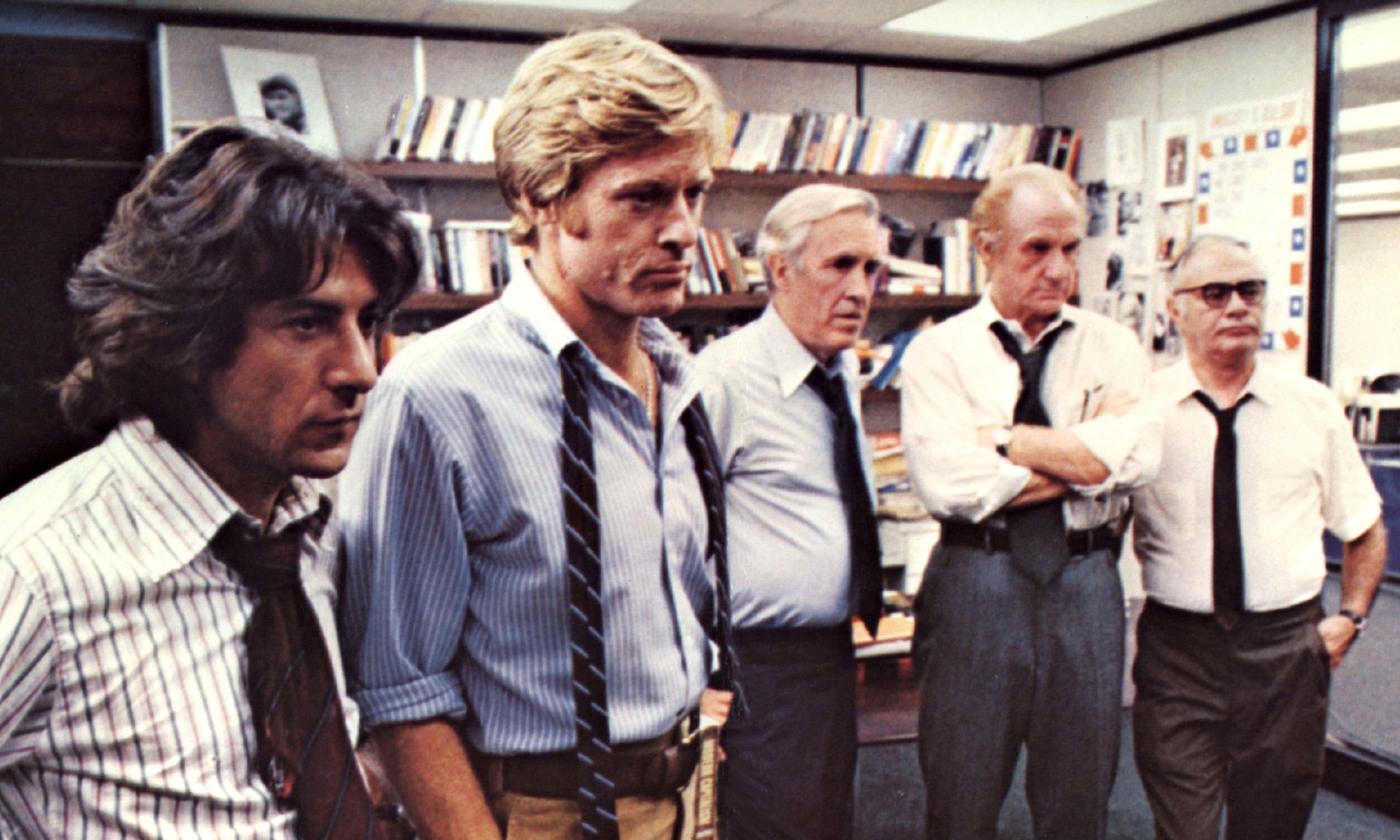
From left: Dustin Hoffman, Robert Redford, Jason Robards, Jack Warden, and Martin Balsam in <i>All the President's Men</i>
Since All the President’s Men was released 50 years ago, journalism has declined almost irreparably. After movie stars Robert Redford and Dustin Hoffman glamorized the exploits of Bob Woodward and Carl Bernstein, the Washington Post reporters credited for breaking the Watergate scandal that led to the resignation of President Richard Nixon, journalism school enrollment was said to skyrocket. But now journalism is largely distrusted, and All the President’s Men can no longer be accepted as a taut thriller or a realistic portrayal of political and journalistic history. It should be regarded as a dubious example of political mythification.
The film never clarifies that the scandal over the break-in at the Democratic National Committee headquarters in the Watergate hotel, which Woodward and Bernstein investigated, was actually a matter of some former CIA associates working at cross purposes with an FBI informant. Instead, the film feeds our poorly informed political paranoia. And the unthinkable conflation of administrative-state espionage still roils politics and journalism today. Media professionals regard themselves as crusading knights above the law — a professional-class crisis that only worsened once the Obama administration, with its links to media authorities, installed elitism as the new American civic mode.
Director Alan Pakula and screenwriter William Goldman focused on Woodward and Bernstein’s single-minded intent to besmirch Nixon, a president whom Hollywood liberals already hated. The filmmakers got away with ignoring the administrative-state chicanery that journalist James Rosen uncovered in 2025 — another reason why ATPM has lost esteem among savvy filmgoers. Despite the charisma that Redford and Hoffman -- both good actors -- brought to their roles, Woodward and Bernstein are not memorable characters with profound opinions and feelings. They’re just worker bees for the cause of leftist liberalism. Now is the time to question the film’s obfuscations, as well as those of Woodward and Bernstein, about deep-state interaction and conflict. The movie, like the media, can no longer be trusted. France’s Lost Illusions did all this much better. Sam Fuller’s Park Row comes second.
***
Citizen Kane is, of course, the greatest movie ever made about journalism, so Pakula immediately steals a Citizen Kane trope. Orson Welles delves into the psychology that motivates a media titan (overshadowing his underlings), but Pakula starts with intimidation: copying the immense close-up of typewriter print (Welles’s genius emphasis on the word “WEAK”) for a pretentious synecdoche: typing the date “June 1972” as if inscribing the birth of justice by letter and numeral.
The rest of All the President’s Men is less impressive: a series of dull, overly gloomy mysteries presumably leading to D.C. righteousness. Although the break-in malfeasance seems like standard operating procedure next to Crossfire Hurricane FISA abuse and the J6 set-up, Goldman’s slick script winks at the smugness of Beltway subterfuge — spooky insiders who like to divulge their secrets and flaunt their power. It’s actually satirist Goldman’s smirky parallel to the film industry.
Cynics Goldman and Pakula glorify the indecent prowling into private behavior and secrets — journalism’s most scoundrelly aspect. It’s not intense; it’s the same lugubriousness that made Pakula’s The Parallax View a drag — film noir style boasting of its own importance. With leaden-soled haute-seriousness, Redford with his blondest highlights and Hoffman at his most puppy-dog arrogant pursue nothing less than their own holy grail, the tyranny of what the term “investigative reporting” once meant.
As producer, Redford continued his sanctimonious approach to politics in The Candidate and journalism in Three Days of the Condor (whose climax salutes the New York Times). Redford reserved his pessimism (a liberal projecting the worst) for the scenes where Woodward meets the informant “Deep Throat,” dubbed after the scandalous early-Seventies porn movie. It’s the closest Redford gets to the Beltway’s sexual underbelly, a smirking clue to the film’s dishonest leering — especially when Redford and Hoffman dig information out of D.C.’s secretarial subculture, flirting with various women (Jane Alexander, Lindsay Crouse, Penny Fuller, Valerie Curtin, Meredith Baxter, Allyn Ann McLerie) as a sop to feminism. This seduced most critics, although Pauline Kael saw through it, debunking the myth of intrepid reporting by scoffing at “the journalistic benefits of having an informer tucked away in a garage.”
In 2005, the 91-year-old Mark Felt, former FBI deputy director, revealed to Vanity Fair that he was the mysterious “Deep Throat” figure (played by Hal Holbrook in a shadowy D.C. parking garage), a revelation eventually made into the 2017 movie Mark Felt: The Man Who Brought Down the White House, which even Watergate fanatics ignored -- it didn’t fit Hollywood’s preferred mythology, crafted to serve partisanship. (“I’ll never quote you,” Redford/Woodward tells Felt.) It’s a humorless perversion of Truth, Justice, and the American Way as cartoon virtues. (The film’s only evident wit is cinematographer Gordon Willis’s almost tactile contrasts of fluorescent light and natural darkness.)
***
It’s dismaying — though unsurprising -- that many journalists still idealize All the President’s Men. This is the start of using media pressure as a political weapon. Redford and Hoffman, the two most self-serious actors of that era, allowed the real-life Woodward and Bernstein to bask in their reflected glory. That also explains Jason Robards’s suave impersonation of Washington Post editor Ben Bradlee (antecedent to Tom Hanks’s glum impersonation in Spielberg’s The Post) and the diminutive nickname “WoodStein” by which he addressed his eager-beaver underlings.
Media celebrity worship explains why All the President’s Men was favored over Timothy Crouse’s superior The Boys on the Bus, which chronicled the 1972 presidential campaign and critiqued the phenomenon of “pack journalists” among the political press corps. Crouse’s book has never been filmed while the WoodStein text demonizing Nixon was considered Scripture. Now, Watergate revisionists who cast suspicion on the motives of Woodward and Bernstein are considered blasphemers (especially after Jeff Bezos’s purchase of WaPo made its rep vulnerable). Yet Pakula’s myth is worse than apocryphal. As National Review colleague Luther R. Abel posted, “No movie has done more to give journalists an entirely unearned sense of moral superiority.”
In the years since the populist Rocky beat All the President’s Men at the Oscars, Woodward and Bernstein have not covered themselves in glory. Instead, they’ve revealed absolute partisanship and pettiness — the legacy-media routine that birthed what we know as today’s seditious media.
All the President’s Men did actual damage to the practice of journalism. It blacks out the genuine Watergate history recounted in Mark Felt, which elided the issue of moral compromise (a disgruntled FBI agent used a reporter for what now looks like a deep-state op) by treating its treasonous point man as a patrician — still the elite’s euphemism for patriot. This truly damnable movie uses ballyhooed suspense mechanisms (unexplained night scenes in which a guard admits Redford/Woodward to the White House) that are not compelling but self-congratulatory.
Pakula reveals nothing of how journalism — specifically WaPo -- became cutthroat, biased, and fake, or how D.C. became the paranoid hellscape it is today. All the President’s Men seems to have inspired the current generation of scoundrel-journalists. It celebrates conmen-journalists on a partisan mission; they’re untrustworthy and sneakily profane, as in “ratf***ing,” the epithet for the behavior of the Donald Segretti (Robert Walden) character.
The film’s light/dark moral motif denies us the mundane truth of daytime corruption that we’re living through. Those “Deep Throat” scenes fit the WaPo motto “Democracy Dies in Darkness.” Buried in the stylish murk, Redford/Woodward breathlessly confesses, “The coverup had little to do with the break-in. It was to protect covert operations; the covert activities involved with the entire intelligence community.” He’s answered by Robards in a gravelly, sage voice: “Nothing’s riding on this except the, uh, First Amendment of the Constitution, freedom of the press, and maybe the future of the country. Not that any of that matters.”
A detestable finale offers a split-focus shot of Nixon’s nomination at the Republican National Convention juxtaposed with Redford and Hoffman keyboarding Nixon’s fate against TV sounds of cannons. Redford, Pakula, and Goldman bequeath their liberal paranoia to film history. Only citizen-journalist social media liberates us from that tyranny.
Watching All the President’s Men today, you don’t wonder that there are so many pretend investigative reporters, but you may realize why so few exhibit moral integrity.
https://www.youtube.com/watch?v=c-FS7jJckug
About the Author
Armond White is National Review’s culture critic and the author of New Position: The Prince Chronicles and Make Spielberg Great Again: The Steven Spielberg Chronicles.
Featured Tags
Advertisement
Advertisement


Comments