The Dollar: Stormy Weather
Written by Andrew Stuttaford
The week of June 23, 2025: The dollar and its rivals, Zohran Mamdani, housing, fiscal, and more.
Share this story
Dollar, money, debt, bonds
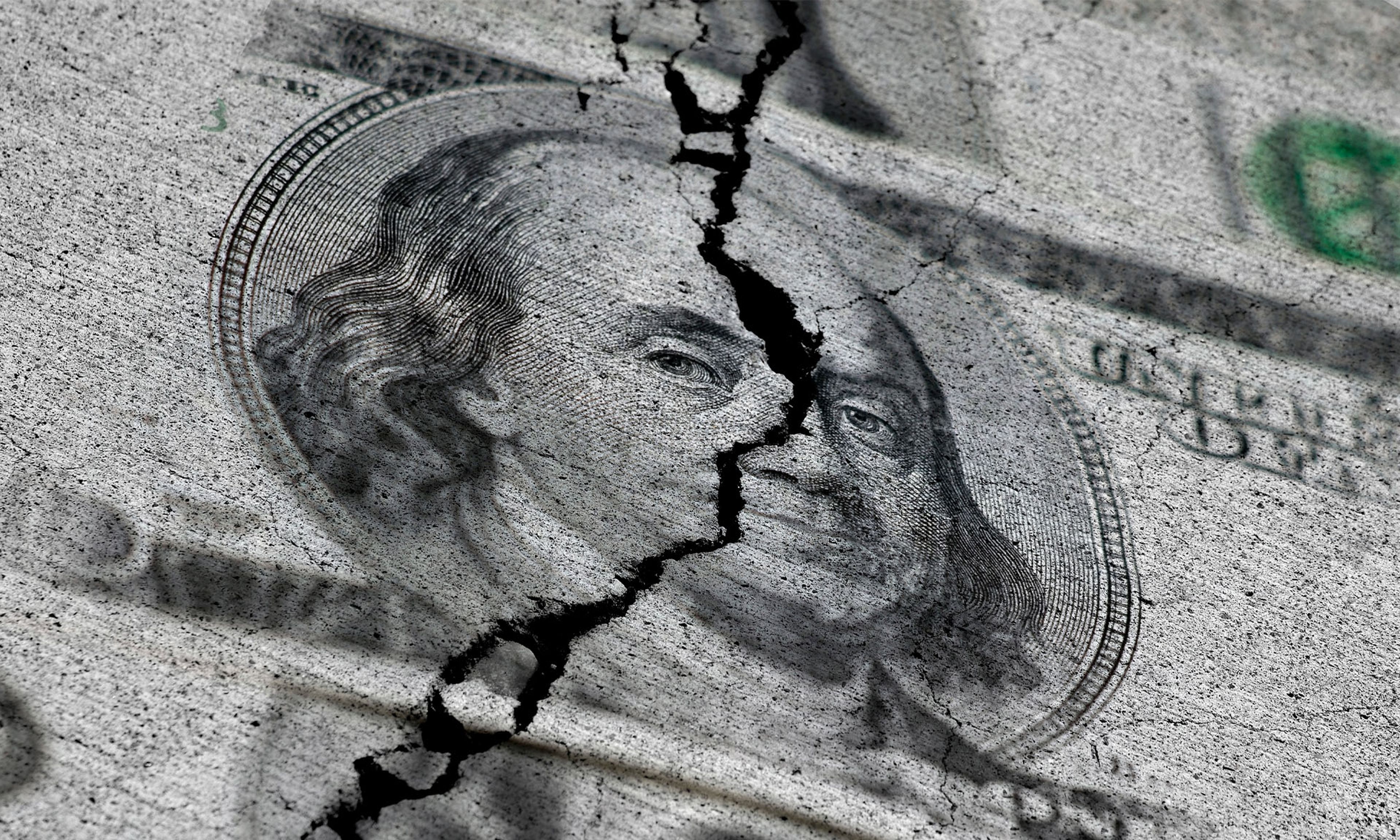
With things (for now) a touch calmer in the Middle East, gold has eased a little, trading at around $3,300. But the greenback (as measured by the DXY index) continues to drift down, and is now off nearly 11 percent year-to-date. Some of the current sell-off is a response to an overbought dollar in 2023-24, and currencies, of course, can bounce around, but there are indications that something more substantive is taking place below the surface. Above all, strong buying of both Swiss Francs and gold may suggest that the dollar is no longer seen as quite the safe haven it once was.
That erosion of confidence seems set to continue as concerns about U.S. finances grow. These risk driving interest rates up still further, adding to an already increasing debt burden — and the need to sell more bonds to finance it. The more debt a country issues, the more (in theory) it will cost. Then add fears that the Fed’s independence may come under severe pressure once Federal Reserve Chairman Jerome Powell’s term ends next year. There will be a price to pay for that too.
President Trump is making it very clear that the Fed should be aggressively cutting interest rates, despite signs that inflation has yet to be vanquished, not to speak of the danger that tariffs may give prices another upward nudge. Higher inflation will push up interest rates, increasing the government’s debt burden yet more, unless the plan is to try to inflate that debt away. Then there’s chatter of a “Mar-a-Lago accord” to lower the dollar’s value, not the most enticing prospect for prospective buyers or holders of a dollar-denominated debt securities. That talk will come at a price.
And so (via the Financial Times’s Harriet Clarfelt and Kate Duguid):
Investors are fleeing long-term US bond funds at the swiftest rate since the height of the Covid-19 pandemic five years ago as America’s soaring debt load tarnishes the appeal of one of the world’s most important markets. Net outflows from long-dated US bond funds spanning government and corporate debt have hit nearly $11bn in the second quarter, according to Financial Times calculations based on EPFR data.
The second-quarter exodus is on track to be the biggest since severe market turbulence in early 2020 and marks a powerful shift from the average inflows in the previous 12 quarters of about $20bn.
As Clarfelt and Duguid point out, the absolute sums are not huge (about $28 trillion in Treasury securities are outstanding, and around daily trading volumes are around $900 billion), but they are yet another negative indicator. And so is the fact that the outflows are at the long-dated end of the market, where inflation fears weigh most heavily.
Meanwhile, potential rivals are eyeing the opportunity that a crisis in confidence in the dollar might represent. As I noted in a recent Capital Letter:
One of the reasons the euro was established was to operate as a rival reserve currency to the dollar. Many of Europe’s leaders had long regarded that position as (in the words of a French finance minister, speaking in the 1960s) an “exorbitant privilege.” They envied the power and the freedom of maneuver that it gave the U.S., something worth remembering when Washington is paying less attention to preserving that status than it should.
On top of that longer term ambition, European central bankers are, as I explained in that Capital Letter, pondering a plan B in case they are unable to draw on dollar liquidity swap lines in the event of a dollar squeeze in Europe. These swap lines are in no sense bailouts, and, by containing potential financial crises, they offer considerable benefits to the U.S., but in the current political climate they might easily be portrayed as such, become politically contentious, and/or have political strings attached to them.
As I mentioned:
The ECB is pressing banks in its region to reduce dollar exposure that would not be adequately covered in the event of a dollar squeeze. That’s sensible, but it too would chip away at demand for dollars and the idea of the greenback as the linchpin of the global financial system.
Robert N McCauley has written an article for VoxEU, the “policy portal” for Europe’s CEPR, in which he argued that the fourteen central banks that had standing and temporary Fed swap lines in 2008 and 2020 held between them (as at the end of 2021) around $1.9 trillion dollars, an amount that, if they formed a coalition of the willing, should contain enough capacity to stand in for the absent Fed.
Among the plan Bs being discussed, one stands out as a blunt reminder of the geopolitical consequences of a diminished dollar: The central banks of some smaller countries are reportedly cutting swap deals with China.
Perennially lacking the democratic consent it needs to build the “ever closer union” of its dreams, Brussels has often deepened EU integration by exploiting “beneficial crises” which force its member states closer together. Some in the EU’s leadership are now using the anticipation of a crisis arising out of the bloc’s unnerving reliance on the dollar in the time of Trump to promote the euro as a rival reserve currency. Currently the euro accounts for about 16 percent of global reserve assets, a little way behind gold, and a long way behind the dollar (57 percent).
Writing in the Financial Times (June 28), Katie Martin argues that now is the time “to give the euro a glow-up and make it more suitable for global official reserves.” But how? One approach would be for the EU to work with what it has:
Rather than offering one huge unified government bond backed by each member and feeding spending in each state, it could stick to what it already has: a loose-ish collection of national bond markets with different sizes, flavors and externally-assessed measures of their safety. Some big investors like that variety, and it might be possible to sell it as a virtue to the state-backed managers of vast pools of cash around the world.
But that would do little to advance the agenda of an “ever closer union,” and so there is talk about the EU (or at least those members of the bloc that have signed up for the single currency) borrowing jointly. There would be different ways of structuring such borrowing (a discussion for another time) but the underlying idea, at least nominally, would be to create a debt instrument “big” and highly rated enough to rival treasuries.
Underlying such a scheme, however, would be its use as a device to bind the richer countries even closer into the bloc, and to accelerate the “transfers” from their taxpayers to poorer EU regions. Doubtless eurocrats would appreciate the opportunity to control some or all the money spent using such money. If the history of the euro is any guide, pooling of the borrowed funds will lead to the relaxation of fiscal discipline and may well prove politically unpopular at a time when the EU is not the happiest of unions. As “glow-ups” go, I’ve seen better, but it wouldn’t be the first time that Brussels has allowed the imperative of “ever closer union” to trump more rational alternatives.
Writing (also in the Financial Times) a few days before, Christine Lagarde, the president of the European Central Bank (ECB) had also called for an “increase in the euro’s global status,” stressing the importance of the euro as an invoicing currency and the existence of the ECB’s own swap lines.
But Lagarde stressed that it would take more to create the “global euro.”
Investors seek regions that honor their alliances.
Do I detect a dig there?
She continued:
Europe is undergoing a major shift towards rebuilding its hard power, which should also help bolster global confidence in the euro.
It is true that Europe, prompted in different ways by Messrs. Trump and Putin, is committed to increase its hard power, a welcome step. The question is whether those commitments (to increase defense spending to 3.5 percent of GDP plus another 1.5 percent of defense-related spending by 2035) will be honored, and whether they will be honored in time. The euro’s value as a reserve currency will disappear very quickly if Russia’s forces move west.
Lagarde notes that a “supply of high-quality safe assets” will be required to boost the euro’s reserve status. Investors will not just want to hold cash. As she sees it, the pooled Eurobond would be such an asset.
And, as always, part of the solution will be “more Europe.”
For the euro to gain in status, Europe must take decisive steps by completing the single market, reducing regulatory burdens and building a robust capital markets union. Strategic industries, such as green technologies and defense, should be supported through coordinated EU-wide policies. Joint financing of public goods, like defense, could create more safe assets.
And, no less naturally, the ability of a single member state to veto proposed EU policies would have to be reduced still further.
Lagarde admitted that the EU’s mechanisms were not always easy to understand, but “respect for the rule of law and the independence of key institutions, like the ECB, are critical comparative advantages the EU should leverage.”
This is the same Lagarde, who in the depth of the eurozone crisis (when she was France’s finance minister) acknowledged that the first bailouts had been "major transgressions,” transgressions she had helped arrange. "We violated all the rules because we wanted to close ranks and really rescue the euro zone… The Treaty of Lisbon was very straight-forward. No bailout.” Even the process of creating the euro was marked by ignoring or twisting its ground rules, setting a pattern for the governance of the single currency that has never changed. Whether those looking for an alternative to the dollar will care has yet to be seen.
Lagarde herself, engaged in a double power play, under which she increases the strength of the EU’s institutions within the bloc and projects the value of its currency outside it, claims to believe that now is the time to strike:
Shifts in global currency dominance have happened before. This moment of change is an opportunity for Europe.
Beijing is playing a similar game. Firstly, it is establishing a payments network independent of the dollar for obvious geopolitical reasons, and as part of this it has already established a Cross-Border Interbank Payment System (CIPS).
Beyond that, Beijing, resentful of the dollar’s dominance, would like to establish the renminbi as a rival global reserve currency too, as part of a multi-polar currency system in which, to quote China’s central bank governor, “a few sovereign currencies coexist, compete with each other, and check and balance each other.” The renminbi is already the world’s second-largest trade finance currency and third-largest payment currency.
Beijing appears to be having some success with countries anxious that, due to American control of much of the world’s financial plumbing, using the dollar may bring them too close to the reach of U.S. sanctions for comfort. This is not without its ironies. As I wrote in a Capital Letter in March 2022:
That the greenback is the reserve currency is one of the foundations of American power (not least because of the way that it allows this country to finance itself). But the more that the U.S. uses the dollar as a weapon, the more (over time) it will undermine the willingness of others to put their faith in it, with consequences that, to say the least, could be self-defeating.
Such reductions in exposure to the dollar may be adding to its weakness. Ominously, they have been accompanied by reports that some central banks have been moving their countries’ gold reserves away from London and New York, for fear of being entrapped by sanctions.
As the Financial Times reports other countries may also pull their gold out of its transatlantic safe haven:
Germany and Italy are facing calls to move their gold out of New York following President Donald Trump’s repeated attacks on the US Federal Reserve and increasing geopolitical turbulence.
According to the FT, Germany and Italy “hold the world’s second- and third-largest national gold reserves after the US, with reserves of 3,352 tonnes and 2,452 tonnes.” Both hold about a third of their reserves in the U.S.
A survey of some seventy central banks revealed that they are considering bringing some of their gold back home in order to avoid any problems in getting ahold of it in the event of a crisis.
In an article devoted primarily to the reliability of the Fed’s swap lines, the FT’s Gillian Tett referred to a concept developed by the American economist Charles Kindleberger (1910-2003). In his view, one aspect of being the world’s leading power was to help stabilize the global financial system. That was the role played by Britain for much of the 19th century, but after the end of World War I, it was one that was essentially beyond its powers.
Tett:
[Kindleberger warned] that turbulence erupts when a dominant geopolitical power loses the ability or desire to support a reserve currency, without its ascendant rival stepping into the breach. (This is what happened in the interwar years before sterling was replaced by the dollar.)
In Tett’s view we “are emphatically not at such a Kindleberger moment now.” That is so, but if the U.S. cuts back the Fed’s swap lines out of carelessness, clumsiness, or pique we could arrive at something very like it. In the meantime, Kindleberger’s warning is a reminder that even a partial dilution of the dollar’s leading role could trigger a nasty shock to a financial system ill-equipped to adjust to a new more multipolar financial regime, however much Beijing or Brussels might wish otherwise.
But, despite the current turmoil, the dollar should not yet be consigned to a dramatically shrunken status. The U.S. economy has its troubles, America’s fiscal position is alarming, and the Sturm und Drang of Trump 47 has diminished this country’s reputation as a reliable partner, but it is still the fittest (large) horse in the glue factory.
Ralph Schoellhammer, writing in Unherd:
The Ukraine war, ballooning welfare states, failing industry, potential energy crises — it all means that Europe’s economy has significant problems that investors are right to worry about. The US — for all its troubles — is the world’s largest energy producer and is strong in all the areas that will matter for the future, especially artificial intelligence and robotics. Europe is simply not competitive, and a declining economy will not be the provider of the world’s reserve currency. As for the Chinese yuan, Beijing would have to give up its policy of capital controls, which is highly unlikely. Finally, the oft-mooted Brics currency has just been dealt a heavy blow by India, with New Delhi rejecting the entire concept and backing the dollar instead.
If I had to guess, the dollar will continue to come under pressure, pushed down by uncertainties about the nation’s finances and the direction of both its tariff and foreign policy. But the greenback is still likely to preserve its position, if by a smaller margin than in the past, as the nearest the world comes to a reserve currency, a position that the Trump administration should want to preserve for both economic and geopolitical reasons.
The “exorbitant privilege” can sometimes be a burden, but it is still worth it.
The Capital Record: Sound & Vision
We released the latest of our series of podcasts/playlists, the Capital Record. Follow the link to see how to subscribe (it’s free!). The Capital Record, which is hosted by financier David L. Bahnsen makes use of another two formats to deliver Capital Matters’ defense of free markets. The original podcast continues, but if you want to watch David talk, please click on the YouTube link.
The 238th episode: (Podcast/YouTube)
David walks through the new Barry Diller autobiography and extracts some key business lessons that speak to our own objectives here on the Capital Record. Barry may have been a Hollywood and media industry giant, and he may not care much for all our ideological commitments, but he has a lot to offer in this week’s episode.
“Business Lessons from the New Barry Diller Book”
The Capital Matters week that was . . .
Fiscal
By now, most Georgians know their state is more fiscally responsible than the federal government. If not, Washington is doing everything it can to prove the point…
Housing
Homeownership is increasingly becoming out of reach for Americans. Federal, state, and local lawmakers have turned their attention to targeting large institutional investors in the single-family rental (SFR) market over the past decade. People are worried that these institutional investors are raising rents and making it more difficult for families to buy a home. Those opposed to institutional real estate investors have pushed for restrictions or outright bans on SFR ownership by institutional investors…
Automation
The emergence of Zohran Mamdani “from nowhere” is yet another sign that “elite overproduction” (a term coined years ago by social scientist Peter Turchin) in an age of automation will give rise to serious political upheaval, a topic I first discussed in an article for National Review in 2016. To oversimplify, elite overproduction describes a state of affairs in which members of the “elite” (or those with the talents to join it) become too numerous for society to accommodate their aspirations. That leads to frustration and, more specifically, the formation of a “counter-elite” set on reorganizing society in a way that gives them the leading roles to which they believe they are entitled…
Writing earlier in the week about Zohran Mamdani’s victory in the Democratic primary for New York’s mayoral elections, I argued that some of it could be explained by the phenomenon known as elite overproduction (a term coined by social scientist Peter Turchin), a state of affairs in which members of the “elite” (or those with the talents to join it) become too numerous for society to accommodate their aspirations. High rates of graduate unemployment or underemployment are evidence that that that is the situation the U.S. (and not just the U.S.) now faces (and has faced for some time), This problem will get worse as automation cuts further through “graduate-level” jobs, a process likely to accelerate as AI gathers speed…
Social Security
The annual Social Security trustees’ report came out this month, and it tells the same old story everybody knows: The program is financially unsustainable. Benefits are automatically scheduled to be cut by 23 percent in 2033, and Congress made an already bad situation slightly worse by passing a giveaway to government workers during the lame-duck session last year…
Regulation
It ain’t what you don’t know that gets you into trouble,” said Mark Twain, that brilliant purveyor of American wisdom, “it’s what you know for sure that just ain’t so.” This is so true that modern humans developed various forms of science, including economics, to help us discern what is true versus what is merely asserted. Yet all too often the rules handed down from Washington amount to assertion dressed up as “common sense.”
A case now before the Eleventh Circuit Court of Appeals throws the consequences of that trend into sharp relief. At stake is not just economic efficiency, but the rule of reason…
Tariffs
The European Union has spent years exploiting its trade relationship with the United States while ignoring the obligations that should come with it. President Trump has rightly made clear that this era of U.S. indulgence is over…
Policymaking
My latest Washington Post article is about New York City’s advance to containerized trash. After making fun of them for being so late, I ask what took them so long…
Tax
Zohran Mamdani, the socialist Democratic nominee for mayor of New York City, has a very different idea from conservatives about what tax competition between jurisdictions means…
To sign up for The Capital Letter, please follow this link.

About the Author
Andrew Stuttaford is the editor of National Review's Capital Matters.
Featured Tags
Advertisement
Advertisement




Comments