The Elitism of <i>Merrily We Roll Along</i>
Written by Armond White
A Sondheim preservation venture against the odds
Share this story
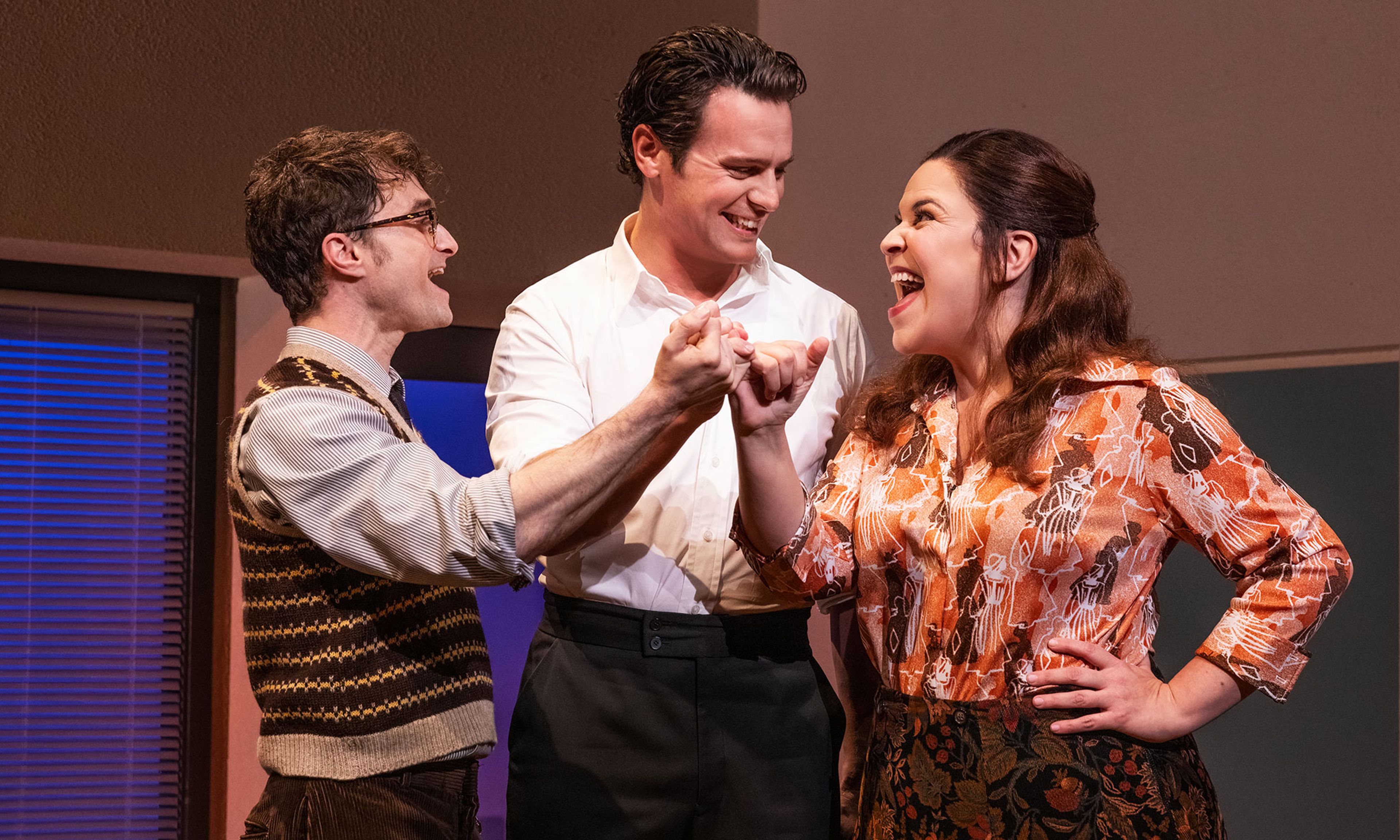
Daniel Radcliffe, Jonathan Groff, and
Lindsay Mendez in <i>Merrily We Roll Along</i>
The Broadway musical is no longer at the center of American pop culture. Like the rest of contemporary Broadway theater, it has moved into dark, extreme political partisanship. Its once-uplifting, signature art form has soured, which explains the oddity that a video transcription of the 2023 Broadway production of Stephen Sondheim’s Merrily We Roll Along is being released as a movie during our current political/cultural crises.
Sondheim’s title, Merrily We Roll Along (based on a 1934 play by George S. Kaufman and Moss Hart), ironizes a story about three adults — songwriter Franklin Shepard (Jonathan Groff), his composer-partner Charley Kringas (Daniel Radcliffe), and their theater-critic pal Mary Flynn (Lindsay Mendez) -- who look back at their youthful friendship. The show reveals each character’s regret; a reverse-chronology flashback structure details their growing cynicism.
All three are, of course, highly successful in their professions, but personally they are miserable, dishonest with themselves and one another. Sondheim’s recurring theme, “Jazzin’ in My Old Apartment,” lets them boast, “We’re the movers, shapers, names in tomorrow’s papers.” This passes for sophistication on contemporary Broadway, where every show pledges progressive empowerment. Envy and competition are implicitly the secret talents prompting every self-proclaimed activist-artist in the “Broadway community.” It’s a self-congratulatory version of what used to be called “tired businessman’s theater.”
The reasoning behind this version of Merrily began with Sondheim reworking his original, troubled 1981 production, which then acquired cult fascination. It merely needed Millennial self-importance — and diversity-casting — for a new 2023 production to win hysterical acclaim. Richard Linklater was signed to direct a film adaptation in the manner of his obtuse twelve-year project Boyhood, to emphasize the show’s timeline conceit. Thus, the ballyhooed Broadway revival became important to the Sondheim cult, so this “filmed” version was made by the same RadicalMedia company that “filmed” the original cast of Hamilton for Disney+.
Crossing the Rubicon from Broadway to film exposes all the show’s faults (and that of the Sondheim cult). Frank’s solo success in Hollywood initiates the time-shifting self-examination. “I’m as sick of myself as you are,” he says when Charley and Mary are disgusted at the shallow, unfriendly titan he has become. This showfolk cynicism looks artificial next to the legacy of such behind-the-scenes showbiz films as What Price Hollywood?, The Bad and the Beautiful, Two Weeks in Another Town, and Play It as It Lays.
Stage performers Groff, Radcliffe, and Mendez aren’t credible, and RadicalMedia director Maria Friedman’s cutting, framing, and close-ups butcher the performances. Without the proscenium’s illusion and distance, it’s difficult to believe this story, since the actors look like they’re acting — and each one is cinematically unprepossessing.
Unlike the superb Stuart Burge version of Laurence Olivier’s Othello at the National Theatre Company in 1966, which preserved an important live-theater achievement, everything about Merrily seems minor and affected. Sondheim and book-writer George Furth (who had succeeded with the marriage-and-sex comedy Company) foolishly venture into superficial political contexts to describe how all in the Frank-Charley-Mary trio betrayed one another.
The movie symbolizes America’s own self-betrayal in the sociopolitical context of thousands of Americans killed in Vietnam, pro-abortion rallies, peace marches, two bouts of Nixon-bashing, the civil rights movement, and Sputnik, ending on the deliberately snide irony of the Kennedy administration “making the White House a cultural lighthouse.” A Greek chorus of background characters announce the rewinding years of decline -- the trio’s and the country’s decline -- through songs representing changing musical styles but with Sondheim’s familiar sound.
Merrily documents the current fallacies of this Broadway era — especially how diversity forces the delusion of political correctness, even at the cost of falsifying historical reality. Frank, Charley, and Mary appear mismatched from the start. Their gimmicky camaraderie has no basis in the background or principles that supposedly brought them together: A politically engaged show titled Take a Left was never produced; a proposed Sinatra film titled Musical Husbands represents selling out. Both instances exemplify what’s wrong with Merrily itself. Its elitism differs from what once made Americans love Broadway shows like The King and I, West Side Story, and The Sound of Music. When the show’s trio cheers itself -- “Here’s to us / Who’s like us?/ Damn few” -- it recalls why the Tony Awards broadcast has become unwatchable.
https://www.youtube.com/watch?v=Ams0ROhWX0w
About the Author
Armond White is National Review’s culture critic and the author of New Position: The Prince Chronicles and Make Spielberg Great Again: The Steven Spielberg Chronicles.
Featured Tags
Advertisement
Advertisement


Comments