Share this story
Marco Lawrence
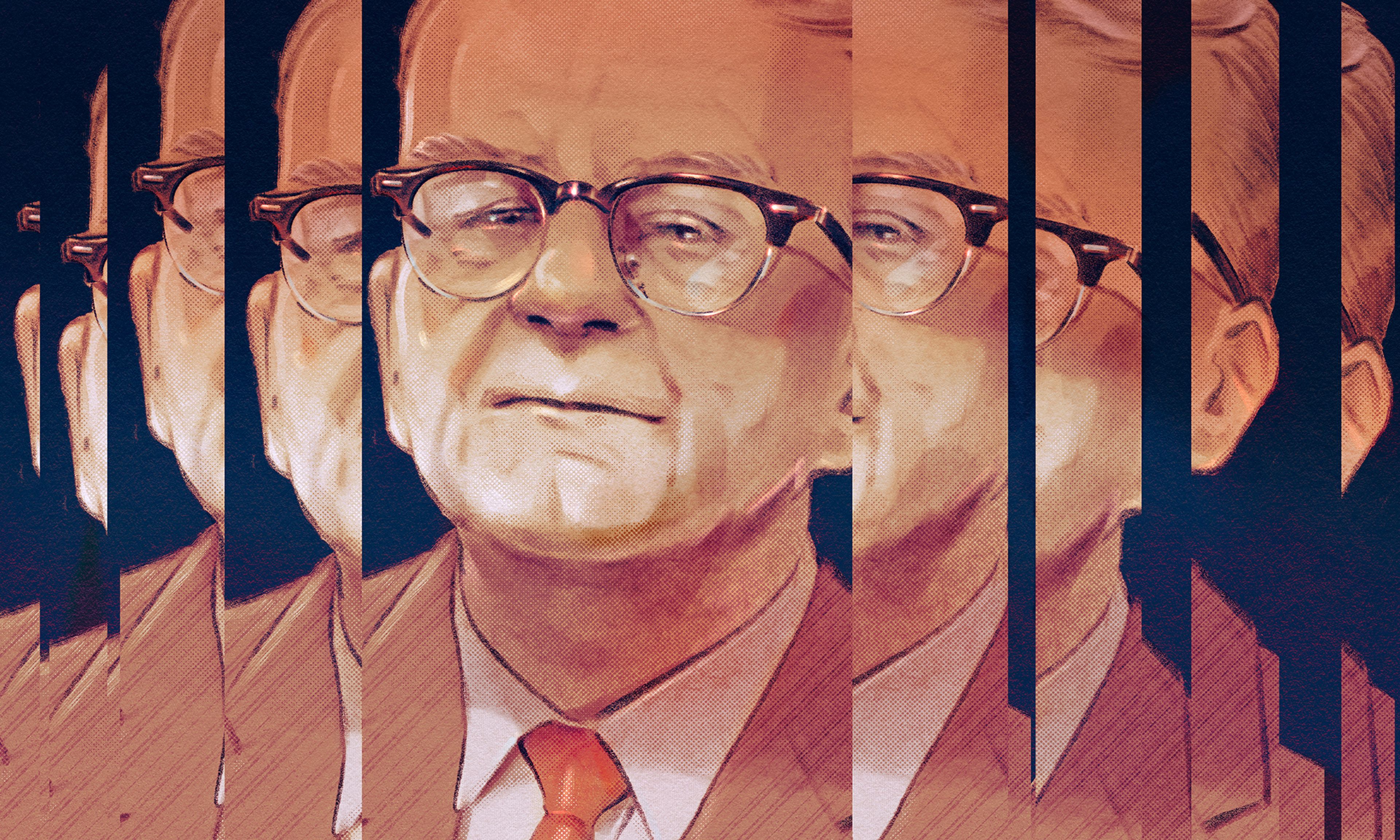
Given that the first essay I ever penned on James Burnham -- the 10,000-word behemoth, “Present before the Creation: James Burnham and the New World Order” -- appeared in NR’s 35th anniversary issue and that two more have since been included in issues marking later anniversaries, I feel a need to justify returning to the same distinguished NR veteran in the present special issue. That justification is not any obsession of mine but the observable fact that Burnham (1905–1987) has had more resurrections than the soprano Dame Nellie Melba said farewells from the stage. He is recurringly relevant.
Burnham entered intellectual history in 1941, when he created a world sensation with his first major book, The Managerial Revolution. At a time when the world was tending to extremes of left and right, the defection of Trotsky’s favorite pupil, an American to boot, to a new post-Marxist ideology that dismissed even the possibility of a proletarian revolution was hot copy. It was a somewhat nuanced defection: he predicted that a revolution was indeed happening, even quite advanced, but it was in the wrong hands. Not the workers but the managers of industry who knew how to make things work would inherit the earth. Accordingly, states governed by such managers -- whose skills made things work in both private and public sectors -- would therefore triumph in military and economic competition. What would eventually emerge from that competition would be three vast autarchic superstates rooted in industrial power, engaged in endless conflict, and ruling their peoples through authoritarian bureaucracies behind formal democratic masks.
In the age of Nazism and Soviet communism -- the book was published two years after the Nazi-Soviet pact that started World War II -- that was a plausible thesis, well argued and resting on a mountain of economic statistics. It was given theoretical support in Burnham’s more reflective second book, The Machiavellians (1943), a study of elite theorists in which, however, he qualified his conclusions by noting that some form of free and democratic government might survive in those state systems built on competition between elites.
Unfortunately for him, Burnham tied his thesis to predictions that didn’t work out. Of the first two managerial states destined to triumph, Nazi Germany stopped winning, indeed unmistakably lost, and though the Soviet Union did win and take over Central Europe, it did so as an ally of democratic capitalist America and inspired by a nationalist love for Mother Russia rather than by proletarian internationalism (there wasn’t much of that around in those years). George Orwell duly delivered the coup de grâce to Burnham’s reputation in “Second Thoughts on James Burnham,” an essay that accused him of predicting “a continuation of the thing that is happening” -- which was a form of power worship not wholly separable from moral cowardice. Burnham’s reputation was already in decline in the mid-Forties when he moved rightward, broke with the liberalism then dominant in American culture, and was rewarded by Philip Rahv of the then-influential Partisan Review with the famous obituary: “James Burnham had committed suicide.”
So there’s some irony in the fact that his first resurrection took place a few years later, when Orwell published 1984, his dystopian vision of England under totalitarian communism -- Ingsoc is its ruling party -- that was clearly modeled on Burnham’s first two books. The novel was an immediate classic that I devoured as a schoolboy. When I was reading Burnham a little later as an undergraduate, I exclaimed out loud: “For heaven’s sake, James Burnham is Emmanuel Goldstein!” -- in the novel, the hated author of the forbidden book The Theory and Practice of Oligarchical Collectivism. In effect, 1984 signified that Burnham was very much alive, as Orwell had already conceded in his second critique, “Burnham’s View of the Contemporary World Struggle,” a respectful answer to Burnham’s 1947 book, The Struggle for the World.
This book, which mapped out a Western strategy for defeating communism while averting nuclear war, took Churchill’s famous 1946 “Iron Curtain” speech in Fulton, Mo. -- highly controversial in America when delivered -- and built upon it an entire geopolitical strategy founded on realistic conservative principles. It was a strategy that was implemented in the next decade, moreover, with the foundation of NATO, the Marshall Plan, the encouragement of European unity, and the worldwide “U.S.-U.K. special relationship” that (despite the rift over Suez) lasted another 60 years.
It is worth pointing out that our collective memory of this debate, distorted by the liberal bias of American culture, misremembers who prevailed. Orwell scored real points against Burnham, but on the central issue he punted. His alternative to the latter’s strategy of a democratic “American empire” was a socialist United States of Europe that competed with communism by offering economic security without concentration camps. As I pointed out in my 1990 argument: “Orwell himself admitted [this policy] would need twenty years to bring about. Yet any sane policy at the time had to be directed, as Burnham’s was, to securing the twenty years of peace Orwell’s alternative policy required. On top of that, a proposal for European socialism was an absurd distraction at a time when a prostrate Europe was living on loans from a capitalist America.” Not to mention a massively divisive issue in European and British politics, as later events have shown.
If the emergence of the Western alliance with the signing of NATO signifies Burnham’s first resurrection, he still enjoyed the identity of a Cold War liberal intellectual, albeit an unusually hard-line anti-communist one. He now began a further journey along the political spectrum in stages. He was an early member of the Congress for Cultural Freedom -- an influential alliance of conservative and Cold War liberal intellectuals founded to counter the Soviet Union’s cultural propaganda in the Cold War. He now resigned on the grounds that its dominant liberals would prove to be unreliable defenders of U.S. and Western interests when some crisis arose requiring a strong American response that couldn’t be justified in purely liberal terms. He became a consultant to the CIA on U.S. strategy in the Cold War. Most of his advice was behind closed doors, but his critique of George Kennan’s (and the Eisenhower administration’s) policy of containing Soviet communism, rather than rolling it back, as too passive made it into the Washington Post and became a public quarrel. He lost that bureaucratic battle. In time, he left the CIA for National Review, where he was the dominant influence on its editor, William F. Buckley; its guru on foreign policy through his fortnightly column, the Third World War; and finally an unhyphenated, undoubted conservative.
That was Burnham’s second resurrection. The general view today is probably that he was rightly defeated on the issues above. Consider the following facts, however. Less than 20 years after he resigned from the Congress for Cultural Freedom, many of its liberal members resigned in protest when it was revealed that CIA money had paid for its cultural warfare tactics such as smuggling books into communist countries and samizdat manuscripts out of them. (Later, one of the most distinguished protesters, Ireland’s diplomat-writer Conor Cruise O’Brien, conceded that CIA funds had never been so well spent.) In the wider world, America’s commitment to defending South Vietnam drove liberals wholesale out of the broad Cold War coalition that supported containment when it proved difficult, unpopular, and less than a manifestation of liberal virtue.
As for the choice between containment and rollback, containment led to a period in the mid- to late 1970s when Leonid Brezhnev could boast that the “correlation of forces” was such that no question in the world could be settled without the acquiescence of the Soviet Union. Within 18 months of Ronald Reagan’s taking office with a policy of “We win, they lose,” Soviet leaders were confiding to their diaries that their own rule would become as shaky and unstable as Poland’s communist regime already was. And that’s exactly what happened. For a detailed and historically informed insider’s account of how the Reagan administration, in the course of winning the wider Cold War, applied a blend of hard diplomacy and aid to guerrillas to push the Soviets out of countries they had subverted and occupied in the third world, read More Precious Than Peace, by Reagan’s senior aide (and NR’s own) Peter Rodman. Add the modest military intervention that freed Grenada from rival Marxist dictatorships -- and you have rollback in all but name.
Burnham’s third resurrection was probably provoked by his sense that if communism was America’s real enemy, liberalism was nonetheless its main threat because it repeatedly weakened America in its struggle with the Kremlin. By the 1960s, moreover, the contradiction between the objective realities of international power and the way liberal policymaking responded to them must have been infuriating to Burnham or any other clear-eyed observer. Though the West, and in particular the U.S., was dominant economically, militarily, and morally, the West was everywhere faltering, uncertain, or even in retreat (as over Hungary, Suez, Algeria, Vietnam, the Bay of Pigs, etc.).
In supporting rollback, he had argued for a form of political warfare designed to undermine the Soviets; now even the containment he thought inadequate was only feebly enforced. Too often Washington placed greater importance on the grievances of the postcolonial third world than on the interests of its allies in NATO and elsewhere. All in all, the West was in retreat by the simplest of tests: the geographical space it controlled was shrinking steadily.
In his 1964 book, The Suicide of the West, Burnham explained this contradiction by drawing on the psychology rather than the conscious principles of Western liberalism, as the former often seemed more influential on its policymaking. He looked into the soul of liberalism and found a fog of guilt: “For Western civilization in the present condition of the world, the most important practical consequence of the guilt encysted in the liberal ideology and psyche is this: that the liberal, and the group, nation, or civilization infected by liberal doctrine and values, are morally disarmed before those whom the liberal regards as less well off than himself.”
Burnham was not the first analyst to indict Western guilt in this way, but he was the most acute and passionate in laying out its suicidal consequences. He knew by then that the Western order of global power -- largely a liberal one -- was the freest, most prosperous, and most just order available to mankind in that era. Yet it was being consistently betrayed by this deep impulse within liberalism to reconcile the West, with soothing sedative assurances, to its own needless defeats and eventual dissolution. As he put it in the most-quoted sentence from his book:
Even if Western civilization is wholly vanquished, . . . we or our children will be able to see that ending, by the light of the principles of liberalism, not as a final defeat, but as the transition to a new and higher order in which Mankind as a whole joins in a universal civilization that has risen above the parochial distinctions, divisions, and discriminations of the past.
His distinguished liberal critics, who included historian Arthur Schlesinger Jr., argued when the book was published that this rhetoric was exaggerated, even alarmist. Within a few years, however, Schlesinger’s own book lamenting the follies of multicultural history was making similar claims and being similarly denounced as “racist.” The distance we have journeyed since then can be seen from this contrast. Burnham had to argue that hostility to the West lay at the heart of modern liberalism by long and careful reasoning. Today’s liberals proclaim anti-Western attitudes as a matter of course, and the more extreme woke companies seek to make them compulsory. That more than proves Burnham’s point. Nor, as we shall see, is there an end to this in sight.
James Burnham told Bill Buckley in January 1978 that he was conscious of his waning powers, as they were returning from NR’s Panama Canal debate, where their uncharacteristic motion to accept the surrender of the canal had been defeated by Ronald Reagan. He gradually wound down his editorial responsibilities at NR. In 1983 he received the Presidential Medal of Freedom from Reagan, who was then driving a foreign policy strategy rooted in Burnhamite thinking to what would be historic success in the next half decade. He died in August 1987. It may therefore seem that any further Burnhamite resurrections, whether literary or historical, must come at the hands of others.
And one has done so. Numerous diplomats, historians, and journalists have written admiringly of Burnham -- and not a few left-wing writers have argued that his failed predictions were so numerous, his writing so apocalyptic, and his biases (e.g., toward power worship) so disabling that they are perfectly content to see the right adopt him as a guide. Against the latter the argument of this essay -- that he got the biggest things right -- must stand as a refutation. Of the former, two stand out for contributions to Burnham studies that amount to original and important applications of the theory of “the managerial revolution” to post–Cold War politics: the late Samuel Francis, a paleoconservative intellectual activist of the 1970s through the 1990s, and N. S. Lyons, the nom de plume of a China expert whose successful blog, The Upheaval (50,000 subscribers), extends the critical analysis of elites in The Machiavellians to government bureaucracies, global agencies, and postmodern ideologies in fruitful and persuasive ways. And as I was proofing this essay, Daniel Mahoney sent me a deeply perceptive essay for a forthcoming issue of the Claremont Review of Books on Burnham’s gradual reshaping of his own political insights in the direction of a conservative understanding of practical liberty.
Still, from the grave or at least from “the stacks,” Burnham himself continues to speak eloquently to us on the meaning and destiny of liberalism. We hear his oracular judgments when, coming to grips with events that astonish us, we realize that they are the next stage in liberalism’s unilateral psychological disarmament of the West. From where we stand in 2025, the two astonishing events are the German government’s 2014 decision -- later endorsed by the European Union -- to “welcome” waves of migrants (only some of whom were refugees) into, well, all European countries really, though the EU’s existing rules forbade that; and the Biden administration’s plainly unconstitutional open-borders policy of not only encouraging but financing mass illegal migration while denying it was doing any such thing.
In the Euro-Germanic case, the welcome policy was initially greeted with almost religious enthusiasm, especially by liberal Germans who saw it as their repentance for the Holocaust. Neighboring countries occupied and oppressed by Nazi Germany were more ambivalent. At first that didn’t matter. Joyful support of mass influxes was official policy. Criticism was disinformation. Ditto statistics of crimes, especially rapes, committed by migrants. One young woman was photographed holding a sign proclaiming “Will Trade Racists for Rapists.” Countries that resisted the imposition of migrant “quotas” were subjected to EU fines. Books critical of mass migration -- e.g., the 1970s French novel The Camp of the Saints, by Jean Raspail -- were frowned on in polite society. Indeed, there was widespread punitive censorship -- official and corporate, formal and informal, rooted in both law and social pressure -- of opposition to the welcome policy. Most of those approved attitudes were replicated in the U.S., if in slightly different forms.
In the last year, things have changed, including public opinion. There has been a “vibe shift” in the U.S., Britain, and many European countries toward a more hostile view of mass and uncontrolled migration. That’s the result of many things, among them the growing evidence of disproportionate migrant crime, particular outrages such as the Southport murders, the Manchester synagogue attack on Yom Kippur, and the rape and grooming gangs in Britain; the new proximity to power of populist parties across Europe that reflect opinions neglected or repressed by mainstream parties and media; Trump’s election on the issue of immigration; and much else.
At the same time, despite the evidence that a large majority of voters want less migration, still fewer unskilled migrants, and rules for entry that encourage assimilation, little has changed. Across Europe, migration policy remains relatively liberal even if less welcoming. On both continents, judges, bureaucrats, and NGOs (including those financed by governments) do their best to frustrate the rare and occasional efforts of elected political leaders to reduce numbers, tighten rules, or deport anyone. And in all these countries there is a significant number of voters -- maybe a fifth of the electorate -- who are passionately opposed to almost any measure to restrict immigration on the grounds that it must be by definition racist, xenophobic, fascist, and whatever else the Dictionary of Misunderstood Ideologies throws up. Any attempt to defend such a measure on the grounds that it would strengthen and calm either America or the West would be greeted with cries of “That’s why we oppose it.” Many of these voters are highly educated, albeit miseducated; most come from comfortable middle-class homes; and as we know too well from Charlie Kirk’s assassination, some are prepared to murder and wound to enforce their opinions.
What explains their passions?
For an explanation, Rod Dreher, coiner of the Law of Merited Impossibility (“It will never happen, and when it does, you will deserve it,” as preached by liberals to conservatives resisting leftist virtue), directed me to a new translation, by Ethan Rundell, of The Camp of the Saints. In this dystopian fantasy, an armada of the wretched of the earth seize ships in Bombay and set off to the Côte d’Azur (where else?) to expropriate and enjoy what Europe has created over centuries. The rickety old armada, though it poses no military threat, does pose a fatal threat to Europe: it exploits Europe’s own liberal humanitarianism to invade the West, conquer its civilization, and enjoy its riches while they exist. As I noted a while back in NR (“Invasion of a Certain Kind,” April 30, 2001), it’s a powerful novel. What was new to me, however, as explained in Nathan Pinkoski’s brilliant introduction to the new translation, is who and what provoked its author to write it:
It was Jean-Paul Sartre who first made the case that justice demanded a conquered Europe. In his 1961 preface to Frantz Fanon’s The Wretched of the Earth, written as Charles de Gaulle was preparing to lower France’s flags in Algeria, Sartre argued that decolonization was not enough to settle the score. Fanon had already accepted the necessity of the violent brutality of decolonization; because decolonization “sets out to change the order of the world,” it “is, obviously, a program of complete disorder.” Sartre went further. France and the French deserved punitive subjugation. “Our soil must be occupied by a formerly colonized people and we must starve of hunger,” he wrote.
That rang a distant bell with me. Where had I seen that sacrificial utopianism before? And not merely read its insane wickedness but also enjoyed its cool and logical refutation? Well, I remembered. In Burnham’s Struggle for the World, there is a chapter, “The Renunciation of Power,” in which he addresses those vaguely neutralist partisans of “Peace” in the post-Hiroshima conditions of 1947’s early Cold War, and he asks how Peace might be achieved in his harsh version of the real world. His answer:
The way, the only way, has been known for a long time. It has been repeatedly told to us in all the thousands of variations on the winged words that we link to the names of Christ and Buddha and Confucius and St. Francis and Lao-tse.
We may have peace, permanent peace, when, and only when, we are ready to renounce power, to renounce it totally, absolutely. This is the way, and there is no other way.
Something like that seems to be Sartre’s proposal for postcolonial France. Burnham then lays out the costs of such a renunciation, which, to be fair, Sartre also acknowledged when he recommended France’s occupation and starvation less than two decades after those things had actually happened:
Let us suppose that the persons not of the whole world but of a single nation renounced power absolutely. They would no longer, of course, be a nation, because a nation is itself a form of organized coercion and power. For them, we know in advance, it would mean a total enslavement. We should not, with historical experience before us, fool ourselves with the illusion that, because of the passivity of the slaves, this slavery would be less than the most harsh.
Much else may be said about Burnham’s insight here. For instance, the renunciation of power advocated by the great moral teachers, including the Son of God, is recommended for individuals, not nations. Not even the most pacific and generous government would be justified in making such a sacrifice of its people, because it is the guardian of their interests. Nor are those “others” demanding the sacrifice -- for whom Sartre, the woke, and some deluded liberals speak -- justified in doing so, for their hands are no cleaner than the West’s. Indeed, they are generally dirtier, and they have an interest in the spoils from that sacrifice in everything from open borders to critical race theory. Nor is it inevitable or even likely that most liberals would willingly commit the crimes that Burnham and Sartre both foresee. On the contrary, I am sure that many liberals would cross over to the camp of conservatism to defend the West and its peoples against oppression just as neoconservatives did in the 1960s. Alas, I can also imagine that other liberals, reluctant as ever to break with the radical left or condemn Antifa violence, especially when threats against national majorities are framed in leftist language as protecting minorities from the “far right,” would contextualize whatever violence happened as “necessary,” blame “both sides,” and advocate policies to deal with the “root causes,” which is usually a synonym for appeasing left-wing grievances. After all, that’s what is happening now. And if antisemitic violence is rising and even being justified in those terms despite a genocide that actually occurred in our parents’ or grandparents’ lifetimes, would social justice warriors be restrained from violence against racists, homophobes, opponents of transgenderism, and “haters” of all kinds by their nervousness that they might go too far or by our warnings of where their violence might end? And would their liberal allies halt funding their bail and legal defense costs? These questions answer themselves.
But the main things to be said about sacrificial utopianism are that utopia is not to be found in this world and that there is no need to sacrifice anyone, let alone whole classes or nations, to atone for the West’s sins.
Somebody has already done that, just more comprehensively, as James Burnham accepted on his deathbed.
About the Author
John O’Sullivan is a senior fellow at National Review Institute and a contributing editor of National Review.
Featured Tags
Advertisement
Advertisement


Comments