The Greatest Showman on Earth vs. the Global Propaganda Superpower
Written by Thérèse Shaheen
In the long run, the obviousness of China’s weaknesses will grow. But for now, in the battle of appearances, the Party’s propaganda may be outpacing Trump’s showmanship.
Share this story
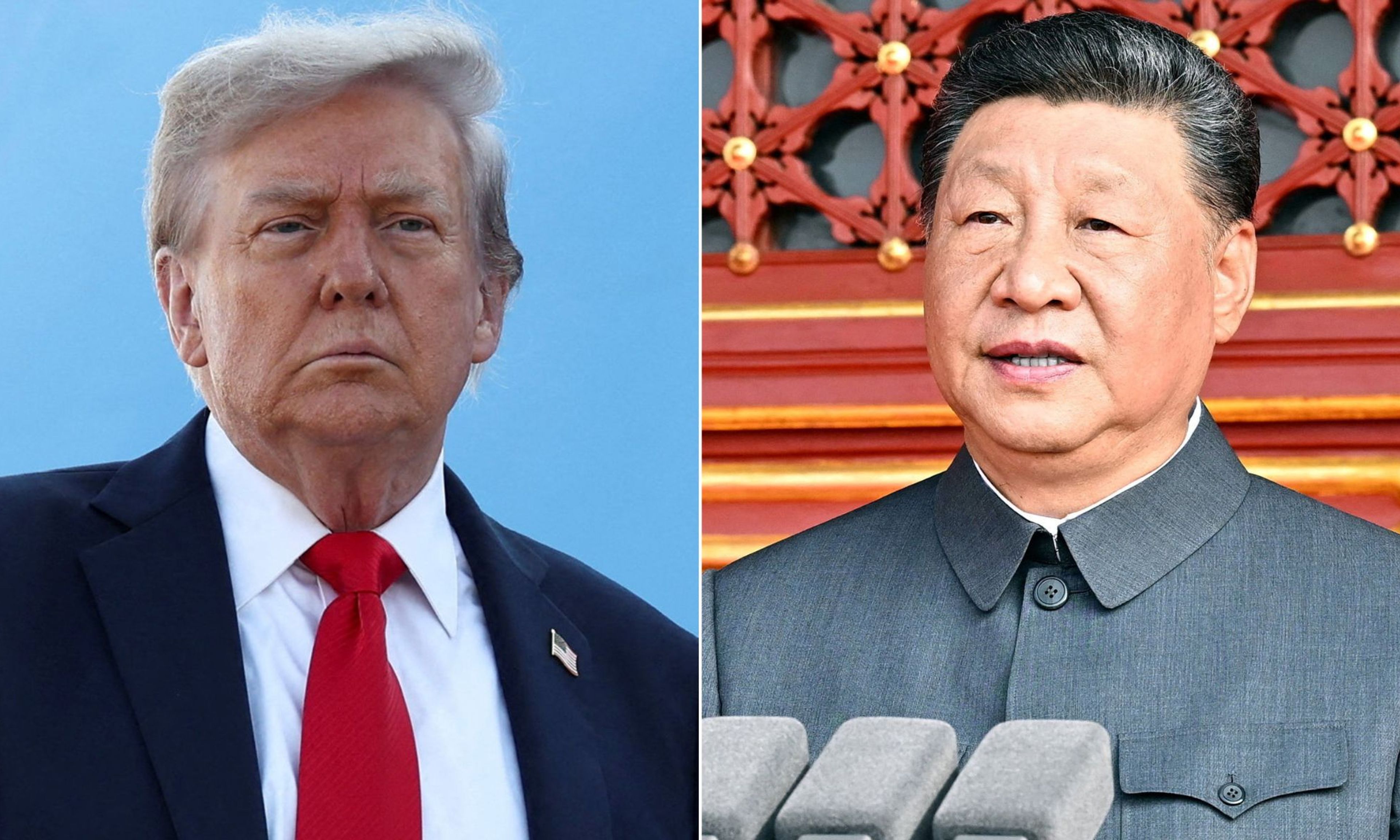
Left: President Donald Trump boards Air Force One from Joint Base Andrews in Md., August 15, 2025. Right: China's President Xi Jinping speaks during a military parade marking the 80th anniversary of the end of World War Two, in Beijing, China, September 3, 2025.
This week’s meeting in Beijing between Chinese Communist Party Secretary-General Xi Jinping, Russian President Vladimir Putin, and Indian Prime Minister Narendra Modi purports to demonstrate that a rising China is leading a large and growing coalition of like-minded countries to challenge U.S.-led dominance in every dimension: economic, military, technology, and global influence. The disciplined execution of this narrative by Beijing crystallizes the difference in styles and impact between the leaders of the world’s two largest economies. China under Xi Jinping reflects a high point in decades of CCP perfection of global propaganda. The orchestration of several days of apparent unity among countries that are trying to create an anti-liberal, anti-Western bloc is noteworthy.
By contrast, Donald Trump is one of history’s great showmen with a lifelong record of unerring instinct for gaining media attention and the ability to focus people on what he wants them focused on. The challenge the U.S. faces is how sustainable is the president’s gut-instinct, daily-changing transactional approach against the illiberal bloc’s ability to control various organs of information and influence over time. While China lags the U.S. in every indicator -- economic, military, global influence, freedom, you name it -- the country under the Communist Party is the sole global propaganda superpower.
What is the scale of that power? The Chinese Communist Party (CCP) wields the full force of the state in service of its narrative. Media outlets, universities, corporations, embassies, and even entertainment are fully aligned behind the party’s line. This state-backed/-controlled machinery delivers coherence across every channel, from the tone of the news broadcasts to the slogans on the billboards to the carefully crafted storylines in popular films. There is no cacophony of voices, priorities, and areas of attention that comes with freedom and with open societies. The party runs a finely honed operation from strategic planning to tactical executive across all the elements of Chinese society.
Against this, even as talented a showman as Trump is at a disadvantage. He controls the executive branch and has tightened his grip on Republican legislatures at the federal and state level -- meaning the Republican Party overall. There is something of a compliant conservative media, but there also is a defiant liberal media, not to mention many other channels that are downright hostile. That’s how it goes in a democratic society, and we shouldn’t wish otherwise. Just the same, Trump uses his tools effectively: his rallies, his social-media presence, and his ability to provoke media coverage from mainstream networks. Quite apart from the exquisitely organized and executed CCP propaganda machine, Trump relies upon improvisation, catchphrases, and repetition. These can electrify his base, but they cannot approach the sustained consistency of a state-driven campaign.
So what is the effect of these competing styles and capabilities? The CCP has managed to drive home a simple and unwavering perception: that China is rising and the West is in decline. Alternative narratives and dissent are squelched. The party also hones the message of stable, unified leadership in Beijing.
Despite this week’s pretense of China as the leader of the Alt-World, the country is much weaker than that. Debt relative to GDP is more than twice that of the United States. The economy is in a deflationary spiral, and no amount of government pump-priming will reverse that. Urban unemployment exceeds 20 percent. In its quest for energy independence through rapid adoption of renewables, government policies at every level in China are destroying the natural environment. China’s population is declining and aging, with no meaningful social safety net. The country is on an unsustainable path in multiple dimensions: economic, demographic, social, environmental. Yet even when observable reality contradicts it, the propaganda machine grinds forward. The appearance of strength conceals tremendous fragility.
Against this consistency and discipline, the Trump approach relies on disruption rather than coherence. He does this through a mix of grievance, self-promotion, and by attacking his opponents’ weak points. His themes shift depending on his mood and the mood of his audience. This improvisation seems to work at rallies, where his supporters relish the unpredictability. But the personal, one-man nature of it makes it harder to create a broad front of opposition in the propaganda war in which Beijing is fully engaged. Trump’s rhetoric is noisy, often contradictory, and therefore less effective in sustaining a disciplined narrative. Absent state-controlled media and shutting down dissent, which is not something our democracy could countenance, the Trump approach can result in unforced errors. The presence of Modi in Beijing, for instance, would have been entirely preventable were there a more coherent policy behind the administration’s showmanship.
Even when the president makes a compelling, substantive point, his reliance on quickly decaying social-media statements, soon to be drowned out by unrelated flurry of follow-on comments, becomes a missed opportunity. A case in point: his statement castigating Xi for the military parade he hosted with Putin and North Korea’s Kim Jongiun. Trump rightly faulted Xi for seeming to ignore the many sacrifices made by the U.S. during World War II to defend China. The U.S. role was significant, including the “Flying Tigers” who engaged the Japanese air forces at critical moments early in the war, providing a morale boost and defense of Chinese cities. In fact, the full story includes CCP ignominy for more or less concealing itself from the fighting until it was safe to come out after the war and drive the Nationalists out of the mainland. But Trump’s episodic, unfocused style gains him little against the Chinese propaganda juggernaut.
While showmanship still captures headlines, momentary attention is not the same as long-term persuasion. Trump may be the master of spectacle-creating moments that dominate the news cycle, but he has yet to demonstrate an interest in the underlying substance and the work needed to sustain the impressions he creates. And, unlike what Xi is able to do, Trump cannot silence competing narratives. His antagonism with much of press, as satisfying as it feels and as justifiable as it may be, works against him.
Who will prevail between these two approaches? Don’t bet against freedom and against noisy, attention-deficit democracy. But the CCP has so far persuaded the world not to look beyond the veneer of strength that the party has stretched across a fractured backdrop. Trump seems uninterested in engendering trust in and support of his declarations beyond his loyal base. America’s underlying strengths and advantages are far more profound than China’s. Yet even many American leaders are starting to question that because of the effectiveness of the China propaganda machine.
In the long run, truth asserts itself. The obviousness of China’s weaknesses will grow. But for now, in the battle of appearances, the party’s propaganda may be outpacing Trump’s showmanship.

About the Author
Thérèse Shaheen is a businesswoman and CEO of US Asia International. She was the chairman of the State Department’s American Institute in Taiwan from 2002 to 2004.
Featured Tags
Advertisement
Advertisement
Comments