The Gulf State That Shelters Under Western Defenses While Suing to Disrupt Them
Written by Diana Furchtgott-Roth
The FCC faces a straightforward choice.
Share this story
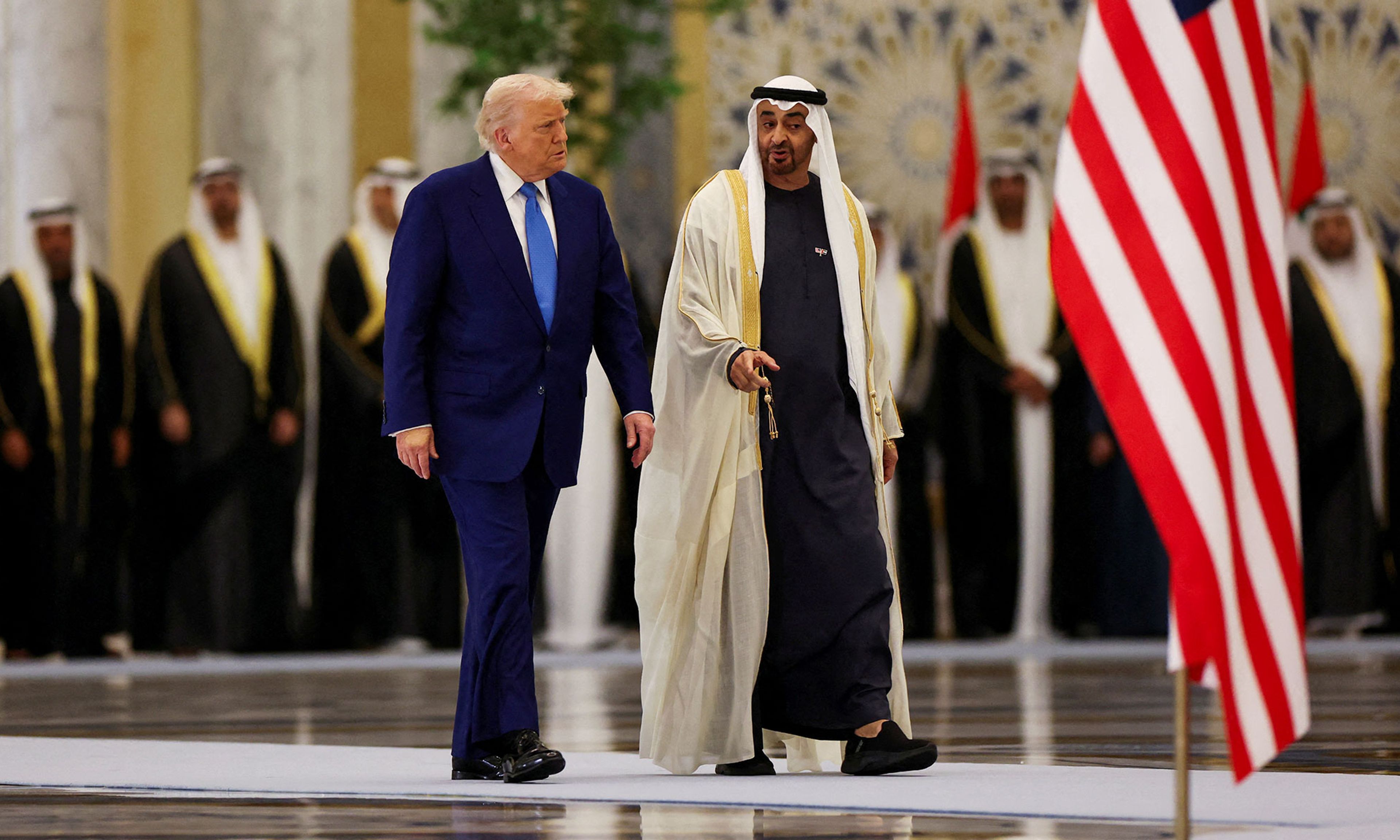
U.S. President Donald Trump meets UAE President Sheikh Mohamed bin Zayed Al Nahyan at Qasr Al Watan in Abu Dhabi, United Arab Emirates, May 15, 2025.
As American military technology helps defend the United Arab Emirates from Iranian attacks, an investment fund that is an arm of the UAE state — not merely a passive financial actor but an instrument of Abu Dhabi’s national policy — is quietly working the phones in Washington, trying to pry a multibillion-dollar gift out of a federal agency.
The same technology that underpins modern logistics, defense, and daily life is being put at risk, not by an adversary acting openly but by a Gulf sovereign wealth fund working quietly through America’s own regulatory system.
NextNav, whose largest shareholder is the United Arab Emirates–held Fortress Investment Group, has filed a petition asking America’s broadcasting and spectrum regulator, the Federal Communications Commission, to rewrite decades of rules governing a band of radio frequency spectrum, handing the company spectrum licenses worth $2 billion, according to market valuations. The return for the American public? Nothing whatsoever.
The section of the spectrum in question, the lower range of the 900 MHz band, is not an obscure corner of the airwaves. It underpins systems that Americans rely on every day, including electronic toll collection (E-ZPass alone processes more than $23 billion in transactions annually), warehouse logistics, home-security systems, and the encrypted codes embedded in driver’s licenses.
Disrupting or displacing those users would impose costs running to tens of billions of dollars on American businesses and consumers, with no compensating public benefit. NextNav asserts that its ownership of the spectrum will not disrupt businesses that now use the spectrum, but tests presented to the FCC by Plum Consulting and Neology show otherwise, although the FCC has yet to respond.
NextNav’s argument is that America urgently needs a terrestrial backup to GPS and that only a reallocation of this portion of the spectrum can make this possible. The claim does not survive scrutiny. NextNav already sells GPS backup services (Pinnacle, NextNav 3D, TerraPoiNT, and Next Generation 3D PNT) under existing rules. Its own website describes these systems as live and operational today.
In addition, a dozen other companies have GPS backup systems that are being tested by the U.S. Department of Transportation and the Pentagon. There is no need to give away spectrum valued at billions of dollars in order to provide a backup for positioning, navigation, and timing systems.
The trail begins with Mubadala Investment Group, the sovereign wealth fund of the Government of Abu Dhabi, capital of the United Arab Emirates, through its wholly owned asset-management subsidiary Mubadala Capital. Mubadala Capital, which also enjoys business links to the Trump family, owns 68 percent of Fortress Investment Group, a major American private equity firm. Fortress, in turn, is the largest investor in NextNav, a Nasdaq-listed technology company, with a 10 percent to 14 percent stake.
Moreover, a parallel legal offensive is being mounted by another Fortress-linked company. Fortress is also one of the controlling investors behind Ligado Networks, which is currently suing the United States government for $39 billion on the grounds that the Department of War has been using its assigned spectrum without compensation. Ligado’s plans ought to raise significant technical and public interest concerns for all users of GPS services.
The Department of Defense stated in 2022 that findings by the National Academies of Sciences are consistent with its “longstanding view that Ligado’s system will interfere with critical GPS receivers and that it is impractical to mitigate the impact of that interference.”
The strategic irony is arresting. The United States helps defend the UAE from Iranian ballistic missiles using systems that depend on the very GPS infrastructure now being targeted in American courtrooms by UAE-linked capital. The same sovereign wealth fund that benefits from Western defense guarantees is simultaneously trying to monetize the regulatory and legal systems of its guarantor.
American spectrum is not an asset available for private companies, with foreign government backing, to convert into private profit. The FCC was established to act in the public interest, not to award billions of dollars in spectrum value to a UAE-controlled company, while imposing tens of billions in compliance costs on American consumers and businesses.
This matters beyond America’s borders. The principle that regulatory agencies should serve their own citizens, rather than function as instruments of foreign enrichment, is one that applies in Washington and beyond.
If the FCC sets a precedent that spectrum worth billions can be captured through patient lobbying by a foreign sovereign fund, the message to every Gulf state, Chinese sovereign vehicle, and state-backed conglomerate with a Washington presence is clear: America’s administrative state is open for extraction.
The Mubadala-Fortress-NextNav chain appears to be an example of a Gulf sovereign fund, operating through an American private equity firm, using a Nasdaq-listed company as its instrument for capturing federally administered spectrum. The FCC faces a straightforward choice: It can serve the American public, or it can serve Abu Dhabi. It cannot do both.
About the Author
Diana Furchtgott-Roth is a distinguished fellow at the Energy Policy Research Foundation and a former deputy assistant secretary for research and technology at the U.S. Department of Transportation. She serves on the advisory board of Tern, which provides GPS backup solutions through a signal-independent navigation system.
Featured Tags
Advertisement
Advertisement

Comments