Share this story
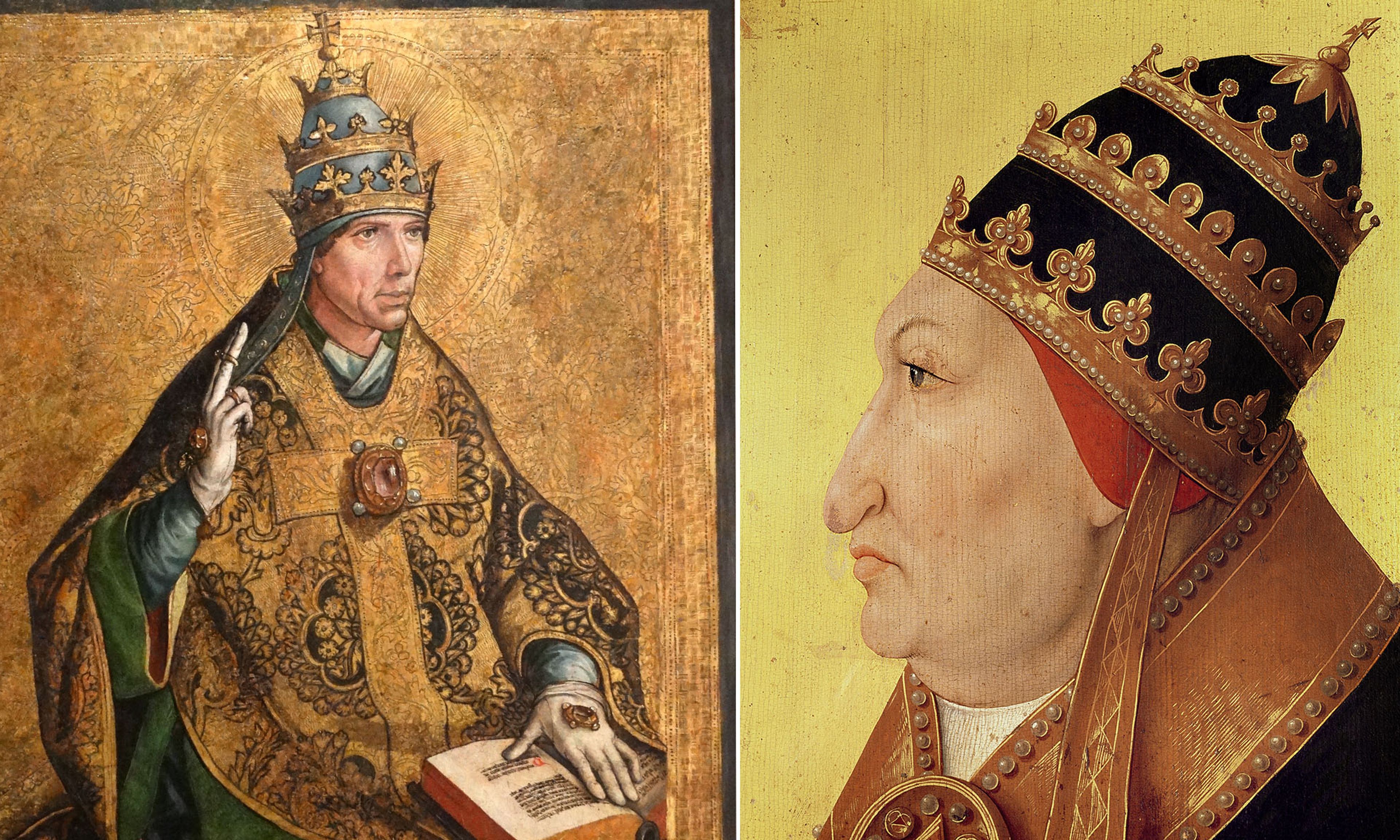
<B>Left</B>: Pedro Berruguete, <i>Pope Gregory the Great</i>. <B>Right</B>: German School, <i>Pope Alexander VI</i>.
History has seen some very bad popes. There was Pope Boniface VIII (elected 1294), who paved the way for his own pontificate by persuading his predecessor to resign, then promptly having him seized and tortured to death. Pope Stephen VI (elected 896) was even grislier, forever remembered for the “Cadaver Synod,” at which he exhumed the body of his hated predecessor and put it on trial. The Borgia popes (elected 1455 and 1492) were so infamous that their name is now synonymous with political corruption, and though it’s hard to sift fact from sensationalist fiction, they surely did keep mistresses, sell church offices, and squander immense resources on lavish parties and general debauchery.
There have also been very good popes. Fully 31 of the first 34 were martyred, and though some of those have faded into historical obscurity, it’s impressive that so many were willing to accept the office, given the standard life trajectory of the early popes. Pope Gregory the Great (elected 590) stands out for his energy in caring for the poor, his contributions to the development of musical notation, and his writings urging Christians to be more respectful and protective of Jews. Leo the Great (elected 440) risked life and limb to meet with Attila the Hun, who, camped outside Rome, was preparing to sack and burn the city. In a conversation that historians would kill to have on record, Leo somehow persuaded the “scourge of God” to depart peacefully, leaving the city unmolested. That’s papal heroism.
Saints, scholars, schemers, soldiers, liars, lawyers, lechers, musicians, monks, martyrs, and megalomaniacs have all occupied the papal office. It’s a colorful cast of characters, with every kind of virtue represented, and likewise every vice. In general, the office tends to amplify both. Good men may be elevated to immense holiness. Bad men fall to astonishing depths.
Power can have that effect. The pope is truly peerless, not just in the Catholic Church but in the world. Today he holds humanity’s most ancient office and heads its longest-functioning institution. No other church or faith has such a recognizable and renowned leader. Orthodox and Protestant congregations may have a spiritual head, but none who shepherds more than a fraction of the pope’s 1.4 billion–strong flock. Islam’s caliphate was abolished in 1924 by Atatürk; the Dalai Lama openly speculates on whether he will even have a successor. But when the pope dies, the cardinals immediately start checking fares to Fiumicino. Religious authority may be in decline, but rest assured: Habemus papam. The chair is seldom empty for long.
With uniqueness comes great possibility, and also temptation. The good news is that modern pontiffs can’t easily be corrupted in the way that the Borgias were, by the allure of hard power, wealth, or promiscuity. Calling a new crusade would be a decidedly uphill battle today, and any effort to keep papal mistresses would certainly be noticed and globally condemned. Popes still get to wear fancy clothes, but assuming control of the Vatican’s present finances is by all accounts an unenviable task. There is, however, one coveted modern currency that a pontiff still enjoys in abundance: influence. In the 21st century, donning the white cassock is like picking up an enormous megaphone. A new pope will find that even offhand comments reverberate back to him from every corner of the world.
In temporal terms at least, this is the papacy’s greatest asset today. It can also be the Achilles’ heel. The papal megaphone can in principle be used to soften hearts, stiffen spines, form intellects, uplift, chastise, or persuade. It seems that Jorge Mario Bergoglio smoothed the way to his own selection for the papal office by convincing his brother bishops, in a speech given shortly before the 2013 conclave, that he was the man to do all of that. But influence, like wealth and power, is a slippery thing. It can be applied to an almost infinite range of human projects, but there is a serious caveat: it doesn’t reliably achieve the intended goal.
Unfortunately, the most readily achievable goals generally aren’t the noblest. For a pontiff, it’s child’s play to stir up a ruckus with some off-the-cuff comments on a plane, but much harder to convey a real sense of what it means to “think with the church.” Stimulating applause from friends and howls from enemies is simple, but forming souls in virtue is not, especially in today’s media environment, where eyeballs are quickly captured and just as quickly lost. He who has ears to hear, let him . . . sorry, they’ve clicked away already.
Francis’s pontificate tested the limits of influence. It began on an intoxicating high, with the pope dominating headlines as he washed prisoners’ feet, made impromptu phone calls to ordinary people, and instructed young Catholics at World Youth Day to go out and “make a mess.” Although traditionalists (including this writer) were skeptical from the very beginning, it should be acknowledged that the early Francis deeply moved many people. His rhetoric conveyed an urgent sense of mission, depicting the church as an oasis of grace and mercy in a desiccated postmodern world. Euphoric chatter about a “Francis effect” spoke to the hunger many Catholics felt for a transformative evangelical moment, with grace overflowing from the cloisters onto the highways and byways.
Then came the scandals, and Francis’s distressing willingness to protect cronies and loyalists. Then came the shameful capitulation to China. The war with traditionalists dragged on through his entire pontificate, enervating the church to a surprising degree, given that Latin Mass traditionalists represent a very small percentage of Catholics. Though they had their own set of influencers, frequently prone to intemperate rhetoric, traditionalists grated on Francis and his supporters in part because they refused not to see how often he held the world’s attention by giving the tantalizing impression that core elements of Catholic tradition might soon be jettisoned. He, for his part, was unable to turn that corner. A pope with a burning sense of mission ought to command the global stage with magnanimous ease, but Francis instead seemed to be perpetually swatting at this tiny, eclectic minority, like a buzzing gnat that could not quite be silenced. Even for those who cared little for liturgy, it was hard not to see traditionalists as a convenient scapegoat for the disappointments of the Francis effect that wasn’t.
By the late years, Pope Francis had largely disappeared from the headlines. Ordinary Catholics did not anticipate his phone call, but they did cringe at the tacky memes and clownish figurines gifted to the church by the Vatican, evidently the fruits of the interminable Synod on Synodality. Instead of washing the world in God’s mercy, the church seemed to have devolved into a branding committee. In a way it was grimly poetic. Francis leaned into the role of influencer with the idea of spreading the Gospel but ended up reducing the Gospel to a corporate-looking logo. That presumably wasn’t what the early Francis had in mind when he urged his clergy to “smell like the sheep.”
This is a harsh assessment, and it should be recognized in fairness that both Francis and his supporters had good and sympathetic reasons for seizing the papal megaphone. Influence is the modern papacy’s greatest temporal asset. Modern people do have deep spiritual needs that the church could help meet, and wounds she could bind. Moreover, it’s not always bad for a pope to court media attention in a fundamentally modern way. We have a recent example of a very successful influencer pope in Saint John Paul II, one of the most inspirational figures of the past century, who (despite some human failings of his own) restored a measure of honor to the church in a very dark hour.
Power is perilous, however, and it turns out that Pope John Paul II was just as extraordinary as his supporters always believed he was. Very few can combine orthodoxy, charisma, and real magnanimity as beautifully as he did. In light of John Paul, and of his fateful visit to Poland in 1979, it’s hard to assert with confidence that popes should stay out of politics. Some men do use the white cassock to make tyrants quail. But that kind of pope may leave very big shoes that others may struggle to fill.
In the context of the papacy’s long history, one can see a deeper principle at work. Visionary pontiffs tend to want to rise above the tawdry flow of history, enabling the church to act on the world as a force for good. That impulse can be honorable, and some popes follow it to good effect, but earthly goals tend to require earthly tools that fallen men inevitably struggle to use well. Pope Gregory VII (elected 1073) pushed the papacy to the peak of its temporal power through a series of reforms meant to elevate it above the squalid realm of secular politics. In one sense he was brilliantly successful; despite many blemishes, the medieval papacy accomplished much that was noble and good. But by the time of the Borgia popes, it was clear that the Chair of Peter conferred no immunity to earthly temptation. In the modern influencer popes, we might start to see a similar pattern. When the papacy moves too far into the world, it comes to resemble it.
What should the pontiff do, then? In the wake of Francis’s pontificate, the temptation is to say simply: less. It’s rather delightful to imagine a pope setting down the papal megaphone, retreating into the Vatican, and disappearing from public view, apart perhaps from an occasional papal blessing tossed out a high window. Shrouded in mystique, a pontiff of that profile might issue the occasional pronouncement to a world waiting with bated breath. He might even get through an explanation of credo ut intelligam without everyone clicking away.
It won’t happen, of course. It’s understood today that the pope must stand as a public figurehead, and the next pontiff will presumably engage in the same obligatory activities, globe-trotting and giving interviews, issuing apologies and expressing sympathy. Who am I to judge? Across its long history, the papacy has moved the world in all sorts of surprising ways. Perhaps the next pope really will supply the kind of wise guidance that softens the sharp edges of today’s social and political challenges. Perhaps he will find the magical words that can replant the seeds of faith in a stony postmodern soil.
The important thing to stress at present is that a pope need not have that kind of transformative influence in order to execute the role successfully. It would be enough to protect the church’s existing assets, which are considerable despite the real challenges that the church faces, especially in the West. Catholics represent about 17 percent of the world’s population, with significant growth in Africa and Asia. Rich philosophical, artistic, and liturgical traditions give Catholics immense resources to draw on as they respond to modern political challenges and address spiritual needs. This is the work of all believers, not just popes or clergy, and it doesn’t always need to be meme-ified. It’s good that people can get excited about the potential for new evangelism, but it’s a mistake to depend too much on the personal charisma of one man.
Hold the center. Keep the wheels on. The church might flourish under a capable administrator who curbs flagrant disobedience, rearticulates core Christian truths, and leaves frontline evangelism to God and the laity. The papacy has always been a political office to some extent, and popes are allowed to express opinions about immigration, economics, or the requirements of just war, but sometimes it may be wiser to exercise restraint. In the age of the 24-hour news cycle, a quiet, contemplative holiness could speak volumes.
Despite the papacy’s many historical shortcomings, Catholics can take a justifiable pride in the fact that we still have a pope. Nothing lasts 2,000 years unless there’s a reason for it to exist. Unlike secular politicians, popes don’t need to exert themselves constantly to prove to the world that they’re worth keeping. The rock of Peter has endured for quite some time. It will weather today’s political storms.

About the Author
Rachel Lu is an associate editor of Law & Liberty and a contributing writer at America magazine.
Featured Tags
Advertisement
Advertisement
Comments